
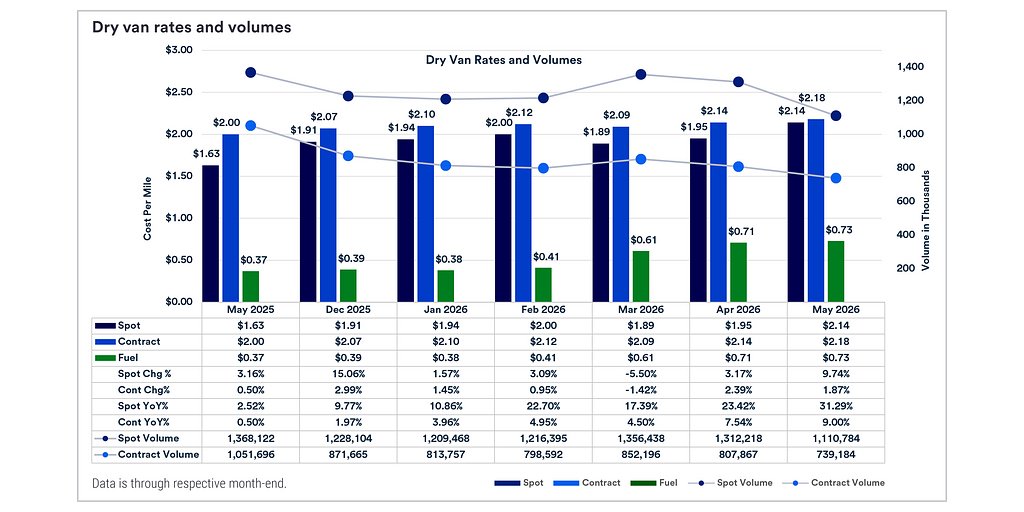
- Spot market rates surged 31.29% in May 2026 year-over-year
- Contract shipment volumes dropped over 13%
- Driver shortage projected to reach 82,000 in 2026
Experts agree that the freight market is experiencing a structural shift driven by supply constraints rather than demand growth, posing risks for broader inflation.
The Freight Paradox: Why Shipping Costs Are Soaring as Demand Falls
MINNEAPOLIS, MN – June 29, 2026 – A perplexing and costly paradox is unfolding across America's highways. Even as the volume of goods being shipped declines, the price to move them is accelerating at a startling pace. The latest quarterly U.S. Bank Freight Payment Index, produced in collaboration with DAT Freight & Analytics, reveals a market disconnect that is sending shockwaves through the logistics industry and threatening to fuel broader inflation.
According to the new report, spot market rates—the real-time price to move a load—surged an astonishing 31.29% in May compared to the previous year. Contract rates, which are negotiated for longer terms, also climbed a significant 9%. This sharp rise in costs occurred alongside a pronounced drop in activity. Spot shipment volumes fell by nearly 18% from March to May, while contract volumes slid over 13%.
For shippers, the data paints a grim picture. “Even with lower volumes, costs are rising as capacity tightens,” noted Jeff Pape, Head of Transportation for U.S. Bank Corporate Payment Systems. This isn't a fleeting spike; it's a structural realignment. As Patrick Pretorius, GM of Shipper at DAT Freight & Analytics, cautioned, “The figures holding steady point to a lasting shift, rather than a temporary anomaly.” Businesses are now grappling with a new reality where the fundamental law of supply and demand appears to have been turned on its head.
Anatomy of a Supply-Side Squeeze
The current market is not being driven by a boom in demand, but by a severe contraction in supply. The trucking industry is emerging from a prolonged “freight recession” that saw thousands of smaller carriers and owner-operators go out of business. This “Great Purge” has permanently removed a significant number of trucks from the road, creating the tightest capacity environment in years.
The most critical constraint, however, is the human one. The industry is facing a chronic and deepening driver shortage, projected by the American Trucking Associations to reach 82,000 this year. The workforce is aging rapidly—the median age for a tractor-trailer driver is 57—and a wave of retirements looms. Meanwhile, the pipeline of new talent is insufficient to fill the gap, hampered by high training costs, lifestyle concerns, and federal age restrictions for interstate driving.
This long-simmering crisis has been brought to a boil by a recent wave of regulatory enforcement. A federal crackdown that began in March 2026 on non-domiciled Commercial Driver's Licenses (CDLs) and fraudulent Electronic Logging Devices (ELDs) has taken thousands of drivers and trucks off the road. Stricter enforcement of English language proficiency standards has further thinned the ranks. The result is a smaller, more compliant, but far more expensive pool of available drivers and equipment. This isn't a recovery fueled by economic growth; it's what one analyst described as a “rare supply-side recovery,” where scarcity, not prosperity, is dictating price.
Shippers Caught in the Crossfire
For the businesses that make, sell, and ship goods, this new high-cost landscape is a strategic nightmare. The rapid escalation in rates is blowing holes in transportation budgets and forcing a painful re-evaluation of cost assumptions. Companies that aggressively pursued the lowest-cost carriers during the recent downturn are now finding themselves at the back of the line, struggling to secure capacity at any price.
In this environment, the value of relationships has skyrocketed. Shippers who maintained strong partnerships with their core carriers are finding they are being prioritized for the limited available capacity. The focus has shifted from transactional cost-cutting to ensuring operational continuity. This new paradigm demands a more strategic approach, with businesses racing to lock in long-term contracts earlier in the bid cycle to hedge against further spot market volatility.
To survive, shippers are being forced to become more efficient and attractive to carriers. This includes using technology to create precise appointment scheduling, pre-staging loads to minimize driver detention time, and providing better amenities at facilities. In a market where drivers and trucks are the scarce resource, a shipper’s reputation can be the deciding factor in whether a load gets moved or sits on the dock.
Freight's Inflationary Ripple Effect
The shockwaves from the freight market extend far beyond the loading dock. Transportation is the backbone of the economy, and a sustained increase in logistics costs inevitably translates into higher prices for consumers. The Logistics Managers' Index (LMI), a key industry barometer, shows aggregate logistics costs hitting their highest level since May 2022—a period that immediately preceded a multi-decade spike in inflation.
The LMI’s Transportation Prices component rocketed to 89.4 in March 2026, signaling extreme price pressure. These figures are flashing the same warning lights for the broader economy that were seen just before the last major inflationary surge. When the cost to transport goods can swing 20-30% in a matter of months, that expense must be absorbed or passed on, rippling through the supply chain until it lands on the price tag of everything from groceries and electronics to building materials.
This presents a significant challenge for the Federal Reserve. Just as it seeks to guide the economy toward stable, lower inflation, this supply-side shock in a critical sector could complicate its efforts and keep upward pressure on prices. The cost of moving a truckload of goods is no longer a niche data point for industry insiders; it has become a crucial leading indicator for the cost of living for every American household.