
- 60% productivity gains: AI-enabled factories can unlock up to 60% productivity improvements, reshaping global manufacturing economics.
- $1.03 trillion at risk: Western Europe faces potential relocation of $1.03 trillion in manufacturing value without AI upgrades.
- 82% of executives: 82% of manufacturing leaders view AI as a key growth driver, with 85% planning significant 2026 investments.
Experts agree that AI is revolutionizing manufacturing by prioritizing technological efficiency over labor costs, potentially reversing decades of offshoring trends and demanding urgent workforce and infrastructure adaptations.
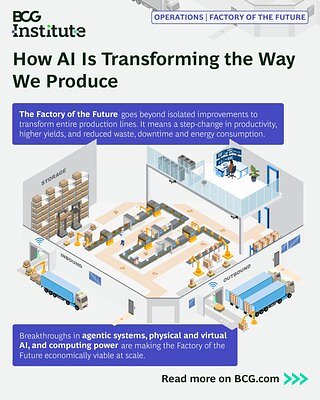
The Factory Reimagined: AI Flips the Script on Global Manufacturing
BOSTON, MA – May 27, 2026 – For decades, the logic of manufacturing has been simple: chase cheaper labor. This principle hollowed out industrial heartlands in the West and built sprawling supply chains across the globe. Now, a new technological wave, powered by artificial intelligence, is poised to upend that entire equation.
A landmark report from Boston Consulting Group (BCG) reveals that AI-enabled “factories of the future” can unlock productivity gains of up to 60%, fundamentally reshaping the economics of production. The findings suggest that upgrading a factory in a high-cost country could soon be more competitive than offshoring to a low-cost one, signaling a potential paradigm shift in global industrial strategy.
However, the report, titled How the Factory of the Future Is Reshaping the Economics of Manufacturing, also carries a stark warning. For nations that fail to adapt, the risks are colossal. BCG estimates that without upgrading, approximately $1.03 trillion of manufacturing value is at risk of relocation out of Western Europe, with another $440 billion at risk in the United States.
A New Competitive Calculus
The core of this transformation lies in a complete rethinking of the factory floor. It’s no longer a simple contest of labor costs versus logistics. Instead, competitiveness is becoming a function of technological prowess.
“Manufacturers are entering a new era where competitiveness is no longer defined by static cost comparisons, but by how effectively they can redesign production setups end to end,” said Daniel Kuepper, a BCG managing director and coauthor of the report. “The factory of the future is fundamentally changing how companies create value and how they think about where to produce.”
This redesign is holistic. AI-driven systems don’t just automate a single task; they optimize the entire production line. They create “digital twins”—virtual replicas of the factory—to simulate changes and predict outcomes. They use computer vision to spot microscopic defects invisible to the human eye, use predictive analytics to schedule maintenance before a machine fails, and optimize energy and material consumption in real time. The result is simultaneous gains in throughput, quality, and resource efficiency that can dramatically lower overall conversion costs.
This new reality is forcing a re-evaluation of global footprints. As geopolitical uncertainty and supply chain volatility become permanent features of the business landscape, the ability to produce goods closer to where they are sold offers a powerful strategic advantage in resilience.
Beyond Offshoring: A Manufacturing Renaissance?
The most provocative finding from BCG's analysis is the potential reversal of the offshoring trend. By heavily reducing the dependency on manual labor and maximizing capital and resource efficiency, AI-powered automation narrows the cost gap between high- and low-cost countries. For some sectors, particularly those with high logistics costs like food and beverages, the benefits of proximity to market can make local production the clear winner.
Early adopters are already demonstrating this potential. In Germany, a high-wage country, Siemens has transformed its Electronics Works Amberg (EWA) plant into a beacon of digital manufacturing. By integrating AI for real-time quality inspection and process automation, the facility has achieved a 75% reduction in scrap costs and near-perfect quality levels. Similarly, the BMW Group uses AI predictive maintenance in its assembly lines to avoid hundreds of minutes of costly disruption annually, a crucial advantage in a high-cost environment.
These examples show that the conversation is moving beyond theory. According to a recent survey from Xometry, 82% of manufacturing executives now see AI as a key driver of growth, with more than 85% planning to allocate over $100,000 to AI initiatives in 2026. This aggressive wave of investment underscores a sector-wide belief that smart factories are not a futuristic fantasy but an immediate competitive necessity.
The Human and Digital Foundation
This technological leap forward is not without immense challenges. The factory of the future cannot be built on code alone; it requires a foundation of skilled human talent and robust digital infrastructure.
The BCG survey found that 87% of manufacturing leaders believe access to talent and skills has become more critical to deploying these advanced systems. This is the human bottleneck of the new industrial revolution. Independent research confirms the scale of the problem; one IDC report projects that over 90% of global enterprises will face a critical AI skills shortage by 2026. The demand for AI-related talent is outstripping supply by a factor of more than three to one.
“There’s a massive skills gap,” one industry analyst noted. “The jobs on the factory floor now require a hybrid of mechanical expertise and digital literacy. We are not training people for these roles fast enough.”
Recognizing this, organizations like the National Association of Manufacturers are pushing for new policies to support advanced training programs and technical education. The solution will likely involve a combination of reskilling the existing workforce through AI-powered training platforms and building new talent pipelines from vocational schools and universities.
Beyond talent, 69% of respondents in the BCG report cited digital infrastructure readiness as a critical factor. Implementing AI at scale requires a seamless flow of data from thousands of IoT sensors, powerful cloud computing platforms, and sophisticated analytics software—an infrastructure that many legacy factories simply do not possess. Overcoming the complexity of integrating new systems with old, ensuring data security, and managing the high costs of implementation remain significant hurdles for many manufacturers.
Companies that successfully navigate these twin challenges will be the ones to capture the extraordinary productivity gains on offer. As Daniel Kuepper noted, leaders must now evaluate production decisions through a new lens, one that tightly integrates technology deployment with footprint strategy. Those who can align their sector's needs with the right location and the effective use of advanced manufacturing capabilities will be best positioned to compete, and win, in the decade ahead.