
- 80% reduction in audit preparation time claimed by ComplianceCow's customers
- AI generates deterministic, auditable outputs for compliance controls
- System operates within ServiceNow IRM, avoiding system replacement
Experts would likely conclude that while ComplianceCow's AI-driven approach shows promise for automating compliance tasks, human oversight remains essential to validate outputs and ensure regulatory alignment.
The End of Audit Drudgery? AI Pledges to Turn Compliance from Months to Minutes
SAN FRANCISCO, CA – June 11, 2026 – In the world of enterprise Governance, Risk, and Compliance (GRC), time is measured in evidence requests, audit cycles, and the painstaking process of translating policy into provable action. It’s a domain where progress is often incremental, bogged down by manual data collection and brittle scripts. Now, a San Francisco-based firm, ComplianceCow, is making a bold claim: it can compress control deployment timelines from months into mere minutes using Generative AI.
The company recently announced a live webinar for June 22, where it will demonstrate what it calls “CCM 3.0,” a system designed to transform natural language prompts into production-ready compliance controls directly within the widely-used ServiceNow Integrated Risk Management (IRM) platform. For GRC directors and IT audit leads long buried in spreadsheets and evidence chasing, the promise is nothing short of a paradigm shift. But in a field where precision and trust are paramount, the central question is whether the technology is truly ready for primetime.
Beyond the Hype: The Quest for Deterministic AI
ComplianceCow’s entire premise hinges on a critical distinction: its Generative AI produces “deterministic, auditable outputs rather than probabilistic or hallucinated results.” This claim directly confronts the biggest hurdle for AI adoption in regulated industries. Standard large language models (LLMs) are often probabilistic, meaning the same input can produce different outputs, and they are notorious for “hallucinations”—generating plausible but entirely fabricated information. For a compliance control, such unpredictability is a non-starter.
“Deterministic AI,” by contrast, ensures that a specific input will generate the exact same output every single time. This is the bedrock of validation, debugging, and, most importantly, audibility. The system proposed by ComplianceCow allows a compliance manager to describe a control—for example, “Alert when a user is granted privileged access to a production database outside of a change request window”—and have the platform generate the structured, executable code to monitor that rule continuously. Crucially, the platform also promises a “complete trace from prompt to evidence,” satisfying the rigorous demands of auditors and regulators who need to understand how a control decision was made.
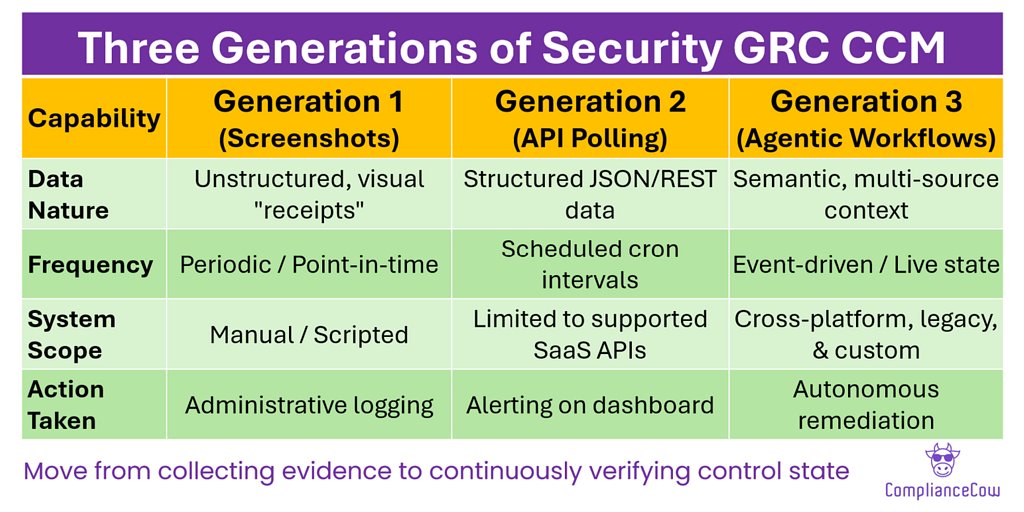
This approach marks what the company brands as “CCM 3.0,” or the third wave of Continuous Controls Monitoring. While CCM itself is an established practice, its evolution has been slow. Early iterations relied on simple, often fragile, scripts. The next phase incorporated more advanced data analytics. ComplianceCow argues its agentic automation platform represents a generational leap, moving beyond template-based tools that often fail in complex, hybrid-cloud environments. By using AI agents to translate human language into machine-verifiable code, the goal is to eliminate the engineering bottlenecks that have historically plagued GRC teams.
From Prompt to Production: A New GRC Workflow
The practical implications of this technology could fundamentally alter the daily work of compliance professionals. The traditional workflow involves a GRC team interpreting a regulatory framework (like SOX or ISO 27001), manually writing detailed control descriptions, and then handing them over to engineering teams to build, test, and deploy—a process that can take months. ComplianceCow aims to put that power directly into the hands of the GRC team.
During its upcoming webinar, the company plans to demonstrate this end-to-end process with two common but critical control scenarios: user access reviews for privileged accounts and segregation of duties conflict detection. According to the announcement, attendees will witness a plain-language prompt being entered, the AI generating the control logic, the code being executed against live data, and the resulting evidence being automatically attached to the relevant control within ServiceNow IRM. The session will be led by CEO Raj Krishnamurthy and Head of Customer Success Megha Shah.
The potential return on investment is significant. The company claims that its customers, which include Fortune 100 firms, report up to an 80% reduction in audit preparation time. While such figures are often part of a new product's marketing push, they align with broader industry analyses on the impact of automation. GRC work is notoriously labor-intensive, and the automation of evidence collection and control testing can free up teams to focus on strategic risk management rather than administrative drudgery. This shift from reactive evidence gathering to proactive risk oversight is the holy grail for many Chief Information Security Officers (CISOs) and Chief Compliance Officers.
A Strategic Play in a Crowded Market
ComplianceCow is not entering an empty field. The GRC technology market is crowded with established giants and nimble startups. Major platform vendors like MetricStream and Archer are actively integrating AI into their offerings, while a new generation of compliance automation tools like Vanta and Drata have already streamlined certification processes for thousands of companies.
However, the company's strategy reveals a nuanced understanding of the enterprise landscape. By building its solution to operate inside ServiceNow IRM, it avoids asking customers to rip and replace their core GRC system. Instead, it acts as a powerful accelerator within an ecosystem that thousands of enterprises already trust. This deep integration, likely a certified application on the ServiceNow Store, allows it to leverage the platform's existing workflows, data, and user base, offering a seamless path to adoption.
Its differentiation lies in its “agentic” approach and focus on deterministic AI. While other tools use AI to scan for regulatory changes or assist in report writing, ComplianceCow’s platform is designed to act as an intelligent agent that builds, executes, and validates the controls themselves. This positions it as a disruptive force aimed squarely at the operational heart of continuous compliance, promising a level of automation and reliability that goes beyond simple scripting or template-based solutions.
Even with these technological advancements, experts caution that human oversight remains indispensable. The outputs of any AI, deterministic or not, must be validated by human experts who understand the nuances of risk and the intent behind a regulation. The true value of a platform like ComplianceCow may not be in replacing GRC professionals, but in augmenting them, transforming them from manual auditors into strategic supervisors of an automated compliance engine. The upcoming demonstration will be a critical test, offering a first look at whether this AI-driven future of compliance is finally within reach.