
- Black mothers in the U.S. are 3 to 4 times more likely to die from pregnancy-related complications than white mothers.
- Over 80% of pregnancy-related deaths among Black women are preventable.
- The film The Ebony Canal has won two Emmy Awards, an NAACP Image Award, and five Telly Awards.
Experts agree that the Black maternal health crisis is driven by systemic failures, including implicit bias in healthcare and lack of access to prenatal services, making initiatives like The Ebony Canal tour crucial for raising awareness and driving policy reform.
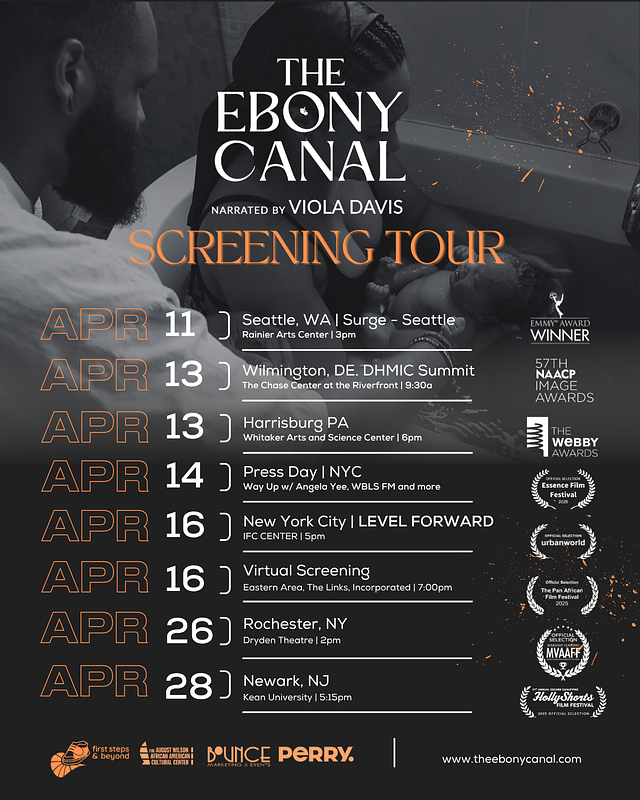
The Ebony Canal: Award-Winning Film Launches Global Tour for Birth Equity
NEW YORK, NY – April 10, 2026 – Fresh off a triumphant awards season, the critically acclaimed documentary The Ebony Canal is transitioning from the silver screen to the global stage, launching an ambitious tour aimed at confronting one of America’s most persistent public health failures: the Black maternal health crisis. The film, narrated by EGOT winner Viola Davis and directed by Emmy-award winner Emmai Alaquiva, has already garnered a staggering collection of honors, including two Emmy Awards, an NAACP Image Award, and five Telly Awards, validating its powerful message and artistic merit.
Now, the team behind the film is leveraging that momentum for a direct-action campaign. The Ebony Canal: Global Birth Equity Tour will bring the documentary to communities, universities, and international festivals, transforming the film from a viewing experience into a catalyst for dialogue, policy reform, and life-saving change. The tour launches next week with a packed schedule spanning the United States and reaching as far as the Festival de Cannes in France.
“It’s important now more than ever, that we capitalize on this moment in our movement,” stated Director Emmai Alaquiva in a press release. “It is not lost on me or my team that the time is now for us to activate, reach as many people as possible, and save more mothers and babies.”
A Crisis Decades in the Making
The tour arrives at a moment of stark reality. The disparities highlighted in The Ebony Canal are not abstract; they are backed by decades of harrowing data. In the United States, Black mothers are three to four times more likely to die from pregnancy-related complications than their white counterparts, a racial gap that persists across all income and education levels. Recent statistics from the Centers for Disease Control and Prevention reveal that while overall maternal mortality has seen slight declines, the rate for Black women has tragically increased, widening the chasm of inequity.
Experts and advocates point to a complex web of causes rooted not in biology, but in systemic failures. The phenomenon of "weathering"—the cumulative physical toll of chronic stress from racism and discrimination—leaves Black women more vulnerable to complications. This is compounded by implicit bias within the healthcare system, where Black patients frequently report that their pain is dismissed and their concerns are ignored. Furthermore, a significant percentage of Black women live in "maternity care deserts" with limited or no access to prenatal and postpartum services.
Crucially, research indicates that over 80% of these pregnancy-related deaths are preventable. This staggering figure transforms the crisis from an inevitability into a solvable problem, underscoring the urgency of initiatives like The Ebony Canal tour. The film itself delves into this reality, weaving personal stories of loss and resilience with expert commentary from figures like Vice President Kamala Harris and data-driven insights from Dr. Margaret Larkins Pettigrew.
The Art of Advocacy: Fueling a Movement with Storytelling
The Ebony Canal joins a legacy of impactful advocacy documentaries like Aftershock that have proven instrumental in shifting public consciousness and influencing policy. By humanizing statistics through the intimate stories of mothers Mariah Peoples, Rachel Strader, Alana Yzola Daly, and Larissa Lane, the film creates a powerful emotional connection that data alone cannot achieve. Its artistic excellence, amplified by an original score from Grammy-nominated producer Bud’da and creative contributions from Keke Palmer, makes its message both accessible and unforgettable.
The involvement of high-profile figures like Viola Davis lends the project significant cultural weight, drawing mainstream attention to an issue often relegated to the margins of public discourse. The film’s numerous awards serve as more than just accolades; they are a megaphone, amplifying its call to action and opening doors to influential platforms, from national television interviews on shows like Way Up with Angela Yee to prestigious international film festivals.
This strategy of leveraging art for advocacy is central to the tour's design. The goal is to move audiences from passive awareness to active engagement, providing a shared language and a focal point for a movement demanding justice and equity in birth outcomes.
A Multi-Pronged Strategy for Systemic Change
While raising awareness is a key objective, the Global Birth Equity Tour is engineered for a deeper impact. Its strategy extends beyond screenings to target the very systems that perpetuate the crisis. A significant component is its academic engagement initiative, which brings the film and its curriculum to medical universities and colleges, including Carnegie Mellon, the University of Pittsburgh, and upcoming engagements at Howard and Harvard. The aim is to educate the next generation of healthcare professionals, fostering conversations about implicit bias and encouraging the adoption of more equitable, culturally competent models of care.
The tour is also designed to be a convening force, bringing together policymakers, healthcare leaders, advocates, and families. These curated community conversations are intended to spark tangible solutions, from local policy changes to institutional reforms within hospitals. By creating a space for dialogue, the tour aims to bridge the gap between the lived experiences of Black mothers and the decision-makers who shape healthcare policy and practice.
This strategic approach aligns with broader legislative efforts, such as the Black Maternal Health Momnibus Act, which seeks to address the crisis through investments in community-based organizations, data collection, and diversification of the perinatal workforce. The tour acts as a grassroots complement to these top-down efforts, building public will and holding institutions accountable.
From Global Stages to Grassroots Empowerment
The tour's itinerary reflects a dual focus on high-level influence and community-level empowerment. It will have a presence at the world’s most renowned cultural events, including the Festival de Cannes, the Tribeca Film Festival, and the Toronto International Film Festival. These appearances, facilitated by partners like Pavilion Afro Nova, ensure the issue of Black maternal health remains on the international agenda.
Simultaneously, the tour will embed itself in local communities across the country, from Seattle, WA, to Wilmington, DE, and Atlanta, GA. Many of these stops are part of the "Power Moms Tour," a collaboration with iRTH App founder Kimberly Seals Allers and actress Naturi Naughton-Lewis, which focuses on empowering mothers with tools and information. Select dates will also feature prominent birth equity leaders from the film, including BirthFund founder Elaine Welteroth and 4Kira4Moms founder Charles Johnson, whose own tragic story has fueled his tireless advocacy.
This grassroots approach ensures that the film's message resonates personally, connecting individuals with local resources and reinforcing a network of support and activism. For the team behind The Ebony Canal, the ultimate measure of the tour’s success will not be in the awards won or the festivals attended, but in the tangible impact on the ground. The mission, as stated in their announcement, remains clear and absolute: saving more lives.