
- Production Timeline: The Tensor Robocar, featuring the foldable steering wheel, is slated for volume production in the second half of 2026.
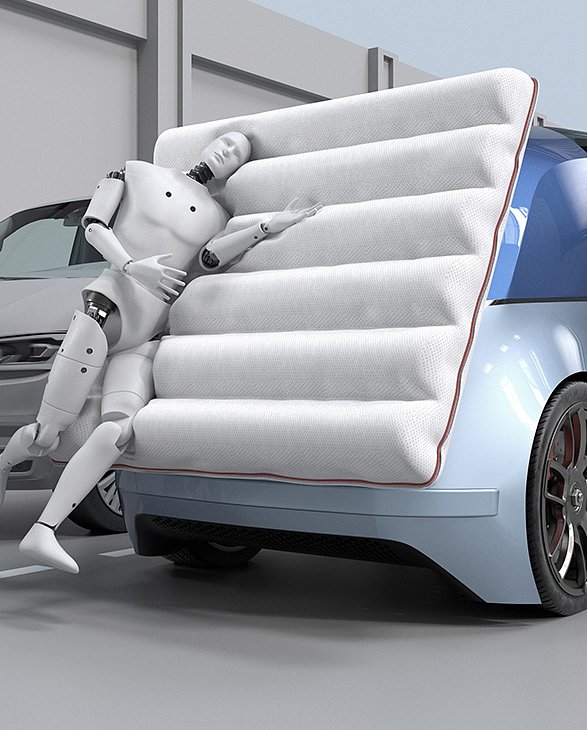
- Safety Innovation: Autoliv's adaptive airbag system transitions between steering wheel and instrument panel configurations to maintain safety in both manual and autonomous modes.
- Sensor Suite: The Robocar includes over 100 sensors, including 37 cameras, five custom lidars, and 11 radars.
Experts would likely conclude that the foldable steering wheel represents a significant advancement in automotive design, merging safety and adaptability to meet the evolving needs of autonomous and manual driving scenarios.
The Disappearing Wheel: Autoliv & Tensor Unveil Foldable Steering
STOCKHOLM, Sweden – January 05, 2026 – In a move that blurs the line between science fiction and the modern production line, automotive safety leader Autoliv and AI innovator Tensor have unveiled the world's first foldable steering wheel. Developed for the forthcoming Tensor Robocar, this technology allows the wheel to retract completely into the dashboard during autonomous driving, fundamentally reimagining the vehicle cabin for an era where the driver can become a passenger.
The collaboration marks a pivotal moment for automotive interior design and safety, transitioning a feature once reserved for futuristic concept cars into a tangible reality. The Tensor Robocar, a Level 4 autonomous vehicle designed for private ownership, is slated for volume production in the second half of 2026, with this adaptive steering system at the core of its user experience.
A New Vision for the Car Interior
The traditional, fixed steering wheel has long defined the driver's domain. However, as vehicles achieve higher levels of automation, it becomes a static obstacle in a space that could otherwise be used for work, relaxation, or entertainment. The Autoliv-Tensor solution directly addresses this challenge.
When the Tensor Robocar engages its Level 4 autonomous mode—where the vehicle manages all driving tasks within specified conditions—the steering wheel smoothly folds and retracts into the instrument panel. This action liberates the driver's area, creating a more open, lounge-like environment. The innovation is part of a broader interior philosophy for the Robocar, which also includes retractable pedals and a sliding central display to maximize flexibility and passenger comfort. This shift transforms the cockpit from a command center into a versatile, multifunctional living space on wheels.
"Fully self-driving technology provides a groundbreaking user experience, but manual driving in certain scenarios is still desired by many people," said Jay Xiao, CEO of Tensor, in a statement. "Our dual-mode approach with a foldable steering wheel combines the best of both worlds and gives customers the freedom to choose." This sentiment acknowledges that while the future is autonomous, driver engagement remains a valued part of the automotive experience for many.
Safety's Next Frontier: Adaptive Protection
Removing the steering wheel, even temporarily, presents a significant safety engineering challenge. For decades, the driver's primary airbag has been housed within the wheel's hub. To solve this, Autoliv has engineered an intelligent, adaptive airbag system that adjusts its protection strategy based on the driving mode.
In manual mode, a conventional driver-side airbag within the steering wheel is active. When the wheel is retracted for autonomous operation, the system seamlessly transitions, enabling a larger passenger-style airbag integrated into the instrument panel. Autoliv asserts that both configurations are designed to provide an "equally high level of protection," ensuring occupant safety is never compromised, regardless of who—or what—is in control.
This dynamic approach to safety is becoming critical as regulators adapt to the new realities of autonomous vehicles. In March 2022, the U.S. National Highway Traffic Safety Administration (NHTSA) updated its rules to accommodate vehicles designed without manual controls, but it maintained the strict requirement that they must provide the same level of occupant protection as traditional cars. Autoliv's adaptive system is a direct response to this regulatory landscape, aiming to set a new benchmark for safety in flexible interiors.
"Automotive safety can no longer follow a one-size-fits-all philosophy," noted Fabien Dumont, Executive Vice President & Chief Technology Officer of Autoliv. "We asked ourselves how to make safety intelligent and adaptive—creating a system that seamlessly aligns with the driver's needs."
Beyond the Concept Car: The Race for Personal Autonomy
While companies like Ford, Bentley, and Apple have filed patents for similar retractable steering wheel concepts, the Autoliv and Tensor partnership is notable for its clear path to commercialization. This is not a distant concept; it's a production-ready component for a vehicle scheduled to be delivered to customers within the next two years.
This innovation is central to Tensor's mission to pioneer the market for personal autonomous vehicles. Distinguishing itself from robotaxi fleet operators like Waymo, Tensor is targeting individual consumers who want to own their autonomous car. The company, which originated from the robotaxi firm AutoX, has certified its technology for driverless testing in California and is positioning its Robocar as the world's first "AI agentic vehicle" for private use.
To support this vision, the Robocar is equipped with a formidable sensor suite of over 100 devices, including 37 cameras, five custom lidars, and 11 radars, all governed by a proprietary AI "Foundation Model." The vehicle's systems, from power to drive-by-wire, are fully redundant to prevent single points of failure. The company has also partnered with insurance giant Marsh to create the first-ever policy for personal L4 vehicle ownership, a crucial step in building consumer confidence and addressing liability questions. Under the plan, Tensor would assume responsibility for incidents that occur while the car is in its fully autonomous mode.
The Tensor Robocar will be manufactured by VinFast in Vietnam, with initial deliveries planned for the UAE in late 2026, followed by the U.S. and European markets. This ambitious rollout, enabled by strategic partnerships in safety, manufacturing, and insurance, signals that the era of the privately owned, fully autonomous car may be arriving sooner than many expected.
Topics & Related
Generative AI
Machine Learning
Digital Transformation
Software & SaaS
AI & Machine Learning
AI & Software Platforms
Electric Vehicles
Corporate Finance
Related Company Pulse