
- Global Expansion: Hasung's machinery is now operational in workshops and refineries across Europe, Southeast Asia, the Middle East, and South America.
- Technology Adoption: Clients in Turkey, Russia, the UK, Chile, Algeria, and Vietnam are integrating Hasung's systems.
- Market Growth: The global jewelry market is projected to surpass $578 billion by 2033, driving demand for precision processing.
Experts would likely conclude that Hasung's expansion represents a significant shift in the global industrial equipment landscape, challenging traditional manufacturing titans with high-quality, intelligent, and reliable technology.
The Digital Backbone of Gold: China Challenges Manufacturing Titans
SHENZHEN, China – June 15, 2026 – The invisible networks that define our future are rarely forged in plain sight. They exist in the silent hum of server farms, the unseen light in fiber optic cables, and, increasingly, in the superheated core of industrial crucibles. The gold in a wedding band and the platinum alloys in a jet engine share a hidden heritage: the precision machinery that melts, casts, and forms them. For decades, the undisputed masters of this high-stakes domain have been industrial titans from Germany and Japan. A quiet but significant shift is now underway, and its epicenter is Shenzhen.
Chinese manufacturer Hasung, founded in 2014, has announced an accelerated global expansion, leveraging a decade of R&D to challenge the established order. This isn't merely a story about a single company's ambition; it's a case study in the rewiring of global industrial infrastructure. It signals a move where “China's smart manufacturing” is no longer just a national policy slogan but a tangible force competing at the highest end of the technological spectrum, defining the very quality of the materials that build our world.
A New Geography of Industrial Power
The traditional map of high-end industrial equipment has long shown a clear flow of technology from Europe and Japan to the rest of the world. Hasung's recent push redraws those lines. The company's press release speaks of its equipment now running in workshops and refineries across Europe, Southeast Asia, the Middle East, and South America, a claim substantiated by a trail of international partnerships.
This isn't a theoretical expansion. A large gold minting and jewelry manufacturer in Turkey, a critical gateway between Europe and Asia, now relies on Hasung's machinery. A Russian client recently took delivery of a 60kg capacity gold bar making machine. In the UK, customers have purchased the company's vacuum gold bar casting machines, while clients from Chile to Algeria and Vietnam are integrating its systems. This geographically diverse client list illustrates a powerful trend: the global market is increasingly receptive to high-end Chinese technology that delivers on performance and reliability.
This success is built on a reputation for consistency and automation. In an industry where purity is paramount and margins are tight, equipment that requires less operator intervention and produces a more consistent yield is a game-changer. By embedding world-class electrical components from brands like Siemens, Mitsubishi, and Omron into its designs, Hasung is making a clear statement: this is not about competing on price alone, but on quality and intelligence. It’s a direct challenge to the long-held perception that the most precise and reliable industrial tools come from only a handful of nations.
From Luxury Goods to Critical Components
The initial impetus for this technological arms race comes from a familiar place: the booming global jewelry market, projected by Grand View Research to surpass $578 billion by 2033. As consumers demand more intricate designs and manufacturers seek higher yields, the need for precision processing has skyrocketed. However, the most significant aspect of this story lies where the technology is going next.
Hasung is actively expanding its applications far beyond traditional jewelry, moving into the demanding world of advanced materials and scientific research. This pivot is where the company's role as a builder of the future's “digital backbone” becomes most apparent. The same systems that cast flawless gold ingots are now being adapted to produce high-performance metal materials for a range of industrial applications.
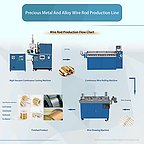
The company’s metal powder water atomization equipment, for instance, is designed to create the fine powders essential for 3D printing and other additive manufacturing processes. Its high-vacuum continuous casting machines are being used to create specialized alloys for the aerospace industry and for new material experimentation in university laboratories. By serving clients that include new material companies and research institutions, Hasung is moving from being a supplier to the luxury market to becoming an enabler of foundational technology.
This expansion underscores a critical truth: precious metals are not just stores of value or materials for adornment. They are vital industrial components. The precision with which we can process them directly impacts our ability to innovate in fields from aerospace to medicine. The network of machines that enables this processing is a form of critical, often overlooked, infrastructure.
Engineering Purity: The Code Behind the Crucible
At the heart of Hasung's competitive advantage is a suite of technologies designed to solve the age-old problems of metallurgy: oxidation, porosity, and imprecision. Traditional processing methods often expose molten metal to air, introducing impurities (oxidation) and creating tiny bubbles (porosity) that compromise the final product's density and structural integrity. Hasung's approach is a system of integrated, intelligent control.
It starts with advanced IGBT (Insulated-Gate Bipolar Transistor) wafers and high-frequency heating technology, which enable the rapid melting of metal in a vacuum or controlled atmosphere. This speed not only boosts efficiency and reduces energy consumption but also minimizes the time the metal spends in a vulnerable molten state.
Once molten, a PID (Proportional-Integral-Derivative) intelligent temperature control system takes over. This system acts as a hyper-accurate thermostat, maintaining the molten metal at an optimal, stable temperature. This precision is crucial for ensuring the metal flows perfectly into its mold, preventing defects like shrinkage porosity or uneven grain structures that can occur with even minor temperature fluctuations. The result is a product—be it a gold bar, a silver wire, or a complex alloy component—with higher purity, superior density, and a flawless finish straight from the cast.
By optimizing equipment structure, temperature management, and automation, the company helps its customers achieve unprecedented consistency. This level of control, once the exclusive domain of only the most expensive European and Japanese systems, is now becoming more accessible, fundamentally raising the quality floor for the entire industry.
The Vision of an Architect
This strategic ascent is no accident. It is the result of a long-term vision articulated by the company’s founder, Mr. Xiang. “Thirteen years ago, we moved into precious metals industry,” he stated, a timeline that notably predates the company's official 2014 founding. “Year after year we've kept pursuing technology development and been committed to driving technological innovation in the global precious metals industry through China's smart manufacturing.”
This statement reflects a journey of sustained focus, beginning with personal expertise and culminating in a national high-tech enterprise operating from a 5,500-square-meter facility in Shenzhen. The company’s ISO 9001 and CE certifications and its designation by the Chinese government as an “AAA credit company” are testaments to a rigorous commitment to quality and process.
The competition to build the world's most precise industrial tools is a quiet but deeply consequential arena. It’s a battle fought in microns and degrees Celsius, where the victors shape the material possibilities of the future. Hasung’s global expansion is more than a business success story; it is a clear signal that the invisible networks of industrial technology are being redrawn, with new architects stepping forward to design the infrastructure that will move the world.