
- Hardware-Agnostic Platform: IntBot's General Social Intelligence Engine (IntEng) is now compatible with diverse robot bodies from different manufacturers.
- Edge Deployment Milestone: First-ever edge deployment of NVIDIA’s Cosmos Reason-2 Vision-Language Model (VLM) on robots, enabling real-time social interaction processing.
- Commercial Deployment: IntBot's systems are already operating 24/7 in high-traffic environments like hotels.
Experts view IntBot's breakthrough as a significant step toward widespread adoption of socially intelligent robots, emphasizing its potential to standardize social intelligence across diverse hardware while raising important ethical and privacy considerations.
The Dawn of Truly Social Robots: IntBot's AI Engine Breaks Hardware Barriers
SAN JOSE, CA – March 16, 2026 – The bustling halls of NVIDIA’s GTC 2026 conference are playing host to a new kind of attendee: socially intelligent robots that can navigate the chaos, understand human interactions, and provide unscripted assistance. Robotics developer IntBot Inc. today unveiled a major breakthrough, announcing that its General Social Intelligence Engine, or IntEng, is now a hardware-agnostic platform. This move effectively creates a universal "brain" that can power a diverse range of robot bodies, a critical step toward the widespread adoption of robots in everyday human environments.
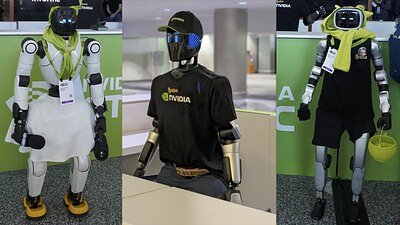
In a live demonstration, the company is showcasing three different robots from separate manufacturers—a front desk concierge, a mobile engagement assistant, and a training helper—all operating autonomously under the control of the same IntEng software. The announcement is supercharged by another significant milestone: the first-ever edge deployment of NVIDIA’s powerful new Cosmos Reason-2 Vision-Language Model (VLM). This integration allows the robots to process and understand the complex social dynamics of a crowded conference floor in real-time, directly on their own internal hardware, heralding a shift from pre-programmed machines to truly adaptive, perceptive collaborators.
The Brain Separated from the Body
For years, the robotics industry has been characterized by fragmented ecosystems where sophisticated software was inextricably tied to proprietary hardware. IntBot's latest announcement represents a fundamental break from this model. By designing its IntEng as a hardware-agnostic software stack, the company aims to become the central nervous system for a new generation of robots, regardless of their physical form or manufacturer.
The IntEng platform is not merely a conversational AI. It integrates a suite of complex capabilities essential for social autonomy. These include multimodal perception, which allows a robot to simultaneously process speech, visual cues like gestures and body language, and overall human behavior. This data feeds into a social scene understanding module that interprets the dynamics of group interactions, personal space, and environmental context. The result is a robot that can engage in context-aware conversations and control its own embodied behavior and expressions to appear more natural and less intimidating.
By decoupling the "brain" from the "body," IntBot is offering a solution to a long-standing industry bottleneck. Robot manufacturers can now focus on creating innovative hardware for different physical tasks, while system integrators can embed advanced social intelligence into a wide range of form factors without needing to build the complex AI from scratch. The GTC demonstration, featuring robots seamlessly performing different roles, serves as a powerful proof of concept for this new paradigm. Attendees can ask the concierge for directions, engage in a spontaneous chat with a roaming robot, or get help with their training session schedule, all powered by the same underlying intelligence adapting to different contexts and physical shells.
NVIDIA's 'Physical Common Sense' at the Edge
The intelligence powering these interactions is made possible by a landmark collaboration with NVIDIA. IntBot is showcasing the first edge deployment of the NVIDIA Cosmos Reason-2 VLM, an advanced AI model announced at CES 2026 and designed specifically to give physical AI systems a form of "common sense" about the world.
Vision-Language Models are a class of AI that can understand and reason about both images and text simultaneously. Cosmos Reason-2 elevates this capability by incorporating enhanced spatio-temporal understanding, allowing it to process the relationship between objects, people, and their movements over time. This is crucial for navigating dynamic, unpredictable human environments.
What makes IntBot's implementation a significant leap is the "edge deployment." Instead of sending massive amounts of sensor data to a remote cloud server for processing—a method that introduces latency and privacy concerns—the entire Cosmos Reason-2 model runs directly on the robots' onboard NVIDIA Jetson Thor compute systems. This is enabled by NVIDIA's TensorRT Edge-LLM, software optimized to run large models efficiently on embedded hardware.
The practical benefits are immediately apparent at GTC. The robots can identify human activities and social cues in real-time, understand the spatial layout of a crowded room, and maintain situational awareness with minimal delay. This low-latency reasoning is essential for safe and natural interaction. A robot that has to wait for a cloud server's response cannot react quickly enough to a person stepping into its path or respond fluidly in a fast-paced conversation. Furthermore, by keeping sensitive data like video and audio feeds on the device, this approach offers a more robust privacy posture, a critical factor for deployments in public venues, healthcare facilities, and hotels.
Beyond Demos: Social Robots in the Real World
While the GTC showcase is impressive, IntBot emphasizes that its technology is already moving beyond demonstrations and into sustained commercial operation. The company reports that its systems are currently operating 24/7 in high-traffic environments like hotels, a claim that positions them as a leader in deploying practical, autonomous social robots.
This focus on real-world social autonomy distinguishes IntBot from a crowded field. While many companies focus on the mechanics of robot mobility or manipulation, and others provide conversational AI, IntBot argues that the missing layer is social intelligence—the ability to reason about human attention, intent, and social boundaries. This capability is what separates a mere novelty from a truly useful assistant that people feel comfortable interacting with.
The competitive landscape includes hardware-centric players like SoftBank Robotics, whose Pepper and Nao robots are designed for social interaction but are tied to their own platforms, as well as the vast open-source community around the Robot Operating System (ROS), which provides foundational tools but requires significant integration work to achieve sophisticated social behavior. By offering a hardware-agnostic, specialized social intelligence engine, IntBot is carving out a unique market position as a pure-play software provider aiming to standardize the "social brain" for the industry. Their target markets—hospitality, transportation hubs, and public venues—are industries where effective human interaction is paramount to the customer experience, representing a massive opportunity for automation that enhances, rather than detracts from, the human element.
The New Social Contract: Navigating a Robot-Assisted Future
The arrival of robots that can perceive, interpret, and react to human social behavior opens a new chapter in automation, but it also brings a host of complex ethical and societal questions to the forefront. The very technology that makes these robots so capable—advanced, always-on sensors and powerful AI models—also makes them powerful data collection devices.
A robot roaming a hotel lobby or conference hall continuously processes visual and auditory information from its surroundings. The deployment of edge AI like NVIDIA's Cosmos Reason-2 may mitigate some privacy risks by processing data locally, but it does not eliminate them. Questions surrounding data consent, storage, security, and potential for misuse remain paramount. Navigating the patchwork of global privacy regulations, such as GDPR and CCPA, will be a significant challenge for companies deploying these systems in public spaces.
Beyond privacy, the societal impact of widespread social robotics is a subject of intense debate. While proponents argue that these robots will augment human workers by handling repetitive informational tasks and freeing up staff for more complex, high-value interactions, concerns about job displacement in the service sector are valid. The introduction of these machines will inevitably reshape job roles and require a workforce prepared for a future of human-robot collaboration.
Ultimately, the long-term success and acceptance of socially intelligent robots will depend on establishing a new social contract. This involves not only technological refinement to avoid the "uncanny valley" and ensure safe operation but also transparent communication from developers and deployers about what the robots are sensing, how their AI makes decisions, and what safeguards are in place. As machines become more adept at navigating our social world, society will need to develop new norms and ethical frameworks to govern our interactions with these new, intelligent inhabitants.