
- 97 dealership groups received FTC warning letters in March 2026 for deceptive practices.
- $4.4 billion in fraud exposure projected from synthetic identity fraud in 2026.
- Fines for Safeguards Rule violations can exceed $100,000 per violation with potential jail time for management.
Experts emphasize that auto dealers must prioritize compliance to avoid severe financial and legal consequences, as regulatory enforcement has intensified significantly in 2026.
The Compliance Crunch: Auto Dealers Face Six Critical Risks in 2026
DALLAS, TX – March 27, 2026 – A deceptive calm in regulatory enforcement has been shattered, leaving auto dealers nationwide facing a renewed and intensified compliance landscape. A recent wave of Federal Trade Commission (FTC) warning letters, coupled with a complex web of state and federal rules, has underscored a critical message for 2026: assuming regulatory pressure has eased is a profit-killing mistake. Experts at EFG Companies, a long-standing F&I and compliance provider, have identified six priority issues that dealer principals must address immediately to avoid staggering fines, legal fees, and reputational damage.
The New Regulatory Reality
The industry's wake-up call arrived in force on March 13, 2026, when the FTC dispatched warning letters to 97 auto dealership groups. The letters served as a stern reminder that the agency is actively monitoring for deceptive practices, particularly in pricing transparency. Regulators are targeting advertisements that fail to include all mandatory fees, promote unavailable rebates, or condition prices on specific financing without clear disclosure. This action signals that even after the procedural withdrawal of the proposed CARS Rule, the FTC's mandate to police deceptive practices remains firmly intact.
This federal scrutiny is not limited to the FTC. The Consumer Financial Protection Bureau (CFPB) continues to pursue fair-lending actions and has recently flagged significant issues in auto servicing, including improper charges for add-on products and wrongful repossessions. The message from Washington is clear: compliance is not a suggestion. Errors, particularly concerning the FTC Safeguards Rule for data protection, are no longer viewed as 'one-off mistakes' but as evidence of systemic failure, inviting deeper and more costly investigations.
Six Fronts in the Compliance Battle
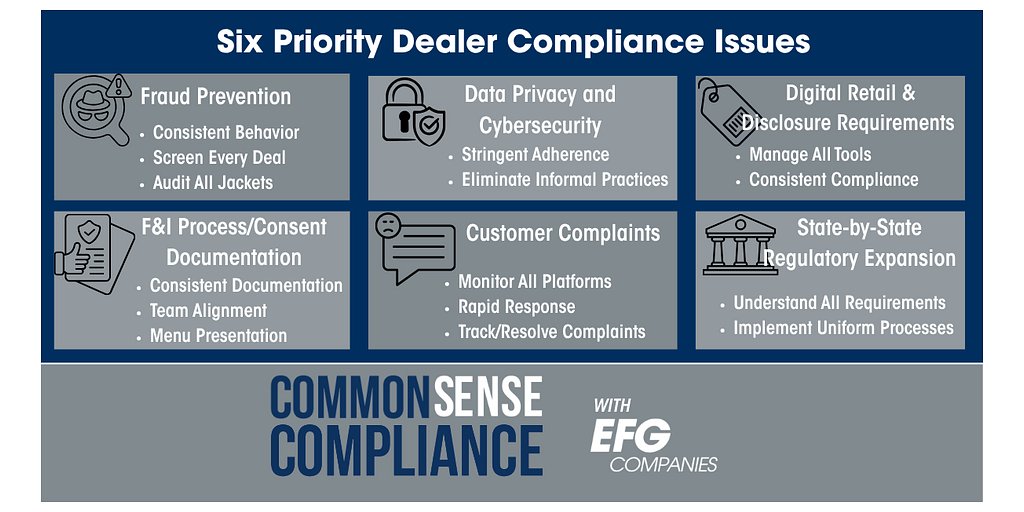
According to EFG Companies' analysis, dealers are fighting a multi-front war against compliance risk. The six most critical battlegrounds require immediate attention and strategic planning.
1. Fraud Prevention: The rise of synthetic identity fraud represents a clear and present danger to dealership profitability. This sophisticated scheme, which involves creating fictitious identities from a mix of real and fake data, is projected to create a staggering $4.4 billion in fraud exposure this year. These synthetic identities can often pass basic credit checks, making it imperative for F&I teams to screen every deal jacket with rigorous, consistent processes to confirm accuracy before submission and prevent devastating financial losses from unrecoverable vehicles and defaulted loans.
2. Data Privacy & Cybersecurity: With the U.S. government issuing heightened warnings of cyberattacks, the stakes for data security have never been higher. Under the updated FTC Safeguards Rule, a breach affecting 500 or more consumers must be reported to the agency within 30 days. Failure to maintain a comprehensive, written information security program can result in fines exceeding $100,000 per violation and even potential jail time for management. Regulators now expect robust, dealership-wide security measures, and any lapse is considered a systemic flaw.
3. Digital Retail & Disclosure Requirements: The shift to online sales has created new compliance pitfalls. The recent FTC warning letters directly apply to digital showrooms, automated pricing tools, and online advertisements. Practices like 'drip pricing,' where mandatory fees are only revealed late in the online process, are squarely in the regulatory crosshairs. Dealerships must ensure absolute consistency and transparency across all digital communication tools, guaranteeing that the price a customer sees online is the full price they are required to pay.
4. F&I Process & Consent Documentation: The F&I office remains under a regulatory microscope. Longer loan terms and rising defaults are red flags for regulators, who are closely examining the sale of add-on products. The CFPB has cited dealers for charging for products without consent and making cancellation difficult. To mitigate risk, dealerships must implement a transparent menu presentation and secure clear, informed, and documented consent for every optional product sold. Consistency between the sales and F&I teams is crucial to avoid any appearance of deceptive practices like payment packing.
5. Customer Complaints: In today's regulatory environment, customer complaints are no longer just a customer service issue—they are a primary trigger for audits. With the CFPB receiving thousands of vehicle finance complaints annually, regulators are actively using this data to identify patterns of misconduct. Unresolved issues on digital platforms can quickly spiral into a formal investigation. A proactive complaint management system that ensures rapid response and thorough documentation is essential to resolving issues before they attract regulatory attention.
6. State-by-State Regulatory Expansion: While federal agencies remain active, states are increasingly expanding their own regulatory frameworks. The invalidation of the federal CARS Rule has prompted states to “fill the void,” creating a complex patchwork of different laws. For example, California's CARS Act, signed in 2025, imposes its own strict transparency rules. This fragmented landscape requires dealers, especially those operating across state lines, to proactively understand and implement processes that comply with a multitude of varying state-level UDAAP (unfair and deceptive acts and practices) laws.
Building a Culture of Compliance
“The biggest compliance risk for dealerships in 2026 is assuming enforcement pressure has eased,” said Jennifer Rappaport, President and CEO of EFG Companies, in the company's announcement. “In reality, fraud prevention, data security and customer complaints remain top compliance triggers.”
This sentiment underscores the need to move beyond a reactive, checklist-based approach. The most effective defense is building an ingrained culture of compliance. This begins at the top, with leadership committing resources and setting a tone of unwavering ethical conduct. It involves transforming compliance from a departmental function into a dealership-wide responsibility.
A cornerstone of this culture is continuous, high-quality training. Ensuring that F&I personnel and other relevant staff hold certifications from reputable organizations like the Association of Finance and Insurance Professionals (AFIP) provides a baseline of expertise. However, this must be supplemented with frequent, targeted training that addresses the specific, evolving risks the dealership faces. Process discipline—including regular internal audits of deal jackets, standardized F&I presentations, and rigorous adherence to data security protocols—is the framework that makes this culture actionable and defensible.
Leveraging Technology and Expertise for Defense
Navigating this treacherous environment requires a combination of modern technology and specialized expertise. Dealerships can no longer rely solely on manual processes to keep pace with sophisticated fraud and complex regulations. Investing in AI-driven fraud detection tools can help screen for synthetic identities early in the sales process, while advanced Dealer Management Systems (DMS) can integrate automated compliance checks to ensure deals are audit-ready without slowing down business.
Strengthening the dealership's cybersecurity posture is also non-negotiable. This means implementing a comprehensive information security program that goes beyond the minimum requirements of the Safeguards Rule, including regular risk assessments, vendor oversight, and clear breach notification protocols. For many, appointing a dedicated Data Protection or Compliance Officer is a logical next step to centralize oversight and ensure accountability.
Finally, given the fragmented state-by-state regulatory landscape, seeking outside expertise is not a sign of weakness but of strategic foresight. Partnering with legal counsel specializing in automotive law and engaging with compliance providers can provide the guidance and tools necessary to adapt to changing rules. In the current climate, proactive investment in compliance is no longer an option but a critical component of sustainable dealership operations.
Topics & Related
Fintech
Data Privacy (GDPR/CCPA)
Data Breaches
Trade Wars & Tariffs
Cloud Migration
Related Company Pulse