
- 50% of employees can perform their entire job within a browser
- 80% of employees can accomplish 80% of their tasks through a browser
- $822 million projected North American Zero Trust Browser Security (ZTBS) market by 2025
- 300% year-over-year growth in Seraphic's annual recurring revenue (ARR)
- 140% surge in browser-based phishing attacks since the rise of Generative AI
Experts agree that the browser has become a critical security vulnerability for enterprises, necessitating Zero Trust Browser Security (ZTBS) solutions to protect against evolving threats, including those posed by Generative AI.
The Browser Is the New Battlefield: Seraphic Leads the Zero Trust Charge
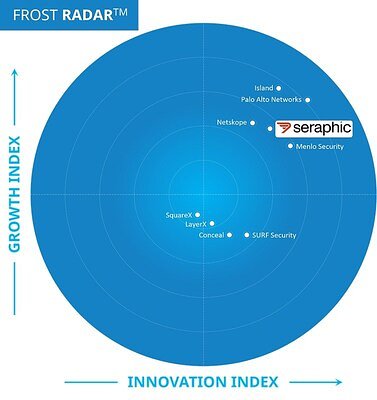
TEL AVIV, Israel – December 15, 2025 – In the intricate world of cybersecurity, where the front lines are constantly shifting, the humble web browser has quietly become the primary battlefield. It is the new operating system of the enterprise, the central conduit for cloud applications, remote work, and now, generative AI. Recognizing this critical shift, analyst firm Frost & Sullivan has cast a spotlight on the emerging market of Zero Trust Browser Security (ZTBS), naming Israeli firm Seraphic a leader in its 2025 Frost Radar™ report. This accolade is more than just a corporate win; it's a powerful signal that the strategy for protecting corporate assets is undergoing a fundamental transformation, moving security to the very edge of user activity.
Seraphic's recognition for its strong growth and innovation underscores a pivotal market trend. As enterprises grapple with securing a distributed workforce and an explosion of SaaS applications, the browser has evolved from a simple tool into a significant vulnerability. The validation from a respected firm like Frost & Sullivan provides crucial market intelligence, suggesting that Seraphic's browser-agnostic approach—designed to fortify any browser rather than replace it—is not just viable but is setting the pace for a rapidly expanding sector.
The New Corporate Achilles' Heel
The modern enterprise runs on the web. Research indicates that for up to 50% of employees, their entire job can be performed within a browser, and a staggering 80% can accomplish 80% of their tasks through this single interface. This consolidation of work onto one platform creates immense efficiency but also a concentrated point of failure. Traditional network and endpoint security solutions were designed for a world where applications ran on-premise, behind a fortified corporate perimeter. That perimeter has now dissolved.
Today, employees on both managed corporate laptops and unmanaged personal devices (BYOD) access sensitive SaaS applications like Salesforce, Microsoft 365, and Workday directly through their browsers. This activity often occurs outside the protective umbrella of VPNs and legacy security tools, leaving a massive gap for attackers to exploit. Sophisticated phishing attacks, credential theft, session hijacking, and malicious browser extensions are no longer edge cases; they are primary attack vectors. The browser, in effect, has become the new endpoint, and securing it has become a paramount concern for CISOs globally.
"Web browsers have become the operating system of the enterprise, making them a primary target for adversaries," noted Ilan Yeshua, co-founder and CEO of Seraphic, in the company's announcement. "Our mission at Seraphic is to close this critical gap by securing the browser from any attack vector and empower organizations to embrace modern workforce by adopting SaaS applications, remote connectivity, and GenAI with confidence."
Zero Trust Enters the Browser
The answer to this new challenge lies in applying the principles of Zero Trust directly within the browser itself. Zero Trust, a security model built on the tenet of "never trust, always verify," abandons the outdated idea of a secure internal network. Instead, it demands continuous verification for every user, device, and application seeking access to resources. A Zero Trust Browser Security (ZTBS) platform extends this logic to the final frontier of user interaction.
Seraphic's platform exemplifies this approach by creating a lightweight, abstracted security layer that operates within any browser—Chrome, Edge, Safari, and others. This browser-agnostic model is a key differentiator in a market where some competitors push for the adoption of a proprietary, locked-down browser. The benefit is clear: enterprises can maintain user choice and avoid the disruptive process of forcing employees to switch browsers, a move often met with resistance and productivity loss. As Swetha Krishnamoorthi, Industry Principal at Frost & Sullivan, observed, "Enterprise customers demand lightweight, clientless, and browser-native security solutions that are easy to deploy and manage and offer high performance."
Functionally, this means providing granular control over user actions in real-time. Seraphic’s solution offers a suite of capabilities, including preventing data loss by controlling copy-paste, printing, and screen captures; governing the use of risky browser extensions; and providing secure, VPN-less access to internal applications. It acts as an invisible security guard within the browser, enforcing policy without hindering the user experience.
Investor Confidence and Market Momentum
Analyst validation is often a leading indicator of market traction and investor interest, and Seraphic’s case is no exception. The company’s position on the Frost Radar is backed by formidable financial momentum. Earlier this year, Seraphic announced a $29 million Series A funding round led by GreatPoint Ventures. Critically, the round included participation from the CrowdStrike Falcon Fund, the strategic investment arm of cybersecurity giant CrowdStrike.
This investment is a significant vote of confidence. The Falcon Fund selectively backs companies that fill crucial gaps in the security ecosystem, and its support provides not only capital but also a potential pathway to integration and go-to-market collaboration with one of the industry's largest players. This strategic backing, combined with a reported 300% year-over-year growth in annual recurring revenue (ARR), paints a picture of a company rapidly converting its technological innovation into enterprise contracts.
The ZTBS market itself is on a steep upward trajectory, with projections showing the North American market alone soaring to over $822 million by 2025 at an aggressive 30.3% compound annual growth rate. This growth reflects an urgent need, and investors are placing their bets on the platforms best positioned to capture this demand. Seraphic, alongside other key players like Island and Talon, is at the forefront of this capital-intensive race to define the next generation of endpoint security.
The Generative AI Complication
Adding another layer of complexity and urgency is the meteoric rise of Generative AI. While tools like ChatGPT offer unprecedented productivity gains, they also introduce new and potent security risks directly through the browser. Recent data reveals a startling 140% surge in browser-based phishing attacks since the advent of popular GenAI tools, many of which leverage AI to create highly convincing and difficult-to-detect malicious sites.
Furthermore, the risk of "Shadow AI"—employees using unapproved AI tools—and inadvertent data leakage is a top concern for data privacy and compliance officers. A well-meaning employee might paste sensitive customer data or proprietary source code into a public AI prompt to summarize or debug it, inadvertently feeding that information into a third-party model. Seraphic’s platform directly addresses this by providing visibility into GenAI usage and establishing guardrails to prevent such data exposure, a capability that is rapidly moving from a nice-to-have to a necessity.
By embedding security within the browser, ZTBS platforms can monitor and control interactions with AI tools, ensuring that enterprises can harness their power without compromising their most valuable data. This ability to enable secure AI adoption is becoming a critical purchasing criterion for enterprises navigating the new economy, further cementing the importance of this emerging security category.