
- AIKO now accounts for nearly 20% of active monthly solar proposals in Australia.
- Neostar 3P54 module delivers 500 watts of power at 25% efficiency in under 2 square meters.
- AIKO achieved gigawatt-scale production of completely silver-free modules.
Experts would likely conclude that AIKO's rapid dominance in Australia's solar market is driven by a combination of superior technology, strategic market penetration, and long-term manufacturing innovation.
The AIKO Blueprint: Dominating a Key Solar Market in Two Years
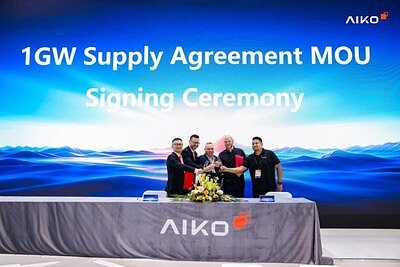
SHANGHAI, CHINA – June 10, 2026 – This week, at the world's largest solar trade show, SNEC 2026, AIKO Energy unveiled a series of announcements that, on the surface, look like standard corporate progress: new distribution agreements, a brand award, and the official launch of a new product. But for leaders watching the renewable energy space, these moves are not just another press release. They are the latest salvo in a masterclass of market disruption, cementing the company’s shockingly rapid ascent in the highly competitive Australian solar market. In just 24 months, AIKO has moved from a new entrant to a dominant force, offering a compelling blueprint for how to win in a mature industry.
A Calculated Blitz on a Mature Market
Entering a market as saturated and sophisticated as Australia's solar sector is a daunting task. It's a landscape crowded with global giants who have spent years building supply chains and brand recognition. Yet, in just two years since its late 2022 arrival, AIKO now accounts for nearly 20% of active monthly solar proposals nationwide, according to data from industry platform OpenSolar. This isn't just growth; it's a land grab.
The company's strategy has been a multi-pronged assault. Rather than a slow build, they executed a calculated blitz focused on the most influential segment of the market: the installers. By winning over the professionals who recommend and install the systems, AIKO created a powerful network of advocates. This approach paid off almost immediately. In its first full year on the market, the company was voted the number one "Installer Choice" on SolarQuotes, a critical third-party validation in a market where peer trust is paramount.
The new memoranda of understanding signed at SNEC with Australian distributors build on this foundation. By strengthening ties with established players like Solar Juice and One Stop Warehouse, and likely adding new partners, AIKO is ensuring its high-demand products can reach every corner of the country. This logistical backbone is critical to sustaining the momentum generated by their technology and installer-focused marketing. The "Top Brand PV 2026 Australia" award from EUPD Research, following a similar win in 2024, is less a cause for this success and more a lagging indicator of the deep inroads the company has already made.
The Technology of Disruption: Performance and Aesthetics
At the heart of AIKO's strategy is a product that offers a clear, demonstrable advantage. The newly available Neostar 3P54 module is a testament to this, delivering a milestone 500 watts of power at 25% efficiency in a residential-friendly footprint of less than two square meters. In a market where government rebates are declining, the long-term value of a solar system shifts from the initial purchase price to the total lifetime energy generation. A panel that produces 500W where competitors offer 460W fundamentally changes the financial equation for homeowners, promising lower bills and stronger returns on investment.
This performance leap is driven by the company's proprietary All Back Contact (ABC) cell architecture. By moving all electrical contacts to the rear of the cell, the technology eliminates the grid lines that block sunlight on conventional panels. Combined with innovations like Zero Gap cell placement and "Invisi-Ribbon" connectors, this allows 93.5% of the module's surface to actively generate power—a significant jump over older PERC and even newer TOPCon technologies.
The business implication is twofold. For installers, it provides a clear point of differentiation based on quality and performance, allowing them to win jobs without engaging in a race-to-the-bottom on price. For homeowners, the technology offers not only superior power density but also a sleek, all-black aesthetic that is highly valued in the premium residential market. This combination of world-class performance, backed by consistent top rankings on industry scorecards like TaiyangNews, and premium design has proven to be a killer combination.
Engineering for Australia: Beyond Lab Results
While headline efficiency numbers are impressive, they mean little if the hardware can't withstand the local environment. This is where AIKO has demonstrated a particularly astute understanding of the Australian market's unique demands. The company has pursued a "triple certification" for its Neostar series that specifically addresses the continent's most challenging climate conditions.
The panels now carry official cyclone approval for Australia's wind regions C and D, a certification conducted in Darwin using local engineering methodologies. This is complemented by a TÜV Rheinland certification for 40mm hail—well above the 25mm industry standard—and the highest possible severity rating for salt mist corrosion, crucial for the 85% of Australians who live near the coast.
As Thomas Bywater, AIKO's Head for the region, stated, "We test our products to beyond Australian standards because this market expects more than a generic lab result." This is more than just good engineering; it's brilliant marketing and risk management. By investing in localized, extreme-weather testing, AIKO provides tangible proof of its commitment and builds a deep level of trust with installers and consumers. It transforms the product from a globally-sourced commodity into a solution specifically tailored and proven for Australian homes, effectively neutralizing one of the biggest perceived risks of adopting a newer brand.
The Silver-Free Gambit: A Bet on Sustainable Manufacturing
Perhaps the most forward-looking aspect of AIKO's strategy lies deep within its cell technology: the complete elimination of silver. The solar industry's reliance on silver paste for cell metallization has long been its Achilles' heel. As a precious metal, silver is subject to volatile price swings and supply chain pressures, representing a significant and unpredictable portion of a module's final cost.
AIKO has sidestepped this entire problem by pioneering and scaling a silver-free process using copper electroplating. This is a profound technological and business achievement. By replacing an expensive, finite resource with an abundant, lower-cost alternative, the company has insulated itself from a major source of industry-wide risk. This move not only creates a potential for long-term cost leadership but also enhances supply chain resilience and boosts the sustainability credentials of its manufacturing process.
While competitors focus on reducing the amount of silver in their cells, AIKO is the first to achieve gigawatt-scale production of completely silver-free modules. For business leaders, this is the key takeaway. AIKO is not just playing today's game better; it is fundamentally changing the rules for tomorrow. This strategic bet on material science provides a durable competitive advantage that will be difficult for rivals to replicate, ensuring its products can remain both high-performance and financially accessible for years to come. This combination of aggressive market strategy, superior product technology, deep localization, and long-term manufacturing foresight provides a powerful blueprint for any organization aiming to make a decisive impact.