
- 91% of IT executives are bullish on AI, but only 42% report measurable cross-departmental impact.
- 90% of enterprises are stuck in AI pilots, with 80% blocked by data issues or governance.
- Only 19% of organizations have a fully implemented AI governance framework.
Experts agree that enterprises must shift from AI hype to operational discipline, focusing on governance, data readiness, and strategic clarity to achieve measurable business value.
The AI Reckoning: Enterprises Face the Hard Work Beyond the Hype
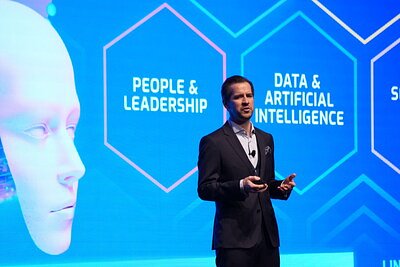
LAS VEGAS, NV – June 19, 2026 – The neon-lit halls of the Bellagio Hotel and Casino recently played host to a different kind of high-stakes game. Thousands of Chief Information Officers and senior IT leaders gathered for Info-Tech LIVE 2026, not to gamble on futuristic promises, but to confront a sobering reality: the chasm between artificial intelligence ambition and measurable business value. The event, organized by global advisory firm Info-Tech Research Group, moved past the now-familiar AI enthusiasm to tackle the unglamorous, essential work of execution, governance, and security. The central theme, “Agentic IT: From Hype to Value,” signaled a critical maturation point for the industry, where proving AI’s worth has officially become the new mandate.
The Great Disconnect: Enthusiasm vs. Execution
The core of the discussion was captured by a stark set of numbers from Info-Tech’s own “AI Adoption in the Enterprise Survey.” While a staggering 91% of IT executives are bullish on AI and 96% expect budgets to climb, a mere 42% of their organizations can report measurable, cross-departmental impact. Worse, only half have a board-approved AI strategy in place. This isn't an isolated finding; it reflects a broad industry struggle. Other recent studies show that as many as 90% of enterprises are stuck in AI pilots, with nearly 80% blocked by data issues or a lack of adequate governance.
“Our 2026 edition of Info-Tech LIVE in Las Vegas made clear that CIOs are no longer trying to prove whether AI matters; they’re now being asked to prove where it creates measurable value,” said Gord Harrison, Chief Research Officer at Info-Tech Research Group. This shift from advocacy to accountability was palpable throughout the conference’s 200+ sessions. The challenge is no longer about buying into AI, but about building the operational discipline to make it work at scale.
In his opening keynote, Info-Tech CEO Tom Zehren introduced the firm’s “Agentic IT Framework,” a structured approach designed to bridge this gap. It focuses on four priorities: owning the AI mandate, picking the right AI bets, enforcing AI discipline, and proving and scaling value. The framework argues that success depends less on the technology itself and more on the surrounding systems of governance, data readiness, and strategic clarity. The message is a grounded one: before you can achieve autonomous operations, you must first master the fundamentals.
The Exponential CIO: A New Mandate for Leadership
As AI becomes woven into the corporate fabric, the role of the CIO is undergoing its most significant transformation in decades. Geoff Nielson, the firm’s SVP of Brand, Reach & Influence, addressed this directly in his keynote, “Become an Exponential CIO.” He highlighted the gap between where the C-suite expects CIOs to be—driving strategic business outcomes—and where many find themselves: mired in firefighting, immature processes, and resource constraints. The era of agentic AI demands that CIOs break free from this operational undertow.
This pressure is creating unprecedented turnover, with one analyst noting the CIO role is seeing its highest transition rates in 30 years. The leaders who survive and thrive will be those who evolve from technology managers to business transformers. According to the framework presented, this involves mastering eight drivers of IT success, including stakeholder satisfaction, mission-critical project delivery, right-sized risk, and evidence-based decisions. It’s a call for CIOs to become architects of value, not just custodians of infrastructure.
This new mandate requires a shift in mindset. Instead of just greenlighting AI projects, exponential CIOs must build the systems that allow for safe experimentation and ruthless prioritization. They must decide which AI bets to make, which to stop, and how to scale the work that delivers real outcomes, transforming IT from a cost center into an engine for compounding business value.
Building the Agentic Enterprise: Architecture and Security
Moving from using AI to running on AI is a monumental leap. It requires what Carlene McCubbin, AVP of Agentic AI Implementation, called designing for autonomy. This means building an “agentic enterprise” where AI is not just an add-on but a core component of orchestrated workflows. However, as Principal Research Director Martin Bufi warned in his “Agents 2.0” keynote, “autonomy without architecture creates risk.”
Drawing on lessons from building 63 agents and 123 tools, Bufi emphasized that successful agentic systems must be meticulously mapped, engineered, and governed before they can scale. This involves standardizing workflows before automating them, designing agents for specific jobs rather than general tasks, and ensuring every agent can be measured, stopped, and improved. It’s an engineering discipline, not a magic trick.
This engineering challenge extends deep into cybersecurity. Sessions by security experts Erik Avakian and Pearl Almeida drove home the point that traditional security controls, built for predictable, human-scale operations, are wholly inadequate for agentic AI. These new systems introduce dynamic reasoning, shifting permissions, and autonomous loops that represent a new class of risk. With research showing only 19% of organizations have a fully implemented AI governance framework, the gap between capability and control is dangerously wide.
Securing the agentic enterprise demands a layered approach, including API security, identity governance, and continuous monitoring. As Almeida noted, “autonomy boundaries” are the new security perimeter. This necessitates new roles, such as “CyberAI agent supervisors,” and a fundamental shift from treating security as a compliance problem to an engineering challenge. As enterprises delegate more tasks to autonomous agents, ensuring those agents operate within safe, observable, and controllable guardrails becomes the most critical system of all.