
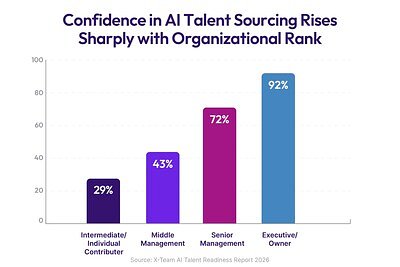
- 92% of executives are confident in their organization's AI talent sourcing abilities, while only 26% of individual contributors share that optimism.
- 50% of organizations admit it would take three months or more to staff a single cross-functional AI team.
- 24% of survey respondents do not know how their organization adds AI engineering capacity.
Experts agree that there is a significant disconnect between executive confidence in AI readiness and the operational realities faced by frontline employees, highlighting the need for better governance, training, and workforce planning to bridge this gap.
The AI Readiness Delusion: Execs Confident, Staff See Chaos
AUSTIN, Texas – April 30, 2026 – A new report has exposed a profound and potentially dangerous disconnect at the heart of corporate America's AI ambitions. While executives project overwhelming confidence in their ability to build an AI-ready workforce, the employees tasked with executing that vision see a far grimmer reality. According to the AI Talent Readiness Report released today by tech talent firm X-Team, a staggering 92% of executives are confident in their organization's AI talent sourcing abilities. In stark contrast, only 26% of individual contributors—the engineers, developers, and data scientists on the front lines—share that optimism.
This chasm between the C-suite and the cubicle suggests a widespread "AI readiness delusion," where strategic ambition has dramatically outpaced operational capability. The findings, based on a survey of 324 U.S. technology, HR, and business leaders, paint a picture of organizations that believe they are prepared for the AI revolution but lack the fundamental infrastructure, training, and governance to succeed.
A Chasm of Confidence
The seniority gap is the most glaring symptom of a deeper organizational misalignment. While executives see a clear strategy, the people responsible for implementing it see roadblocks, delays, and a lack of resources. The X-Team report reveals that despite high-level confidence, 50% of organizations admit it would take three months or more to staff a single cross-functional AI team—a lifetime in the fast-moving tech landscape.
This is not an isolated finding. Other industry analyses consistently show that leadership overestimates AI maturity. A recent study by Multiverse found that 61% of leaders believe AI is fully implemented across their organization, a sentiment shared by only 36% of their workers. Similarly, an HPE report noted that while 86% of IT leaders were confident in their AI plans, fewer than half could describe their deployments as fully successful, pointing to a widening gulf between ambition and execution. The consensus among practitioners is clear: leadership consistently underestimates the difficulty of building and deploying effective AI.
"Most AI readiness conversations start with the wrong questions about what tools to buy or what roles to post," said Amit Sion, CEO of X-Team, in the report's press release. "But the organizations that actually build durable AI capability start by asking who owns AI and what that means for everyone else. That single decision cascades into training, measurement, and governance in ways that no hiring sprint or software subscription can replicate."
The Broken Engine Room: Talent, Training, and HR
The report suggests that the engine room of AI talent development is sputtering. The Human Resources department, critical to any talent strategy, appears particularly disconnected. HR leaders reported a mere 29% confidence in AI talent sourcing, a stark contrast to the 78% confidence reported by data and AI teams who are closer to the problem. Perhaps most alarmingly, nearly a quarter (24%) of all survey respondents did not know how their organization adds AI engineering capacity at all, indicating a fundamental breakdown in communication and process visibility.
This internal confusion is happening against a backdrop of a ferocious war for talent. Research firm IDC projects that over 90% of global enterprises will face critical AI skills shortages by 2026, putting trillions of dollars in potential market performance at risk. According to PwC's 2025 Global AI Jobs Barometer, jobs requiring AI skills are evolving 66% faster than other roles, and workers possessing them can command wage premiums of up to 56%. Companies that cannot effectively source, train, and retain this talent will be left behind.
The data shows that simply posting a job description is not a strategy. Organizations with clearly defined, distributed AI specialists and role-wide AI expectations demonstrate vastly superior outcomes, with 61-69% providing structured training. For companies with no formal AI roles, that number plummets to just 18%.
Governance on Paper, Chaos in Practice
Beyond talent, a vacuum of effective governance is paralyzing progress. According to the X-Team report, more than a third (36%) of companies have published an official AI policy, but enforcement is inconsistent at best. This creates an environment of uncertainty where employees are unsure what tools they can use or what rules apply.
Fearing risk, but lacking clear guidance, many teams are simply frozen. The report notes that only 10% of organizations have explicitly prohibited AI in engineering workflows. The rest exist in a gray area, stifling innovation not through outright bans, but through a lack of clear frameworks. This is particularly acute in regulated sectors, where governance is cited as the top constraint to scaling AI.
This lack of internal clarity is compounded by a rapidly evolving external landscape. The number of AI-related regulations in the U.S. is rising, yet Gartner research indicates that a majority of organizations still lack comprehensive governance frameworks or even clear ownership of AI initiatives. Without strong technical and human guardrails, companies not only risk falling foul of compliance but also erode the trust necessary for broad adoption.
Charting a Path from Delusion to Delivery
For companies looking to bridge the gap between AI ambition and reality, the path forward requires a fundamental shift away from superficial measures and toward building deep, sustainable capability. The report highlights several key differentiators of mature organizations.
First is the discipline of measurement. Only 19% of companies currently tie AI value capture directly to financial or operating metrics. However, this small group is demonstrably more confident, more fundable, and more competitive in the hunt for AI talent. What gets measured gets managed, and mature organizations prove it.
Second is a strategic approach to team building. While speed is often the primary metric in talent acquisition, the report reveals that embedded, longer-term partner teams report dramatically better outcomes—including 85% strong value capture and 66% structured training—compared to internal-only teams. This suggests that deep integration with experienced external partners can be a powerful accelerator for building internal knowledge and maturing governance.
Ultimately, closing the readiness gap demands that leadership looks beyond optimistic top-line strategies and engages directly with the operational realities on the ground. It requires investing in continuous workforce planning, fostering a culture of constant learning, and establishing clear governance that empowers rather than freezes employees. Building a truly AI-ready workforce is not a hiring problem to be solved, but a cultural and structural transformation to be led.