
- $27 billion: Projected market size for liquid cooling in AI data centers by 2033, up from $4 billion in 2026.
- 76%: Forecasted adoption of liquid cooling in AI servers by 2026, up from 15% in 2024.
- 60%: Estimated reduction in data center deployment timelines with modular, prefabricated systems.
Experts agree that the AI data center industry is shifting toward fully integrated, modular systems where compute, power, and liquid cooling are unified, marking a critical evolution in infrastructure design to meet the demands of next-generation AI workloads.
The AI Data Center Revolution: Integration Is the New Imperative
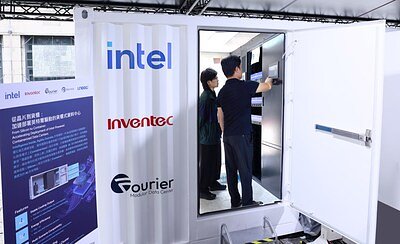
TAIPEI – May 13, 2026 – A structural shift is underway in the world of artificial intelligence, and its epicenter is not a new algorithm but the very foundation of the data center itself. At the 2026 Advanced Liquid Cooling Technologies Conference in Taipei, modular data center firm Fourier Data Center Solution Inc., alongside chip giant Intel, offered a tangible glimpse into this new reality: a fully integrated, 20-foot modular data center container, running and open for inspection.
The demonstration was more than a product showcase; it was a declaration that the era of incremental component upgrades is over. As AI workloads become exponentially more powerful and power-hungry, the industry is rapidly moving away from assembling individual parts and toward deploying unified, factory-built systems where compute, power, and cooling are orchestrated as a single architecture. This shift, highlighted throughout the conference, redefines the core challenge from improving a single processor to mastering the system as a whole.
The End of the Component Era
For years, data center evolution was measured by improvements in discrete components—faster CPUs, more efficient power supplies, or better fans. The AI boom has shattered that paradigm. The sheer thermal density of modern AI accelerators, which can generate heat ten times more concentrated than a clothes iron, has made cooling a primary design constraint, not an operational afterthought.
At the Taipei conference, Fourier CRO Justin Cass captured this new reality in his keynote address. "AI infrastructure is entering a phase where density is mandatory, liquid cooling is foundational, and integration defines competitiveness," Cass stated. He argued that the market no longer requires piecemeal improvements but "deployable systems that unify compute, cooling, and power into a single architecture, delivered consistently across global environments."
The container on display embodied this principle. Visitors could walk through the compact, prefabricated unit and see firsthand how high-performance servers, power distribution, and a sophisticated liquid cooling network were engineered to work in concert. This integrated approach, co-developed with Intel, reflects the chipmaker's platform-driven strategy of enabling ecosystem partners to build complete solutions, moving beyond just supplying silicon.
Why Liquid Cooling Is Now Mandatory
The transition to integrated systems is inextricably linked to the rise of liquid cooling. Traditional air-cooling methods are hitting a wall, simply unable to manage the heat generated by racks packed with GPUs for AI training, which can now demand 50kW, 100kW, or even more. This has transformed liquid cooling from a niche technology for supercomputers into a foundational requirement for mainstream AI infrastructure.
Market forecasts underscore this dramatic pivot. Some analysts project the market for liquid cooling in AI data centers will surge from approximately $4 billion in 2026 to over $27 billion by 2033. Goldman Sachs has gone further, forecasting that the percentage of AI servers utilizing liquid cooling will jump from just 15% in 2024 to 76% in 2026. The reason is simple physics: liquid is up to 1,000 times more effective at transferring heat than air. This efficiency not only enables higher-density computing but also significantly reduces the energy required for cooling, improving a facility's Power Usage Effectiveness (PUE) and supporting corporate sustainability goals.
Intel has been a key driver in this space, developing processor SKUs optimized for liquid cooling and releasing open-source reference designs for immersion cooling solutions to accelerate industry adoption. The collaboration with Fourier is a clear signal of its commitment to building an ecosystem prepared for the thermal challenges of next-generation AI.
The Race for Deployment Speed
In the hyper-competitive AI landscape, speed to market is paramount. Delays in building data center capacity or integrating new hardware can mean missing a critical window of opportunity. This has made deployment speed a crucial competitive variable, and it's here that modular, prefabricated systems offer their most compelling business case.
Constructing a traditional data center is a complex, lengthy process fraught with potential delays. In contrast, modular data centers like the one Fourier showcased are built and integrated in a factory-controlled environment. This approach of prefabrication, factory integration, and standardized design can compress delivery timelines by as much as 60%, according to industry estimates. It also dramatically reduces onsite construction complexity and uncertainty, enabling predictable deployment of high-density infrastructure anywhere in the world.
The conference discussions emphasized the emergence of a more coordinated validation environment, where cooling technologies, power architectures, and system interfaces are aligned within a shared ecosystem. This reduces the integration friction that has historically plagued large-scale deployments, ensuring that the components of a complex system work together seamlessly out of the box.
A New Blueprint for the Data Center Industry
Fourier and Intel are not alone in recognizing this trend. The entire data center industry, from established giants like Vertiv, Schneider Electric, and Dell to specialized cooling innovators like CoolIT Systems and LiquidStack, is racing to provide integrated solutions. The focus is shifting from selling individual products to delivering a holistic, operational system that meets the extreme demands of AI.
This shift has profound implications for data center operators. While modular systems simplify deployment, they also demand a new operational mindset. The tight coupling of IT and facility systems is essential. For instance, while air-cooled systems might tolerate a cooling outage for several minutes, high-density liquid-cooled racks can reach critical thermal limits in mere seconds, requiring unprecedented reliability and immediate continuity on the mechanical side.
As AI continues to scale globally, the convergence toward integrated, prefabricated systems appears inevitable. The ability to translate system-level innovation into deployable, high-density infrastructure is no longer just an engineering strategy—it is the defining characteristic of competitiveness in the new era of artificial intelligence.