
- 94% of firms report critical skills gaps in agentic AI, with 1/3 of organizations impacted in 40-60% of engineering roles.
- Global agentic AI market projected to grow from $7.38B (2025) to $47B (2030), a 43% CAGR.
- 56% wage premium for AI specialists over non-AI counterparts.
Experts agree that the rapid adoption of agentic AI is creating a critical talent gap, with firms struggling to bridge the expertise gap despite explosive market growth and significant efficiency gains for early adopters.
The Agentic AI Gold Rush: Why 94% of Firms Face a Critical Skills Gap
SANTA CLARA, CA – December 29, 2025 – A seismic shift is underway in the technology sector, as agentic artificial intelligence—systems capable of autonomous action and complex problem-solving—moves rapidly from experimental labs into production environments. The transition, which accelerated throughout 2025, has created an unprecedented talent crisis, with a recent industry survey indicating that a staggering 94 percent of engineering leaders now report critical skills gaps within their teams. This shortage is not a minor inconvenience; for approximately one-third of these organizations, the deficit impacts between 40 and 60 percent of their required engineering roles, threatening to derail strategic initiatives.
The market dynamics underscore the urgency. Independent analysts project the global agentic AI market will explode from approximately $7.38 billion in 2025 to nearly $47 billion by 2030, with some estimates forecasting a compound annual growth rate of over 43%. Despite this explosive growth, a chasm has opened between ambition and capability. While 41 percent of organizations plan to deploy agentic AI within the next six months, only about a quarter of enterprises have successfully integrated these autonomous systems into their core operations, leaving the majority under immense pressure to bridge the expertise gap.
A Structural Reorganization of Engineering
This is more than a cyclical hiring trend; it is a fundamental reorganization of how technology is built and managed. As companies race to embed autonomous systems across development, operations, and infrastructure, they are aggressively expanding hiring for AI-focused positions. In a telling sign of the structural change, 75 percent of organizations report increasing headcount for AI specialists even as they reduce or reallocate roles in traditional technical functions. This transformation is reshaping the very definition of an engineering team.
New, high-value specializations are emerging that were largely theoretical just two years ago. Companies are now desperately seeking agentic architecture specialists who can design and orchestrate multi-agent systems, where autonomous agents collaborate on complex tasks. Demand is also surging for platform engineers capable of building the sophisticated infrastructure required to support agentic workloads, including robust inter-agent communication protocols, state management, and system observability. Meanwhile, the roles of infrastructure and DevOps engineers are evolving to include the deployment, monitoring, and scaling of autonomous agents across distributed environments.
The financial incentives for professionals are significant. According to a 2025 analysis by PwC, workers with specialized AI skills can command a wage premium of up to 56% over their non-AI counterparts. This premium reflects a stark reality: the supply of qualified talent is nowhere near meeting the demand. Leadership roles are not immune to this disruption. Engineering managers are now expected to lead teams building agent-driven automation, while technical program managers must assess the feasibility and mitigate the risks of deploying autonomous systems.
The Race for Adoption and Its Hidden Hurdles
Enterprises that successfully navigate this transition are already reaping substantial rewards. Early adopters have reported significant gains in operational efficiency, with some achieving cost reductions of 40% in process automation. In one notable case, JPMorgan’s COiN platform, an agentic system for contract review, saved an estimated 360,000 lawyer-hours annually. Similarly, retail giant Walmart attributed a 22% lift in e-commerce revenue to an agentic inventory intelligence system. These successes are creating a powerful first-mover advantage, as early adopters build institutional knowledge and governance frameworks that will be difficult for laggards to replicate.
However, the path to adoption is fraught with challenges. Beyond the talent shortage, organizations face significant hurdles related to human factors and data readiness. Employee trust in autonomous systems remains a key barrier, and poor data quality can undermine the most sophisticated AI models. The high cost of development and a lack of immediate, demonstrable business value are also major risks. Gartner analysts have warned that over 40% of agentic AI projects initiated today may be discontinued by 2027 for these very reasons. Furthermore, the market is rife with "agent washing," where simple chatbots and reactive AI tools are rebranded as truly autonomous agents, adding a layer of confusion for enterprise buyers.
EdTech Scrambles to Fill the Void
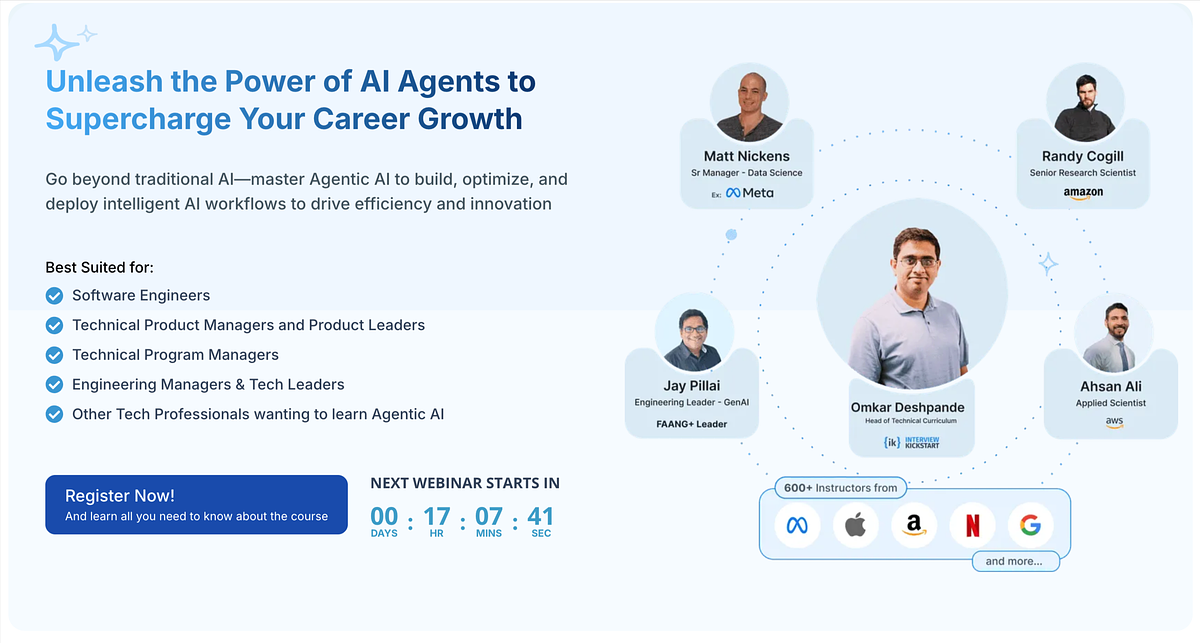
With traditional university curricula struggling to keep pace with the rapid evolution of AI, a new ecosystem of specialized training providers is emerging to fill the void. These platforms aim to rapidly upskill experienced professionals, providing the practical, production-ready skills that companies urgently need. Recognizing this critical demand, edtech platform Interview Kickstart has launched the Agentic AI Career Boost, a 14-week program designed for seasoned technology professionals.
The program's curriculum is a direct response to the specific roles industry is hiring for. It offers distinct tracks for different professionals: software engineers focus on agent architecture and deployment patterns; platform engineers study infrastructure design for agentic workloads; and DevOps engineers learn operational governance for autonomous environments. The program also includes tracks for engineering managers and technical program managers, equipping them with both the technical foundations and the leadership strategies required to guide their teams through this transition.
This model, which combines live instruction from industry practitioners with hands-on projects, reflects a broader trend in technical education. As AI continues to advance at a breakneck pace, the ability to access structured, expert-led training has become a crucial tool for both individuals seeking career advancement and companies striving to remain competitive. The window for proactive upskilling is narrowing, and the engineering leaders who invest in building this expertise today are positioning their organizations to lead in the autonomous era. As these systems become a foundational component of modern technology stacks, agentic AI expertise is no longer a niche specialization but a defining capability for the future of engineering.