
- 4 hours: Average productive computer-based work per day in an 8-hour workday.
- 6.5 hours: Productive computer time on teams with clear management structures (a 60% increase).
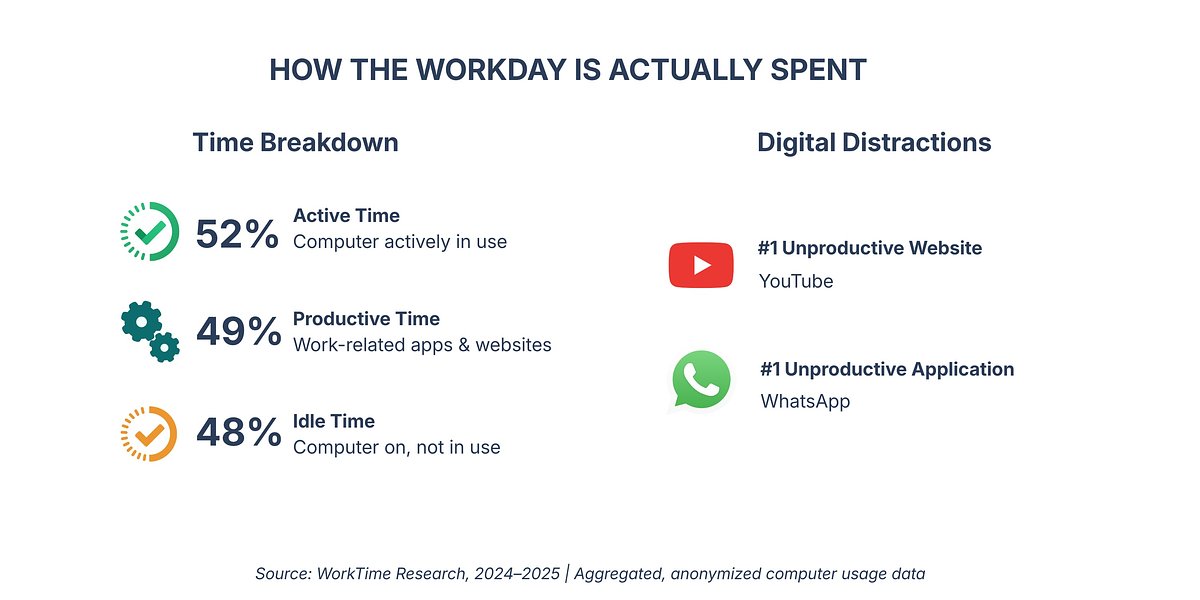
- 49%: Percentage of working time spent on productive applications or websites.
Experts agree that low productivity is primarily a management issue, not an employee effort problem, and that clear structures and well-defined workloads significantly boost output.
The 4-Hour Workday: Is Management, Not Staff, to Blame for Low Output?
TORONTO, ON – February 11, 2026 – In the standard eight-hour workday, the average office employee accomplishes just four hours of productive computer-based work. This stark finding comes from a new, large-scale report by workforce analytics firm WorkTime, which suggests that the root cause of low productivity isn't employee distraction, but a fundamental failure in management and organizational structure.
The research, based on real-world computer usage data from 2024-2025 across multiple industries and countries, challenges the long-held assumption that productivity is solely the employee's responsibility. Instead, it places the onus squarely on leadership.
"What this data shows is that low productivity is not primarily a time problem - it's a management problem," stated Kirill Nesterenko, Founder of WorkTime, in the company's press release. "Most employees are not unproductive; they are understructured. When expectations, workload, and priorities are clearly defined, productive computer time increases without requiring longer workdays."
A Crisis of Structure, Not Effort
The WorkTime study highlights a significant opportunity for improvement. It found that on teams with clearer management structures and well-defined workloads, productive computer time soared to six and a half hours per day—a more than 60% increase—all achieved within the same standard workday. This suggests the productivity gap is not a fixed reality but a variable dependent on leadership effectiveness.
Experts in organizational behavior have long argued that clarity is a cornerstone of performance. When employees have a precise understanding of their roles, goals, and the key performance indicators (KPIs) they are measured against, their motivation and output naturally increase. Conversely, ambiguous roles and poorly distributed workloads create an environment ripe for disengagement and inefficiency.
When tasks are not assigned based on capacity and skill, a company can face a dual crisis: critical employees become overburdened and burn out, while others with lighter loads become disengaged. The WorkTime data provides quantitative evidence for this phenomenon, demonstrating that unstructured time is often filled with non-productive activities, not because of a lack of will, but a lack of direction.
Decoding the Digital Day
The report offers a granular look at how the typical workday unfolds on a computer. On average, only 49% of an employee's total working time is spent on applications and websites deemed productive. Active computer time—when an employee is physically using the mouse or keyboard—accounts for just 52% of the day. The remaining 48% is classified as 'idle time,' where the computer is on but not in use.
This idle time and the hours spent on non-productive tasks point to a significant amount of the workday being lost. The study identified the most common digital diversions, with YouTube ranking as the number one unproductive website globally and WhatsApp as the top unproductive application. While it's easy to blame the allure of social media and streaming, the research suggests these are symptoms, not the disease. In the absence of clear tasks or during lulls between assignments, employees naturally gravitate toward these digital outlets.
It is also crucial to distinguish the report's metric of 'productive time' from general 'screen time.' Other studies show individuals spending upwards of seven hours a day on screens, but that figure includes personal use and entertainment. WorkTime's focus on work-specific applications provides a more sobering measure of actual output during paid hours.
The Double-Edged Sword of Monitoring
The insights provided by WorkTime are derived from workforce analytics software—a category of tools often referred to as employee monitoring software. This technology, which logs computer activity, has become increasingly prevalent, particularly with the rise of remote work. The global market for such software is projected to exceed $10 billion by 2025, with companies like ActivTrak, Teramind, and Hubstaff competing alongside WorkTime.
While these tools can provide valuable data for optimizing workflows, they also walk a fine ethical line. Privacy advocates and employee rights groups raise serious concerns about the potential for over-surveillance, which can erode trust, increase stress, and damage morale. When employees feel they are constantly being watched, it can lead to 'productivity theater'—appearing busy for the sake of monitoring software—rather than fostering genuine innovation and engagement. Studies have shown that electronically monitored employees can experience lower job satisfaction and higher levels of anxiety.
To mitigate these risks, experts recommend a transparent approach. Best practices involve clearly communicating what is being monitored and why, obtaining employee consent, and using the data to improve systems rather than to punish individuals. The most successful implementations focus on analyzing aggregate team data to identify bottlenecks and structural issues—precisely the 'management problem' WorkTime's research highlights—instead of micromanaging individual activity.
Unlocking Potential Without Longer Hours
The ultimate message of the WorkTime report is one of opportunity. It suggests that businesses seeking to boost efficiency should look inward at their own management practices before scrutinizing employee time sheets. The path to reclaiming the lost hours of the workday does not lie in demanding longer days or banning distracting websites, but in building a more structured and supportive work environment.
For leaders, this means investing time in strategic planning, ensuring workloads are distributed equitably, and communicating priorities with absolute clarity. It requires shifting the management focus from policing activity to empowering performance.
By using data to diagnose and fix systemic issues, companies can unlock the latent potential within their workforce. The research indicates that employees are ready and willing to be productive; they are often just waiting for the clear direction that only effective management can provide.