
- $2 trillion: Annual global economic drag due to lack of digital identity in infrastructure
- $400 billion: Estimated annual cost to the U.S. residential housing market
- $580 trillion: Estimated global value of infrastructure assets
Experts agree that the absence of a persistent digital identity for infrastructure assets creates systemic inefficiencies, leading to significant economic losses and operational challenges, and that adopting a standardized identity framework could transform asset management.
The $2 Trillion Identity Crisis Haunting Global Infrastructure
DALLAS, TX – March 06, 2026 – A hidden flaw in the world’s buildings, bridges, and homes - a lack of a consistent digital identity - is creating a staggering $2 trillion drag on the global economy each year, according to a new economic analysis. The report, released by Dallas-based research and technology firm UMIP Inc., argues that this “infrastructure identity gap” is a primary source of massive, systemic inefficiency across the planet's largest asset class.
The study, titled "The $2 Trillion Infrastructure Identity Gap," posits that unlike cars with their Vehicle Identification Numbers (VINs) or aircraft with their registration identifiers, the vast majority of built assets lack a persistent digital anchor. This oversight causes critical lifecycle information to become fragmented and lost as properties are designed, built, insured, sold, and renovated over decades. The result is a costly cycle of duplicated work, verification delays, and missed opportunities for data-driven management.
"Many infrastructure assets exist for decades and generate extensive documentation throughout their lifecycle," said Trevor Vick, Founder of UMIP Inc., in the report's announcement. "But unlike vehicles or aircraft, infrastructure assets rarely maintain a persistent identity capable of anchoring those records across stakeholders and systems."
The Anatomy of a Global Inefficiency
The problem begins the moment an asset is conceived. Throughout its life, a single building generates a colossal trail of data: architectural blueprints, engineering specifications, construction records, inspection reports, insurance policies, maintenance logs, and renovation histories. However, this information is rarely stored in one place. Instead, it is scattered across dozens of disconnected systems managed by architects, contractors, municipal offices, insurers, owners, and facility managers.
When a building changes hands, this fragmented history creates significant friction. Due diligence for real estate transactions becomes a costly and time-consuming scavenger hunt for documentation. Insurers struggle to accurately verify an asset's construction and maintenance history, potentially leading to higher premiums. When a pipe bursts or a system fails, maintenance teams may lack the original schematics needed for a quick and efficient repair, leading to diagnostic delays and more extensive damage.
The UMIP study models these inefficiencies, estimating they cost the U.S. residential housing market approximately $400 billion annually and commercial infrastructure another $300 billion. While the $2 trillion global figure is a new and specific claim, the underlying premise is well-supported by broader industry analysis. For years, firms like McKinsey & Company have highlighted the construction industry's lagging productivity, estimating that inefficiencies and a lack of digitization cost the global infrastructure sector over $1 trillion annually. Similarly, analyses from Deloitte have pointed to compromised outcomes when operational and capital expenditure decisions are made in data silos.
This fragmentation represents a systemic failure to manage the world's most valuable assets, estimated to be worth over $580 trillion globally. Each small inefficiency, when multiplied across millions of properties, compounds into a multi-trillion-dollar economic leak.
A Lesson from the Assembly Line and Airfield
The concept of a persistent digital identity is not new; it is the proven backbone of other asset-intensive industries. The 17-character VIN, standardized globally in the 1980s, transformed the automotive industry. It created a universal language that allows manufacturers, regulators, insurers, and consumers to track a vehicle’s history, manage safety recalls, prevent theft, and verify its features and specifications. This transparency and data continuity is fundamental to the modern automotive market.
Likewise, the aviation industry relies on a strict system of aircraft registration identifiers. These tail numbers are non-negotiable anchors for an aircraft's entire history, including its manufacturing details, maintenance records, flight hours, and regulatory compliance. This rigorous tracking is essential for ensuring safety and managing the operational lifecycle of assets that are worth millions and carry human lives.
Experts argue that the built environment has fallen behind. The absence of an equivalent system for a house, an office tower, or a municipal water system means that these assets, which often have lifespans exceeding a century, effectively suffer from a form of institutional amnesia with each change in ownership or management software. The proposed solution aims to cure this by establishing a similar foundational trust layer for static infrastructure.
The Quest for a Digital Bedrock
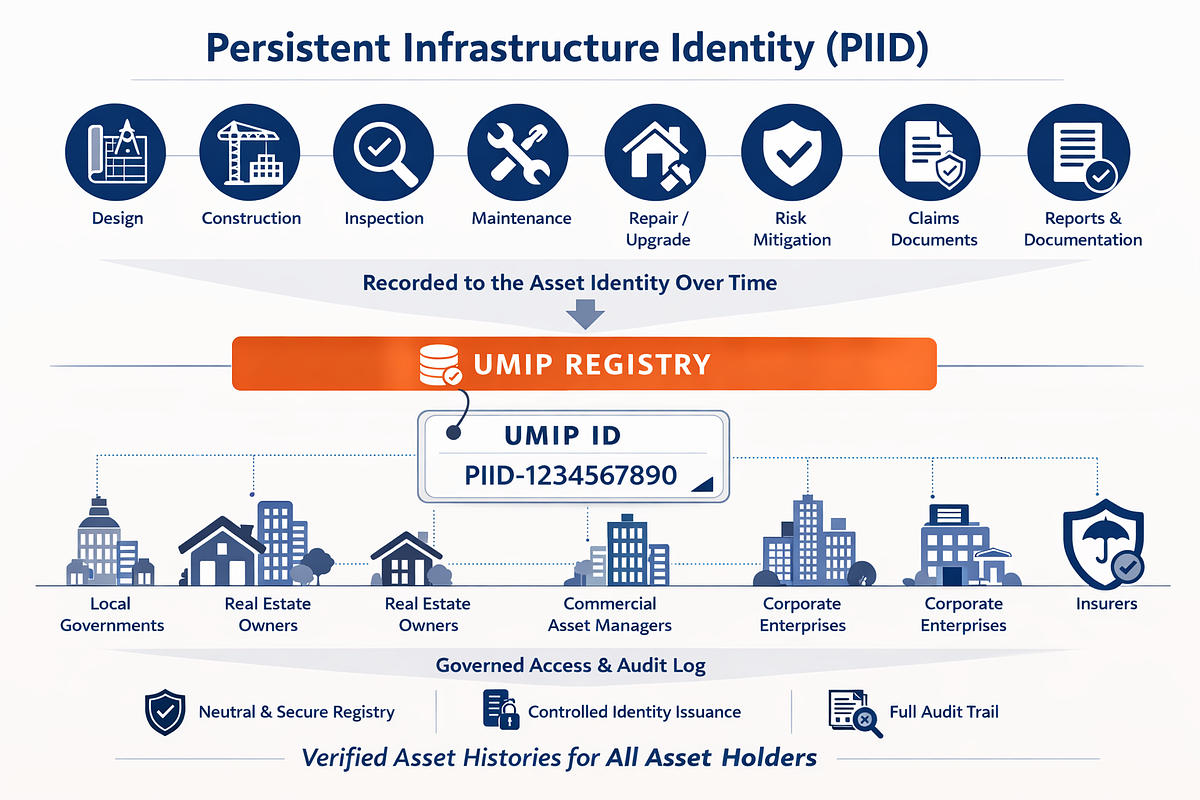
UMIP Inc. proposes a solution it calls "Persistent Infrastructure Identity" (PIID), a framework for assigning a unique, permanent identifier to every infrastructure asset. This ID would serve as a digital anchor, allowing all lifecycle documentation - from initial engineering plans to the latest inspection report - to be linked to the physical asset, regardless of who owns it or what software they use.
This "Infrastructure Identity Layer" is not intended to replace existing technologies like Building Information Modeling (BIM), digital twins, or the Internet of Things (IoT). Instead, it is designed to be a foundational layer that makes them more effective. A BIM model is incredibly valuable during design and construction, but its data can become inaccessible or outdated after the project handover. A digital twin relies on a continuous stream of data, which is difficult to maintain without a stable reference point. PIID would provide that common, enduring reference, allowing different systems and platforms to communicate about the same underlying asset.
However, implementing such a framework faces monumental hurdles. The sheer diversity of the built environment, from single-family homes to complex industrial plants, makes standardization a daunting challenge. Issues of data governance, privacy, and cybersecurity would need to be resolved. Perhaps most significantly, it would require unprecedented collaboration and buy-in from a fragmented ecosystem of stakeholders, many of whom have relied on proprietary systems and workflows for decades.
Despite these challenges, the push for digitization is a powerful enabler. As sustainability goals, risk management, and market pressures demand greater transparency, the economic incentive to solve this problem becomes undeniable. The report suggests that as infrastructure systems continue to modernize, the market for identity frameworks could represent a potential $500 billion global digital infrastructure category, providing a powerful motive for innovation and innovation.
Topics & Related
AI & Machine Learning
Insurance
Related Company Pulse