
- $100,000: Amount spent by Friends of Zion on pro-Trump billboards in 2017
- February 28, 2026: Start date of the joint US-Israeli military offensive against Iran
- June 2025: Month of the 'Twelve-Day War' between Israel and Iran
Experts would likely conclude that the billboard campaign reflects the enduring influence of Christian Zionism in shaping US-Israel relations, particularly through high-profile political messaging and evangelical support for Trump's pro-Israel policies.
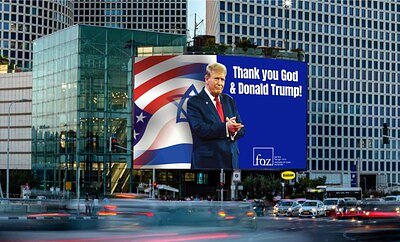
‘Thank You Trump!’ Billboards Blanket Israel Amidst Iran War
JERUSALEM – March 12, 2026 – By Sandra Patterson. As Israel and the United States engage in a wide-scale military conflict with Iran, a new and highly visible message has appeared along the nation's highways: "Thank You God & Donald Trump!" The nationwide billboard campaign, featuring a photo of the former US President, is the latest initiative from Dr. Mike Evans, founder of the Friends of Zion Heritage Center and a prominent American evangelical leader with deep ties to Trump.
A Message of Gratitude in a Time of War
The large-format billboards have been strategically placed at major intersections and along key arteries in Jerusalem and Tel Aviv, ensuring maximum visibility. The campaign was launched by the Friends of Zion organization to, in their words, express gratitude for what they describe as a historic moment in the Middle East.
The timing is significant, coming just weeks into the "2026 Iran war," a conflict that represents a dramatic escalation of long-simmering tensions. The current phase began on February 28, 2026, when a joint US-Israeli military offensive targeted Iran's nuclear and military infrastructure. This followed a series of direct confrontations that began in 2024 and included a "Twelve-Day War" in June 2025. The ongoing war has expanded across the region, with Iranian retaliatory strikes targeting Israel and US bases in several Gulf states.
In a statement accompanying the campaign's launch, Dr. Evans framed the events in biblical terms. "This is nothing less than a Purim miracle," he said. "The courage and leadership shown by President Trump, combined with the faith of millions who believe in God's protection over Israel, are changing the course of history in the Middle East." Evans suggested the conflict could lead to "freedom for the Persian people and greater security for the Jewish people in Israel."
The Enduring Influence of Christian Zionism
The campaign is a powerful illustration of Christian Zionism, a theological and political movement that has become a formidable force in shaping US foreign policy toward Israel. Dr. Mike Evans is a central figure in this movement, leveraging his Jerusalem-based Friends of Zion Heritage Center and his massive social media following through the Jerusalem Prayer Team to advocate for a strong, faith-based US-Israel alliance.
According to the press release, Evans arrived in Israel on February 26, just two days before the joint offensive began, stating his intention was to stand in solidarity with Israelis. He traveled the country with a camera crew, documenting missile impact sites, visiting wounded civilians, and meeting with soldiers and Holocaust survivors. Following his visit, he traveled to Washington, D.C., to continue what his organization calls "public and diplomatic efforts in support of Israel."
This blend of on-the-ground documentation, public relations campaigns, and direct political lobbying is characteristic of Evans's work. By positioning himself as a key conduit between the Israeli experience and the global evangelical community, he reinforces a narrative that resonates deeply with his base: that supporting the modern state of Israel is a religious and moral imperative, and that political leaders who align with this view are fulfilling a historic, even divine, purpose.
A History of Political Messaging
This is not the first time Friends of Zion has used billboards to inject a political message into the Israeli landscape. The organization has a history of high-profile campaigns designed to celebrate and influence US-Israel relations, often centered on Donald Trump.
In 2017, as Trump prepared for his first presidential visit to Israel, the group spent a reported $100,000 on billboards with messages like "Trump Is A Friend of Zion" and "Jerusalem Welcomes Trump." The campaign was widely seen as a public nudge to remind the then-president of his campaign promise to move the US embassy to Jerusalem—a promise he later fulfilled. That same year, Evans presented Trump with the prestigious Friends of Zion Award in the Oval Office.
Another notable campaign invoked ancient history, declaring "Cyrus the Great is Alive." This referenced the biblical Persian king who allowed Jews to return to Jerusalem from exile, explicitly drawing a parallel between the ancient ruler and modern political figures seen as protectors of the Jewish state. This framing is central to the Christian Zionist worldview, which often interprets contemporary geopolitical events through a biblical lens. More recently, in February 2025, billboards with the simple message "Thank You, Mr. President" appeared in Tel Aviv after Trump made controversial statements about taking over Gaza, generating a mix of praise and alarm within Israeli society.
Trump, the War, and Geopolitical Stakes
The "Thank You God & Donald Trump!" campaign serves to solidify the former president's image as an unwavering champion of Israel, particularly among his core constituency of American evangelical voters. For this powerful voting bloc, Trump's pro-Israel policies—including the embassy move and the Abraham Accords—are not just foreign policy achievements but validations of their deeply held beliefs.
The billboards appear as Trump himself has weighed in on the war, reportedly framing the conflict as an opportunity for the Iranian people to overthrow their government. This public display of gratitude from a pro-Israel group on the ground can be seen as a powerful political asset, reinforcing the narrative that his leadership, whether in or out of office, is crucial for Israel's security.
While the immediate reaction from the Israeli public and political establishment is still unfolding, the billboards underscore the complex and often controversial entanglement of American domestic politics, evangelical faith, and the strategic realities of the Middle East. In the midst of a devastating regional war, the larger-than-life images of a former US president serve as a potent symbol of an alliance that continues to be shaped by forces far beyond traditional diplomacy.