
- $80 billion+: Thailand's annual tourism sector revenue.
- 28 billion baht ($770 million): Revenue generated by the 2025 Songkran festival, drawing nearly 3 million people.
- 20%: Income increase for local communities in pilot regions under TAT's 'Village to the World #SustainableAgenda'.
Experts would likely conclude that Thailand's strategic integration of niche cultural heritage with cutting-edge technology offers a sustainable model for diversifying tourism and fostering equitable economic growth.
Thailand's New Playbook: Stars, Drones & A Bid for the Global Stage
BANGKOK, Thailand – December 16, 2025
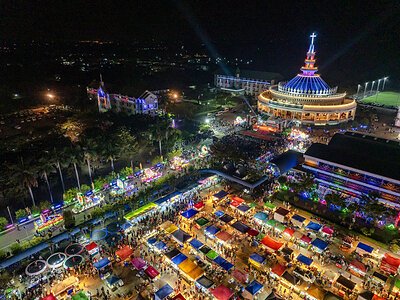
In the quiet northeastern province of Sakon Nakhon, a century-old Christian tradition is being prepared for the global spotlight. The annual Christmas Star Parade, a vibrant local procession of illuminated floats, is the latest and perhaps most telling asset in Thailand's ambitious new economic playbook. The Tourism Authority of Thailand (TAT) is investing heavily to transform this regional festival into an international spectacle, complete with AI-driven installations and drone light shows.
This move is far more than a simple tourism promotion. It represents a calculated strategic pivot, a case study in how a nation can leverage niche cultural heritage, amplify it with technology, and create new, sustainable revenue streams far from the crowded beaches and well-trodden temple routes. For investors, entrepreneurs, and strategists navigating the new economy, the Sakon Nakhon initiative offers a blueprint for unlocking value in authenticity itself.
The 'Signature Event' Playbook: Diversifying a Tourism Empire
The push to globalize the Christmas Star Parade is a core component of TAT's 'Signature Event Thailand' initiative, a national strategy designed to diversify the country's $80 billion-plus tourism sector. For decades, Thailand's brand has been synonymous with idyllic islands and historic capitals. While immensely successful, this model has also led to challenges of overtourism and economic concentration in specific regions, as seen in places like Phuket and Maya Bay.
The new strategy aims to de-risk and expand the portfolio by identifying and scaling unique cultural events into world-class attractions. The model has already proven its power. The Songkran festival, recently elevated by a UNESCO Intangible Cultural Heritage designation, saw its 2025 celebration draw nearly three million people and generate over 28 billion baht (approx. $770 million) in tourism revenue. Similar ambitions are in place for the Loi Krathong light festival, which is being positioned as a premier Asian cultural event.
By adding the Sakon Nakhon parade to this portfolio, TAT is demonstrating a sophisticated approach to asset management. It is identifying underleveraged cultural capital—in this case, the surprising and deep-rooted Christian heritage in a predominantly Buddhist nation—and strategically investing in its development. This isn't just about attracting more visitors; it's about attracting new segments of global travelers interested in deep cultural immersion, and distributing the economic benefits to less-developed regions.
From Local Tradition to Global Spectacle: Tech as an Amplifier
At the heart of the festival lies a tradition stretching back over a century in Tha Rae, home to Thailand's largest Roman Catholic community. Founded in 1884 by a French missionary, the village's heritage is visible in its European-style architecture and the deep faith of its residents. The parade itself, inspired by the Star of Bethlehem, began in 1982 and has grown into a cherished expression of community identity, with locals crafting hundreds of elaborate, star-decorated floats.
Rather than supplanting this history, TAT's intervention uses technology as an amplifier. The 2025 festival, running from December 20-24, will see the historic Cathedral of St. Michael the Archangel and century-old stone houses illuminated with immersive lighting installations. AI-driven photo spots will offer interactive experiences, while a meticulously choreographed drone light show will provide a modern, sustainable alternative to fireworks.
"The Christmas Star Parade reflects the enduring spirit and creativity of the Tha Rae community," said TAT Governor Ms. Thapanee Kiatphaibool in the official announcement. "By elevating its storytelling and visitor experiences, we aim to introduce this remarkable tradition to wider international audiences." The strategy is clear: use technology not as a sterile overlay, but as a tool to deepen the narrative and make the event's rich history more accessible and compelling on a global stage. This fusion of ancient heritage with cutting-edge innovation is a hallmark of the new experience economy, where authenticity is the core product and technology is the delivery mechanism.
The Economics of Authenticity: Investing in Community and Sustainability
Crucially, TAT's plan explicitly frames the project around "sustainable economic benefits for local communities." This language signals a move away from extractive tourism models toward a more integrated, ESG-aligned approach. The festival's structure is designed to ensure capital flows directly into the local economy. A five-day program includes walking streets filled with stalls for local indigo textiles, regional cuisine, and community-made products.
This model is informed by TAT's broader "Village to the World #SustainableAgenda," an initiative that has already demonstrated success in raising community incomes by over 20% in pilot regions. The Sakon Nakhon event incorporates hands-on workshops where visitors can learn to make star ornaments or jewelry from recycled materials, fostering a sense of participation while reinforcing the community's central role.
This approach serves as a deliberate counter-narrative to the potential pitfalls of commercialization and over-tourism. By embedding economic opportunities within the community and making sustainability a core feature—from recycled material workshops to the use of drones over fireworks—the initiative aims for a more resilient and equitable form of growth. It is a model that seeks to preserve the cultural asset it promotes, recognizing that the festival's long-term value is inextricably linked to the vitality and willing participation of the Tha Rae community.
Unlocking Hidden Value: The Case for Niche Cultural Assets
Ultimately, the Sakon Nakhon Christmas Star Parade is a test case for a much larger economic idea: that in a globalized world saturated with homogenous experiences, the most valuable assets are often unique, localized, and authentic. The story of a Christian enclave in northeastern Thailand, founded by a French missionary and Vietnamese migrants, is not a typical Thai tourism narrative. It is precisely this uniqueness that makes it a high-potential asset.
By investing in the infrastructure, technology, and marketing to bring this story to the world, Thailand is tapping into a growing market of travelers who seek more than just relaxation. They seek connection, understanding, and participation in stories different from their own. The success of this venture could provide a powerful proof-of-concept for other regions and nations looking to diversify their economies. It suggests that the next wave of growth in the experience economy may not come from building new theme parks, but from carefully curating and celebrating the rich, often hidden, cultural heritage that already exists.
The illuminated stars parading through Tha Rae this December will represent more than just a holiday celebration; they will be beacons of a new economic strategy, one that wagers on the power of authentic culture, amplified by modern technology, to chart a sustainable path forward.