
- 80% of IT budgets consumed by legacy system maintenance
- Three-stage AI integration roadmap for voice services
- Billions in investment required for 5G Standalone core upgrades
Experts agree that telecom operators must adopt AI-driven, converged networks to remain competitive and avoid obsolescence, though significant technical, financial, and regulatory challenges remain.
Telecom's New Mandate: Reinventing Voice with AI and Converged Networks
BARCELONA, Spain – March 13, 2026 – The humble phone call, long overshadowed by data plans and streaming services, is poised for a radical reinvention. At the Mobile World Congress (MWC) 2026, a new white paper from leading analytics firm GlobalData has laid out a stark new reality for telecommunication operators: embrace a converged, AI-driven future for voice services, or risk obsolescence.
The report, titled Reinventing Voice: A Converged, AI-Enabled, and Multimodal Voice Core for the Next Generation of Telecommunications, was unveiled by Andy Hicks, Senior Principal Analyst at GlobalData. It argues that the dual forces of 5G-Advanced (5G-A) and artificial intelligence are creating an unprecedented opportunity for telcos to reclaim value, innovate beyond the capabilities of Over-The-Top (OTT) applications like WhatsApp and FaceTime, and fundamentally change how we communicate.
The Strategic Imperative for a Unified Network
For years, telecom operators have been grappling with a complex and costly problem: managing a patchwork of network technologies. While 5G and 5G-A represent the future, many carriers are still required to maintain 2G and 3G networks to support legacy services, M2M communications, and crucial international roaming agreements. This creates operational silos, drives up expenses, and stifles innovation.
According to the GlobalData white paper, the solution lies in a "fully converged voice network." This architectural approach unifies voice services across all generations—from 2G to 5G—onto a single, streamlined platform. Such a move is no longer just an option but an essential step for survival and growth. By consolidating their infrastructure, operators can drastically reduce their Total Cost of Ownership (TCO) and simplify operations.
Furthermore, this converged architecture is critical for the industry's broader shift from virtual machines (VMs) to more agile, cloud-native containers. A unified core facilitates this transition, allowing for continuous innovation and rapid updates to voice services—a pace necessary to compete with nimble software companies. "By leveraging a fully converged voice network as a foundation, they can foster service innovation and fully rejuvenate the core value of voice services," Hicks stressed during the announcement. This new backbone is designed not just for efficiency, but to serve as the launchpad for a new generation of intelligent services.
A Three-Stage Evolution: How AI Will Transform the Call
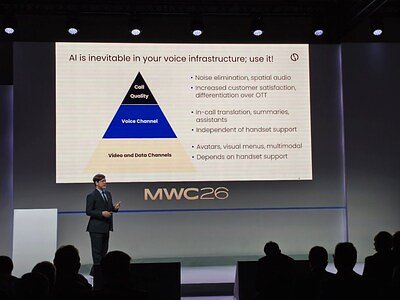
The true transformative potential of this new network foundation is unlocked by artificial intelligence. The white paper outlines a clear, three-stage roadmap for integrating AI into the very fabric of voice communication, moving it from a simple utility to an intelligent, value-added experience.
The first stage focuses on improving the fundamentals to surpass the quality offered by OTT players. This includes AI-powered intelligent noise suppression that can flawlessly isolate a speaker's voice in a crowded stadium, or enhanced spatial audio that creates a more immersive, "in-the-room" feeling for conference calls.
In the second stage, AI is integrated directly into the audio channel to introduce groundbreaking features without requiring any new hardware or apps on the user's end. The most prominent example, already being pioneered by operators like T-Mobile and showcased by Deutsche Telekom at MWC, is real-time, network-based call translation. This allows two people speaking different languages to converse naturally over a standard phone call. Other features include intelligent call summaries automatically generated and sent to participants, saving time and improving productivity.
The final stage envisions a shift from single-modal audio to multimodal, interactive experiences, a concept termed "Call-as-a-Service." Here, AI integrates with video and data channels during a call to enable powerful new applications. Imagine an interactive customer support call where an AI agent can visually guide a user through a repair, or a telehealth consultation where a healthcare assistant AI monitors vital signs transmitted via a data channel during the call. This is already taking shape with initiatives like the "Ubiquitous AI Health Assistant" developed by China Mobile and Huawei, which uses the network's data channel to facilitate real-time medical AI interactions.
From Theory to Reality: The Industry Rushes to Innovate
GlobalData's report is not an isolated forecast; it reflects a powerful current sweeping across the entire telecommunications industry. MWC 2026 has been dominated by discussions of network-level AI, with major vendors showcasing solutions that align with this vision.
Huawei, for example, has heavily promoted its "AI-Centric Network" strategy, including its "AgenticCore" solution that embeds AI directly into the network brain to drive what it calls "experience monetization." The goal is to move beyond simply selling data traffic and instead monetize unique, AI-enhanced experiences that only a sophisticated carrier network can provide.
The industry standards body, GSMA, has also lent its weight to the movement, releasing new specifications for AI Calling applications. This provides a framework for operators to develop and deploy services like real-time translation and noise reduction natively, ensuring interoperability and a consistent user experience. This broad industry alignment signals that the shift is well underway, moving from theoretical white papers to tangible product roadmaps and service launches.
Navigating the Path to Modernization
While the vision of an AI-powered voice future is compelling, the path for operators is fraught with significant challenges. The primary hurdle is the immense cost and complexity of overhauling legacy infrastructure. These outdated systems, which can consume up to 80% of an IT budget just for maintenance, were never designed for the demands of AI and cloud-native operations. The investment required for a full 5G Standalone (SA) core and edge computing sites can run into the billions for a single operator.
Beyond the financial and technical hurdles lies a critical talent gap. The telecommunications sector faces a shortage of skilled AI professionals needed to build, manage, and secure these new intelligent networks. This is compounded by organizational inertia, where traditional, siloed departments may resist the convergence required for a unified infrastructure.
Finally, privacy and security are paramount. Services that process live conversations for translation or analysis touch upon highly sensitive data. While providers insist that data is not stored and AI models are not trained on customer conversations, gaining and maintaining public trust will be essential. Operators must navigate a complex web of regulations like GDPR and the EU's AI Act, ensuring that innovation does not come at the expense of user privacy and data protection. For telecom operators, the race is on to navigate these obstacles and redefine their role in an increasingly intelligent and connected world.