
- 40% reduction in operational emissions by 2025, ahead of TECO's 2030 target of 50% reduction
- 17 MW of solar power capacity installed globally by 2025, contributing to renewable energy goals
- NT$1,600 (USD $50) internal carbon price applied to drive low-carbon innovation
Experts would likely conclude that TECO's strategic integration of sustainability into its core operations sets a benchmark for legacy industrial firms transitioning to a net-zero economy, demonstrating measurable progress through aggressive decarbonization targets and innovative governance mechanisms.
TECO's ESG Playbook: How a 70-Year-Old Giant Redefines Sustainability
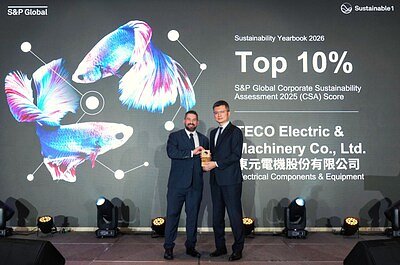
TAIPEI, Taiwan – May 13, 2026 – As TECO Electric & Machinery Co., Ltd. celebrates its 70th anniversary, the industrial heavyweight is proving that longevity and innovation are not mutually exclusive. The company has secured prestigious dual recognition for its environmental, social, and governance (ESG) performance, earning a spot in the 2026 S&P Global Sustainability Yearbook for the sixth time and being selected for the Dow Jones Best-in-Class Indices (DJBICI).
These accolades, presented at a ceremony in Taipei, move beyond mere corporate commendation. They highlight a meticulously crafted strategy that embeds sustainability into the core of TECO's operations, offering a blueprint for how legacy industrial firms can pivot to become leaders in the global transition to a net-zero economy. The recognition is based on a rigorous evaluation of thousands of companies worldwide, placing TECO among the top performers in its sector.
TECO Chairman Morris Li framed this achievement not as a culmination, but as a continuous journey. "Sustainable development is a core element of TECO's long-term competitiveness," Li stated. He emphasized that the company's focus on electrification, intelligence, and green energy will guide further advancements in ESG governance and operational carbon reduction, strengthening its resilience.
Setting an Aggressive Pace for Decarbonization
TECO's sustainability claims are backed by aggressive, measurable targets that are already yielding significant results. The company has committed to a formidable goal: reducing its operational emissions by 50% over a ten-year period by 2030. Demonstrating remarkable progress, TECO had already surpassed a 40% reduction by 2025, putting it well ahead of schedule.
This rapid decarbonization is powered by a dual strategy of reducing consumption and greening its energy sources. The company is steadily advancing toward its 2030 goal of having renewable energy account for 30% of its total electricity consumption. A key driver of this is the continued installation of solar power generation facilities at its own sites, with the global installed capacity exceeding 17 MW in 2025. This proactive investment in self-generation not only lowers the company's carbon footprint but also insulates it from the volatility of traditional energy markets.
These efforts are significant when benchmarked against both industry peers and national mandates. While many companies in the heavy-industry sector are still in the planning stages of their climate transitions, TECO's tangible achievements position it as a frontrunner. Its actions also align directly with Taiwan's national ambition to achieve net-zero emissions by 2050, making the company a critical private-sector partner in the island's climate strategy.
Putting a Price on Carbon: A Mechanism for Change
Perhaps the most innovative component of TECO's strategy is its move to internalize the cost of pollution. The company has implemented a sophisticated internal carbon pricing mechanism, setting a price of NT$1,600 (approximately USD $50) per metric ton of CO2 equivalent. This is not a theoretical or 'shadow' price; it is a tangible cost applied within the company's financial planning.
This mechanism forces managers and engineers to factor the cost of carbon into every decision, from equipment procurement and process design to daily operational routines. To complement the carbon price, TECO established an internal carbon fund. The revenue generated from the internal carbon fee is funneled into this fund, which is then used to finance projects focused on energy management, renewable energy adoption, and low-carbon innovation.
This self-sustaining loop creates a powerful engine for change. Last year alone, the mechanism spurred the launch of three new low-carbon proposals, which are expected to deliver annual carbon reductions approaching 1,000 metric tons of CO2e. By making carbon a line item on the balance sheet, TECO has successfully translated its high-level sustainability commitments into a concrete management tool that drives continuous improvement and innovation from the ground up.
Extending Influence Beyond Factory Walls
Recognizing that a significant portion of any manufacturer's environmental impact lies within its supply chain, TECO has expanded its sustainability initiatives beyond its own operations. For two consecutive years, the company has played a leading role in the "Net-Zero Transformation Promotion Program for the Manufacturing Sector," an initiative by Taiwan's Ministry of Economic Affairs.
Under this program, TECO formed a "1+N Carbon Management Demonstration Team." In this model, TECO acts as the central hub ('1') providing expertise and guidance to a network of its supply chain partners ('N'). The company has worked with more than 20 corporate partners, primarily small and medium-sized enterprises (SMEs) that often lack the resources and expertise to embark on a decarbonization journey alone.
TECO's team provides practical support, including in-depth energy-saving guidance and assistance with conducting comprehensive carbon inventory assessments. This foundational step of measuring emissions is critical for partners to understand their own footprint and identify opportunities for reduction. By acting as a mentor and enabler, TECO is not just cleaning up its own value chain but is also helping to build a more resilient and sustainable industrial ecosystem across Taiwan.
Governance as the Cornerstone of Sustainability
Underpinning all of TECO's environmental and social initiatives is a robust governance structure that ensures accountability from the top down. The company's Board of Directors directly oversees all climate-related issues and sustainability strategies, signaling that these topics are treated with the same seriousness as traditional financial and operational matters.
To ensure that strategy translates into action, TECO has established a powerful "governance plus incentives" mechanism. The company has linked concrete ESG key performance indicators (KPIs)—including carbon reduction results, carbon intensity, and green supply chain performance—directly to the performance evaluations and bonuses of its senior executives. This dual approach ensures that sustainability is not just a policy on paper but a core component of organizational management and a driver of operational performance.
This commitment to strong governance has also been recognized externally, with TECO consistently ranking in the top 5% of Taiwan's corporate governance evaluations. As the company looks toward its next stage of growth, it is championing a "B2B2S" (Business to Business to Sustainability) philosophy, positioning its deep ESG integration as a key competitive advantage and a value proposition for its global customers and suppliers moving together toward a net-zero future.