
- 85% of employees expect a pay raise in 2026
- 82% of organizations plan to hire for net-new, AI-focused roles in 2026
- 69% of professionals say their companies take too long to hire
Experts agree that the talent market is undergoing a fundamental shift where compensation alone is no longer the primary driver of employment decisions, with AI integration and workforce flexibility becoming critical factors in attracting and retaining talent.
Talent Market in Reset: AI and Flexibility Redefine Jobs in 2026
NEW YORK, NY – April 21, 2026 – The professional landscape is undergoing a fundamental recalibration, as the once-dominant role of salary is being challenged by the transformative power of artificial intelligence, a growing demand for flexibility, and the costly consequences of slow hiring. A new report from the talent solutions firm 24 Seven signals a workforce in transition, where the rules of competition for talent have been irrevocantly rewritten.
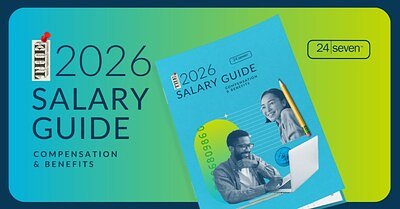
The firm's 2026 Salary Guide: Compensation and Benefits, which surveyed over 2,000 professionals across the marketing, creative, technology, and retail sectors, paints a picture of a complex and sometimes contradictory market. While a staggering 85% of employees expect a pay raise this year, a majority (63%) also believe that employers now hold more leverage in the job market. This tension underscores a deeper shift: compensation, while still critical, is no longer the sole determinant in the employment equation.
Beyond the Paycheck: The New Employee Value Proposition
Today's professionals are increasingly weighing a company's reputation, its commitment to flexibility, and the availability of meaningful work when making career decisions. The 24 Seven report reveals that an overwhelming 76% of employees cite benefits and perks as the primary reason they choose to stay with their current company. This finding is a clear mandate for organizations to look beyond base pay and build a more holistic and compelling employee value proposition.
This trend is not isolated. Broader industry analysis confirms that to attract and retain top performers in 2026, a competitive salary is merely the table stakes. The real differentiators lie in robust benefits packages, genuine work-life balance, and a culture that fosters professional growth and purpose. The companies failing to adapt are not only struggling to attract new talent but are also at a higher risk of losing their most valued team members.
Adding to the pressure is a pervasive inefficiency in the hiring process itself. According to the report, 69% of professionals say their companies take too long to hire. This friction point is more than an annoyance; it has a direct impact on the bottom line. Protracted hiring cycles lead to productivity losses, increased burnout among existing staff, and, most critically, the loss of top candidates to more nimble competitors. Data from prior years already indicated this growing problem, with nearly 40% of companies taking a month or more to fill open roles, a delay that is proving unsustainable in the current climate.
The AI Imperative and the Skills Chasm
Driving much of this market recalibration is the explosive integration of artificial intelligence. AI is no longer a futuristic concept but an embedded reality in the modern workplace. The report highlights this with a striking statistic: 82% of organizations plan to hire for net-new, AI-focused roles in 2026. This surge in demand is creating a new class of jobs and transforming existing ones, from AI/ML engineers and AI strategists to marketing and creative roles that now require a high degree of AI literacy.
This rapid evolution is supported by massive investment, with global spending on AI projected to have increased by over 40% year-over-year. By the end of 2026, industry analysts at Gartner expect 40% of all enterprise applications to feature task-specific AI agents, a dramatic leap from less than 5% in 2025. This indicates a pervasive shift where AI proficiency is becoming a baseline expectation, not a niche specialization.
However, this AI-driven hiring boom presents a significant challenge. Many organizations are struggling to define the skills they need, assess candidate proficiency, and fill these critical roles efficiently. The result is a growing skills chasm, where the demand for AI talent far outpaces the available supply and the organizational capacity to onboard it.
"This is not a slowdown. It's a recalibration," said Anthony Donnarumma, CEO of 24 Seven, in the report's release. "AI is now embedded in how work gets done, and organizations are being tested on how quickly they can translate that into results. The companies pulling ahead are rethinking how they access and deploy talent, not just how they pay for it."
The Rise of the Blended Workforce
In response to the dual pressures of slow hiring and the urgent need for specialized AI skills, savvy organizations are increasingly turning to a more agile and strategic approach to talent: the blended workforce. This model, which combines a core of full-time employees with a flexible contingent of contractors, freelancers, and consultants, is rapidly moving from a peripheral tactic to a central pillar of modern business strategy.
Previous studies showed that nearly 60% of organizations were already relying on a mixed talent model, with over three-quarters frequently utilizing outside resources. In 2026, this trend has only accelerated. In an uncertain macroeconomic environment, the ability to scale teams up or down quickly by tapping into a flexible talent pool provides a crucial competitive advantage. It allows companies to access highly specialized skills—particularly in the fast-moving AI domain—without the long-term commitment and lengthy recruitment process associated with permanent hires.
This shift is fundamentally changing the nature of how work gets done. Flexible talent solutions are no longer a temporary workaround for a single project but a core component of how organizations build and maintain momentum. For specialized tasks, AI implementation, or creative campaigns, bringing in expert consultants or contractors allows businesses to remain agile, innovate faster, and ultimately win the race for market share. As the talent market continues to evolve, the ability to strategically blend full-time and contingent talent will be a defining characteristic of successful organizations.