
- 100-kilowatt (kW) pilot project: Taiwan's first grid-connected wave energy power station at Suao Port.
- NT$7.32 per kilowatt-hour: Highest feed-in tariff for marine energy in Taiwan, set to accelerate commercialization.
- 2.25-hectare site: Repurposed section of Suao Port's breakwater for dual-use as a logistics hub and clean energy power plant.
Experts view this project as a critical test case for wave energy's viability in Taiwan's renewable portfolio, with potential to diversify energy sources and complement solar and wind power.
Taiwan's Green Wave: Suao Port to Host Pioneering Ocean Energy Project
TAIPEI, Taiwan – March 23, 2026 – A quiet but significant step has been taken in Taiwan's quest for energy independence, as waves lapping against the breakwater of Suao Port are set to become a new source of clean electricity. Eco Wave Power Global, a NASDAQ-listed developer of onshore wave energy technology, announced that its local partner has secured a critical land lease, paving the way for the construction of Taiwan's first-ever grid-connected wave energy power station.
The milestone, confirmed today, involves a five-year land lease agreement signed in December 2025 by I-Ke International Ocean Energy Co., a subsidiary of the established Taiwanese firm Lian Tat Company. This agreement provides the legal foundation for a 100-kilowatt (kW) pilot project that will be installed on the port's existing southern outer breakwater. For Taiwan, it represents a tangible move to diversify its renewable portfolio; for Eco Wave Power, it marks a strategic entry into the burgeoning Asia-Pacific energy market.
Taiwan's Renewable Ambitions Meet the Ocean's Might
This project arrives at a pivotal moment for Taiwan's energy policy. The island nation has committed to an ambitious goal of achieving net-zero emissions by 2050, with a mid-term target of generating 20% of its electricity from renewable sources. However, this 2025 target has been pushed to late 2026 and faces potential further delays, largely due to challenges in expanding ground-mounted solar power projects.
This reality has intensified the government's search for viable alternative energy sources. While solar and offshore wind have dominated Taiwan's renewable strategy, the government is actively encouraging the development of geothermal, biomass, and, crucially, ocean energy. To signal its commitment, the Ministry of Economic Affairs (MOEA) set the 2025 feed-in tariff (FIT) for marine energy at NT$7.32 per kilowatt-hour—the highest rate among all renewable categories. This premium tariff is designed to de-risk investment and accelerate the commercialization of nascent technologies like wave power.
The Suao Port project is poised to be a critical test case. Its success could unlock the potential of Taiwan's extensive coastline and provide a predictable, consistent power source to complement the intermittency of solar and wind. By designating a commercial port area for wave power testing for the first time, Taiwanese authorities are positioning the nation as a hub for marine energy innovation.
"We are pleased to advance the Suao Port wave energy project," said CY Huang, Chairman of I-Ke, in a statement. "Taiwan is committed to expanding its renewable energy portfolio, and we believe wave energy can play an important role in supporting the country's clean energy transition."
A Strategic Beachhead in the Asia-Pacific Market
For Eco Wave Power, the Taiwan project is more than just another installation; it is a calculated move into Asia. The company has already proven its technology with Israel's first grid-connected wave energy station and a recently launched pilot at the Port of Los Angeles in collaboration with Shell. With a global project pipeline of over 404 MW, the firm is now looking to replicate its model in new, high-growth regions.
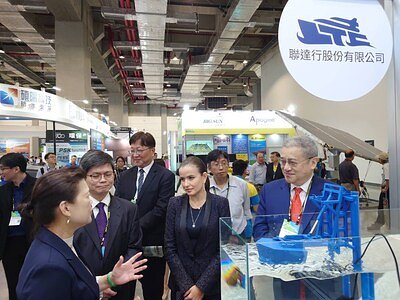
The partnership with a local heavyweight is a cornerstone of this strategy. I-Ke's parent company, Lian Tat Company, brings over 60 years of experience as a resource integrator for Taiwanese industry. Since 1959, Lian Tat has supplied equipment and engineering solutions to key entities including the Taiwanese Navy, Customs, Coast Guard, and the state-owned Taiwan Power Company. Its long-standing presence and expertise in the maritime sector, including a maintenance facility established in Suao itself in 1994, provide invaluable local knowledge and operational credibility.
This collaboration mitigates many of the risks foreign technology firms often face. I-Ke is responsible for navigating the local regulatory landscape, securing permits, and funding the pilot, which is based on a 100 kW conversion unit purchased from Eco Wave Power under a turnkey sale agreement in late 2024.
Inna Braverman, Founder and CEO of Eco Wave Power, highlighted the project's significance. "Taiwan is actively investing in renewable energy solutions, and we are excited to progress this project together with our partner I-Ke and demonstrate how wave energy can be integrated into existing port infrastructure to produce clean electricity."
Repurposing Ports: The New Frontier for Clean Power
The project's most innovative aspect may be its location. Instead of building costly new offshore platforms, Eco Wave Power's technology attaches directly to existing man-made structures like breakwaters, piers, and jetties. The system uses a series of buoyant floaters that rise and fall with the motion of the waves, pushing and pulling hydraulic pistons to generate pressure. This pressure is used to spin a generator, producing electricity that is then fed directly into the grid.
This onshore approach offers several advantages that have positioned it favorably in the market, where onshore systems accounted for over 60% of the market size in 2024. Installation and maintenance are significantly simpler and less expensive than for offshore counterparts that require specialized vessels and divers. Furthermore, the technology incorporates a safety mechanism that automatically lifts the floaters out of the water during storms, protecting the equipment from damage in harsh marine conditions.
The Suao Port project will be situated on a 2.25-hectare site known as Zone C, which I-Ke secured through a competitive selection process in July 2025. By repurposing a section of the port's breakwater, the project aims to demonstrate how maritime hubs can become dual-use facilities—continuing their primary logistics function while also serving as clean energy power plants. This model could become a blueprint for thousands of ports and coastal cities around the world seeking to bolster their sustainability and energy resilience.
With the land lease now secure, the project moves into its next regulatory phase. According to the lease terms, the application for the transfer of land use rights was to be submitted by March 22, 2026, with all necessary port work permits expected to be in hand by October 2026. These next steps will be watched closely by the global renewable energy industry as this pioneering project moves from agreement to implementation.
Topics & Related
Venture Capital
Digital Transformation
Net Zero
Partnership
Joint Venture
Related Company Pulse