
- 588Ah LFP cell: Industry-leading capacity, 40% fewer system components
- 24.8% increase in volumetric energy density: Shrinks station footprint by 17%
- UL 9540A certification: Passed rigorous large-scale fire testing for safety
Experts would likely conclude that Sunwoda's strategic combination of technological innovation, verified safety standards, and regulatory compliance positions it as a formidable contender in the global energy storage market.
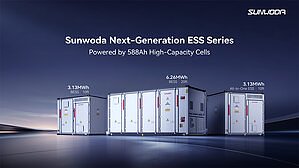
Sunwoda’s Blueprint for Grid Dominance: Density, Safety, and Strategy
MUNICH, GERMANY – June 25, 2026 – In the hyper-competitive arena of global energy storage, product launches are a near-constant hum of activity. Yet, Sunwoda's recent unveiling at ees Europe 2026 cuts through the noise. The company, a BloombergNEF Tier 1 manufacturer, didn't just announce a new product; it presented a meticulously crafted strategy for market leadership, built on the pillars of advanced engineering, verified safety, and astute regulatory navigation. The launch of its next-generation Energy Storage System (ESS) platform, centered on a formidable 588Ah Lithium Iron Phosphate (LFP) cell, is less a simple upgrade and more a statement of intent for the European market and beyond.
Beneath the surface of megawatt-hour ratings and density figures lies a story of permanence and resilience. Sunwoda is demonstrating how to build a durable competitive advantage not just by making a better battery, but by engineering a more bankable, compliant, and deployable system. This move signals a crucial maturation point in the energy storage industry, where technical specifications must be matched by an equally robust framework of safety and sustainability.
Engineering for Economic and Physical Density
The centerpiece of Sunwoda’s announcement is its new portfolio, led by a 20-foot 6.26MWh liquid-cooled Battery Energy Storage System (BESS). This unit, alongside more compact 10-foot 3.13MWh options, is built upon the company’s new 588Ah cell. To appreciate the significance, one must look at the competitive landscape. As of last year, the industry benchmark for grid-scale LFP cells hovered around 280Ah. Sunwoda’s leap to 588Ah places it at the absolute forefront of cell capacity, a move that has cascading benefits.
By using larger, more energy-dense cells, the company has managed to reduce the total number of system components by a remarkable 40% compared to its previous generation. For developers and operators, this translates directly to lower balance-of-plant costs, faster installation, and a fundamentally more reliable system with fewer potential points of failure. The flagship 6.26MWh system achieves a 24.8% increase in volumetric energy density and shrinks the required station footprint by 17%. In an industry where land and construction costs are critical project variables, these are not marginal gains; they are decisive economic advantages.
This performance places Sunwoda in direct, formidable competition with the sector's titans. CATL’s highly regarded Tener system, for instance, offers a comparable 6.25MWh in a 20-foot container, while Tesla’s latest Megapack 3 provides around 5 MWh. Sunwoda’s ability to match or exceed these benchmarks underscores its R&D prowess. The integration of a sophisticated liquid-cooling system is another key differentiator. While air cooling has been a common standard, liquid cooling offers superior thermal management, ensuring uniform temperatures across the battery cells. This precision control is vital for extending the battery's cycle life—a cornerstone of project bankability—and serves as a critical defense against thermal runaway, the primary safety concern for large-scale battery installations.
The Unseen Advantage: Mastering Compliance and Safety
Perhaps the most telling aspect of Sunwoda’s strategy is its concurrent announcement of major safety and compliance milestones. In the modern energy landscape, market access is increasingly dictated not just by price or performance, but by adherence to a complex web of regional and international standards. Sunwoda is proving adept at navigating this terrain.
The company revealed that its 5MWh BESS platform successfully passed large-scale fire testing according to the rigorous ANSI/CAN/UL 9540A:2026 standard. This is not a checkbox exercise. UL 9540A is the industry’s gold standard for evaluating fire propagation risk in battery systems. Achieving this certification from CSA Group provides asset owners, insurers, and regulators with verifiable proof that the system is designed to contain thermal events, a crucial factor for securing project permits and public acceptance.
Even more strategically significant is the certification of its 261kWh ESS series by TÜV Rheinland under the sweeping EU Regulation 2023/1542. This landmark EU legislation moves far beyond basic safety, creating a new paradigm for sustainability and transparency in the battery industry. Compliance requires manufacturers to demonstrate robust lifecycle management, full material traceability, and readiness for a future 'digital battery passport' that will detail a battery's entire history, from raw material sourcing to its carbon footprint and recycling information.
By achieving this certification, Sunwoda has not only secured its entry into the lucrative European market but has also positioned itself as a leader in sustainable manufacturing. As ESG (Environmental, Social, and Governance) criteria become central to investment decisions, this compliance becomes a powerful competitive moat, differentiating Sunwoda from competitors who are slower to adapt to the new regulatory reality.
A Global Strategy Built on Local Execution
This combination of technological leadership and regulatory foresight forms the foundation of Sunwoda’s broader global ambition. The press release points to a strengthening of its “European localization framework,” a clear signal that the company intends to be a permanent fixture in the region's energy transition. This strategy likely extends beyond simply shipping containers from afar.
Building a true local presence involves establishing robust after-sales technical support, creating regional service hubs, and potentially forging partnerships with local system integrators. For customers managing multi-million-dollar grid assets with operational lives spanning decades, the assurance of local, responsive support is non-negotiable. This commitment to localization, paired with its BloombergNEF Tier 1 bankability status, paints a picture of a company building for the long term.
With LFP chemistry now accounting for over 90% of the stationary storage market and battery pack prices continuing to fall, the race is on to capture value through system-level innovation and strategic market positioning. Sunwoda's latest moves demonstrate a clear understanding of this dynamic. The company is competing not only on the performance of its cells but on the intelligence of its system architecture, the integrity of its safety design, and its ability to anticipate and meet the world's most stringent regulatory demands.