
- 72,500 home batteries installed in Australia in 2024 (27% increase from previous year)
- $2.75 billion projected market value by 2033 (up from $500 million in 2024)
- Sungrow’s SBH system self-extinguished within an hour during UL 9540B fire safety test
Experts agree that safety certifications like UL 9540B are becoming essential for residential battery systems, as consumer priorities shift from cost to long-term reliability and peace of mind.
Sungrow Sets New Safety Bar in Australia's Home Battery Boom
HEFEI, China – February 11, 2026 – As government incentives and soaring electricity prices fuel an unprecedented boom in household battery installations across Australia, a critical question is taking center stage: how safe are the systems being installed in our homes? Moving beyond promises and marketing claims, renewable energy giant Sungrow has provided a decisive answer, achieving the stringent UL 9540B fire safety certification for its SBH Series residential energy storage system.
This certification represents more than just a new badge on a product; it signals a significant maturation of the residential energy market. With Australian households installing a record 72,500 home batteries in 2024—a 27% jump from the previous year—the focus is rapidly shifting from upfront cost to long-term safety and reliability. As Finn Peacock, founder of the Australian solar industry platform SolarQuotes, noted, "User focus is shifting from upfront cost and capacity to installation quality and long-term manufacturer accountability." In this evolving landscape, Sungrow's achievement sets a new benchmark for what homeowners can, and should, expect from the technology powering their energy independence.
The New Gold Standard: What is UL 9540B?
For most homeowners, technical certifications can seem like an alphabet soup of standards. However, UL 9540B is a critical differentiator in the world of battery safety. Officially titled "The Outline of Investigation for Large-Scale Fire Test for Residential Battery Energy Storage Systems," it was developed specifically to address the worst-case fire scenarios that concern firefighters and safety regulators.
Unlike other standards that may focus on individual components, UL 9540B evaluates the entire system's ability to handle a catastrophic cell failure—a condition known as thermal runaway. The test is brutal by design. Engineers deliberately induce thermal runaway in a single cell of a fully charged battery system and then observe what happens over a 24-hour period. To make the test even more extreme, active fire suppression systems are disabled, and external ignition triggers are used to see if vented gases will ignite and spread.
To pass, a system must prove it can contain the event without propagating a fire, causing an explosion, or launching projectiles. In the case of Sungrow’s SBH system, it not only met but exceeded these requirements. The system demonstrated no fire propagation and self-extinguished within an hour, proving its inherent safety without reliance on external fire suppression. This level of verified containment is what separates a truly safe system from one that simply meets basic electrical standards.
Australia's Battery Boom and the Safety Imperative
The Australian residential energy storage market is in a period of explosive growth, projected to surge from just over half a billion dollars in 2024 to nearly $2.75 billion by 2033. This expansion is driven by a perfect storm of factors: high penetration of rooftop solar, expiring feed-in tariffs that make self-consumption more valuable, and a suite of federal and state incentives, including the upcoming "Cheaper Home Batteries Program."
However, this rapid adoption places immense pressure on manufacturers to ensure their products are safe for residential use. While statistically rare, battery fire incidents can be severe, involving intense heat and the release of toxic gases. This has led to a crucial shift in consumer and industry priorities.
"For a long time, the conversation was all about kilowatt-hours and payback periods," commented one independent energy analyst. "Now, the conversation is about resilience, reliability, and above all, peace of mind. Certifications like UL 9540B are no longer a 'nice-to-have'; they are becoming an essential proof point for manufacturers who want to be taken seriously. It's about building trust with homeowners who are making a significant, long-term investment in their property and their family's safety."
This shift means that safety is becoming the ultimate competitive differentiator. Companies that can provide third-party, independently verified proof of their system's safety in extreme conditions are poised to lead the market.
Inside the Invisible Firewall: Engineering for Peace of Mind
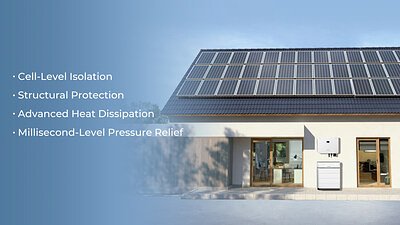
Passing the UL 9540B test is not a matter of chance; it is the result of a deliberate, multi-layered safety architecture engineered from the cell level up. Sungrow's SBH Series functions as an "invisible firewall," incorporating several key innovations to prevent a single fault from escalating into a dangerous event.
Cell-Level Isolation: At the core of the system, each individual battery cell is wrapped in advanced insulation material capable of withstanding temperatures over 800°C. This ensures that if one cell were to fail and enter thermal runaway, the intense heat is contained at its source, preventing a chain reaction from spreading to adjacent cells.
Advanced Heat Dissipation: The system employs a sophisticated thermal design at the base of each battery module. This allows for the rapid and uniform dissipation of heat during normal operation, preventing the buildup of localized hot spots that could increase the risk of thermal runaway in the first place.
Millisecond-Level Pressure Relief: In the event of a cell failure, gases can build up pressure inside the battery module. Sungrow’s unique L-shaped pressure relief channel, combined with strategically placed vents, is designed to safely expel these high-temperature gases within milliseconds. This rapid venting effectively eliminates the risk of an explosion caused by a sudden pressure spike.
Structural Protection: As a final line of defense, the battery enclosure itself is built for extreme durability. A high-strength structural safety latch ensures the unit remains sealed and its integrity is maintained, even if internal pressure rises suddenly, providing a robust physical barrier between the battery and the home.
This comprehensive approach demonstrates a deep commitment to safety that goes far beyond basic compliance. It reflects a design philosophy where potential failures are anticipated and engineered out of the system, providing homeowners with layers of unseen protection. With over a decade of experience in Australia and more than 400,000 homes and businesses powered by its technology nationwide, the company is leveraging its global expertise to address the specific safety concerns of the Australian market. This new certification underscores a commitment to not just providing clean energy, but ensuring it is delivered with the highest possible standard of safety.
Topics & Related
Sustainability & Climate
Related Company Pulse