
- $35 million in funding from top-tier investors
- Early adopter Fanatics identified over $10 million in growth and savings opportunities
- Teams spend more time defending their numbers than debating strategic implications
Experts agree that Summation's AI Reports address a critical gap in enterprise data trust, offering a verifiable, executive-ready solution that could redefine the role of data analysts in strategic decision-making.
Summation's AI Reports Aim to End Data Distrust in the Boardroom
BELLEVUE, WA – April 28, 2026 – In an era where artificial intelligence can generate business analysis in seconds, a deeper problem has emerged: a crisis of trust. Today, Bellevue-based Summation Technologies launched 'Reports,' a new platform capability designed to tackle this issue head-on by transforming raw, AI-generated insights into verified, executive-ready analysis that teams can trust, repeat, and act upon.
The announcement addresses a pervasive pain point in modern enterprises. While foundation models have democratized access to data analysis, the output is often a black box, leaving teams to spend countless hours manually verifying numbers, assembling slide decks, and writing narratives before any high-stakes meeting. Summation, backed by venture capital giants Benchmark and Kleiner Perkins, aims to eliminate this "heroic effort" and make AI a dependable partner in the decision-making process.
The Credibility Gap in AI Analysis
For most companies, the challenge isn't a lack of data or a shortage of analytical tools; it's the gap between a generated number and a trusted business decision. The current workflow is often a fragmented, high-friction process. An analyst might use an AI tool to get an initial answer, but that's just the beginning. The data must be cross-referenced, the logic must be validated, and the findings must be painstakingly packaged into a polished presentation that can withstand scrutiny from leadership.
This manual verification cycle is not only time-consuming but also prone to error and inconsistency. Industry data reveals that poor data quality and a lack of trust are significant barriers to implementing data-driven strategies, with teams spending more time defending their numbers than debating the strategic implications. Summation's launch of 'Reports' is predicated on the idea that for AI to be truly useful at the enterprise level, it must produce "decision-grade" artifacts—analysis that is not just fast, but fundamentally reliable.
"Most companies don't struggle to generate analysis. They struggle to trust it, reuse it, and carry it forward," said Ian Wong, CEO and Co-Founder of Summation, in today's announcement. The new feature is designed to bridge this credibility gap, ensuring that insights are not just generated, but are also durable and defensible.
From Raw Data to Decision-Grade Reports
Summation's 'Reports' feature is built on three core pillars designed to build and maintain trust through automation: traceability, repeatability, and executive-ready presentation.
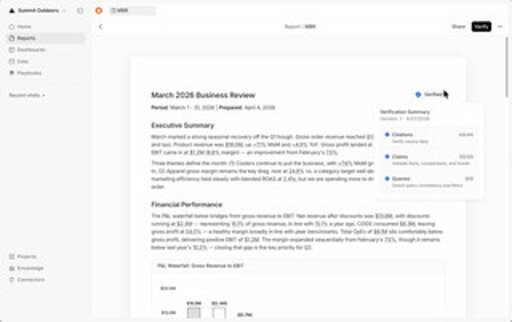
Traceability and Verification: At the heart of the new offering is a commitment to transparency. Every chart, number, and insight within a Summation Report links directly back to its source. Users can drill down from a top-line metric in a report to the specific underlying data, table, or calculation that produced it. This built-in audit trail eliminates the need for analysts to manually explain their work, allowing leaders to self-serve on verification and focus discussions on action and strategy.
Repeatability through Playbooks: A one-time analysis has limited value in the recurring cycles of a business. 'Reports' introduces a concept called 'Playbooks,' which allows teams to systematize their analytical processes. Teams can define the data sources, business logic, and verification steps for a specific review, such as a Monthly Business Review or a weekly performance readout. Once a Playbook is created, the entire report can be regenerated in minutes with each new cycle, ensuring consistency in assumptions and compounding knowledge over time instead of restarting from scratch.
Polished and Exec-Ready: The platform's final output is not a raw data file or a simple dashboard, but a complete, formatted report. It automatically generates a clear narrative, polished charts, and financial summaries with numbers that tie out. This directly replaces the manual process of building a PowerPoint deck, effectively removing the last, cumbersome mile of business reporting and allowing teams to walk into meetings with a finished, defensible artifact.
Carving a Niche in a Crowded Field
Summation enters a competitive landscape populated by established business intelligence giants like Tableau and Microsoft Power BI, which are increasingly integrating AI features like Copilots into their platforms. However, the Bellevue-based startup, founded in 2024 by former Opendoor executives Ian Wong and Ramachandran Ramarathinam, is differentiating itself not by competing on dashboards, but by defining a new category of "AI-native decision infrastructure."
The company's strategy, which has attracted $35 million in funding from top-tier investors, is to focus squarely on the needs of executive and operations teams who require a higher standard of verification. While many tools can show what changed, Summation is engineered to explain why it changed and model what to do next. This focus on verifiable, strategic insight has already shown promise. Early adopter Fanatics, a global digital sports platform, has reportedly used Summation to identify over $10 million in growth and savings opportunities while significantly shortening its reporting cycles. The confidence from investors like Benchmark's Chetan Puttagunta and Kleiner Perkins' Josh Coyne, who both sit on Summation's board, signals a strong belief that a dedicated platform for dependable, executive-level AI is a critical next step in the evolution of enterprise software.
Redefining the Role of the Data Analyst
The rise of powerful automation tools like Summation's 'Reports' inevitably raises questions about the future of data professionals. However, the intended impact is not replacement, but elevation. By automating the most repetitive and time-consuming aspects of the job—data wrangling, report formatting, and manual verification—the platform frees analysts to focus on higher-value work.
Instead of being data janitors, analysts can evolve into strategic partners. Their time can be reallocated to interpreting the nuances of AI-generated insights, applying critical business context that an algorithm might miss, and crafting compelling data stories that drive strategic action. The required skillset shifts from technical execution to business acumen, critical thinking, and communication. In this new paradigm, the data team's role becomes managing and governing the AI systems, ensuring the models are aligned with business goals, and serving as the crucial human-in-the-loop to translate complex analysis into profitable business decisions. Summation's platform is designed to learn a company's unique institutional knowledge, but it still relies on human experts to provide and refine that context, creating a collaborative human-AI workflow.
As Ian Wong stated, the goal is to make business reviews "stop being heroic efforts and start being how the business actually runs." By providing a reliable, repeatable system for analysis, Summation is betting that it can empower data teams to move beyond defense and fully embrace their role as strategic drivers of the business.