
- $1.34 trillion: India's National Infrastructure Pipeline investment between 2020 and 2025
- 8.8% CAGR: Forecasted growth rate of India's construction market, reaching nearly INR 39.10 trillion ($470 billion) by 2029
- $45 million: CEAT's investment to expand OTR tyre manufacturing capacity at its Ambernath plant
Experts would likely conclude that CEAT's strategic focus on high-tech, specialized OTR tyres positions the company to capitalize on India's booming infrastructure sector, leveraging advanced manufacturing and targeted innovation to gain a competitive edge in the heavy industry market.
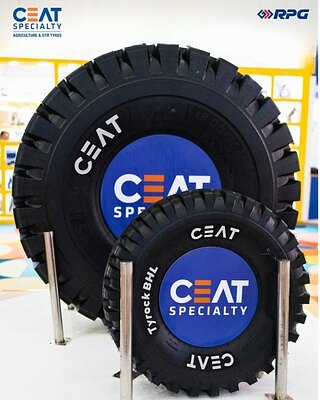
Strategic Grip: CEAT's High-Tech Tyres Target India's Building Boom
BENGALURU, India – December 11, 2025 – Amid the roar of heavy machinery and the buzz of industry deal-making at EXCON 2025, South Asia's largest construction equipment exhibition, a seemingly routine product launch signaled a much larger strategic play. CEAT Specialty, the off-highway division of the global tyre giant, unveiled its new TYROCK BHL tyre. While a new tyre for backhoe loaders might seem niche, its launch represents a calculated move to secure a stronger foothold in one of the world's most dynamic markets: India's burgeoning infrastructure and construction sector. This isn't just about a new product; it's about how advanced component technology is becoming a critical lever for business strategy in a rapidly industrializing economy.
A Bidirectional Bet on Field Efficiency
The star of CEAT's showcase was the TYROCK BHL, a tyre engineered specifically for the punishing environment of earth-moving and construction sites. Its key innovation lies in a bidirectional tread pattern, designed to provide superior stability and traction whether a backhoe loader is moving forward to scoop a load or reversing to dump it. For business leaders and fleet managers, this technical detail translates directly into bottom-line benefits. In the high-pressure world of construction, where project timelines are tight and operational costs are constantly scrutinized, every minute of uptime and every ounce of fuel saved matters.
Backhoe loaders operate in a constant cycle of forward and reverse motion on uneven, often muddy terrain. Sub-optimal traction can lead to wheel slippage, increased fuel consumption, premature tyre wear, and—most critically—lost time. By enhancing grip and stability in both directions, the TYROCK BHL directly addresses these operational pain points. This focus on a specific engineering solution showcases a deep understanding of the end-user's challenges, a core tenet of modern industrial product strategy. It aims to differentiate CEAT from competitors like BKT and other major players in the crowded Off-The-Road (OTR) tyre market, shifting the conversation from price to performance and total cost of ownership.
This kind of targeted innovation demonstrates a critical shift in the industrial components space. No longer are tyres a simple commodity. Instead, they are becoming highly specialized, engineered assets that contribute directly to a company's productivity, safety, and profitability. For a fleet manager, the promise of extended tyre life and reduced downtime for a critical piece of equipment like a backhoe loader is a powerful value proposition.
Gearing Up for a Trillion-Dollar Opportunity
CEAT's strategic focus on the OTR segment is no accident. The launch at EXCON, an event attracting over 80,000 business visitors, is timed perfectly to capitalize on India's unprecedented infrastructure push. The Indian government's National Infrastructure Pipeline (NIP) has earmarked approximately $1.34 trillion for investment between 2020 and 2025, fueling massive projects in roads, railways, energy, and urban development. The construction market itself is forecast to grow at a staggering 8.8% compound annual growth rate to reach nearly INR 39.10 trillion (over $470 billion) by 2029.
This explosion in construction and mining activity creates a voracious appetite for heavy equipment and, by extension, the high-performance components required to keep that machinery running. CEAT's leadership clearly recognizes this. "Customer centricity and innovation remain at the core of CEAT Specialty, and EXCON 2025 provides a pivotal platform to showcase our internationally recognised OTR range," commented Amit Tolani, Chief Executive of CEAT Specialty. His statement, outlining "ambitious plans to introduce innovative products," underscores a strategy aimed at capturing significant market share in this high-growth environment.
The company is backing this ambition with substantial capital. CEAT has been actively expanding its OTR tyre manufacturing capacity, including a $45 million investment to boost output at its Ambernath plant. This facility, which focuses on specialized agri-radial and OTR tyres, is a key part of the strategy to not only serve the domestic boom but also increase its international revenue share, targeting markets in Europe and North America. By showcasing a comprehensive portfolio—from the new TYROCK BHL for backhoes to the ROCK XL for mining and the PORT PRO SS for port operations—the company is signaling its intent to be a one-stop solutions provider for heavy industry.
The Unsung Heroes of Industrial Progress
Zooming out from a single product launch, the real story is the increasingly vital role of component technology in powering large-scale economic progress. A nation's ability to build its future—from highways and smart cities to mines that extract critical minerals for the energy transition—depends on the efficiency and reliability of its industrial backbone. In this ecosystem, specialized OTR tyres are the unsung heroes. The failure of a single tyre on a multi-ton dumper truck can halt operations, causing cascading delays and significant financial losses that far outweigh the cost of the component itself.
This is where a company’s deep-seated commitment to technology and quality becomes a powerful competitive advantage. CEAT's unique position as the world's first tyre brand to receive both the Deming Grand Prize for Total Quality Management and the World Economic Forum's 'Lighthouse' designation for its use of Fourth Industrial Revolution (4IR) technologies is more than just a list of accolades. It is tangible proof of a culture that embeds excellence from the factory floor to the final product.
At its manufacturing plants, the company leverages Industrial IoT, advanced analytics, and machine learning to optimize production, enhance quality control, and improve energy efficiency. This high-tech manufacturing environment is what enables the creation of consistently reliable and high-performing products like the TYROCK BHL. For a business operating a fleet of heavy equipment, this reputation for quality provides an assurance of reliability that is essential for mission-critical operations. As industries continue to digitize and optimize, the intelligence built into the manufacturing of physical components will become just as important as the software that runs the front office. This fusion of advanced manufacturing and practical, rugged engineering is what will ultimately separate the market leaders from the rest of the pack in the demanding world of heavy industry.