
- $2 million: Non-dilutive, asset-based line of credit secured by Luminit to fuel production and solidify market leadership.
- 17% CAGR: Projected growth rate for the automotive AR-HUD market over the next decade.
- 16% CAGR: Expected growth rate for the aerospace HUD market.
Experts would likely conclude that Luminit's strategic use of non-dilutive capital positions it to meet surging demand for advanced optical technologies, ensuring a competitive edge in the rapidly growing AR-HUD and aerospace display markets.
Strategic Capital Fuels Luminit's Optical Tech for Next-Gen Displays
TORRANCE, CA – December 10, 2025 – As the defense and automotive sectors race to integrate next-generation displays, the companies supplying the core enabling technologies are facing immense pressure to scale. Luminit Inc., a U.S. leader in holographic and light-shaping optics, has just secured a $2 million growth facility from Hum Capital. While the figure may seem modest in a world of billion-dollar funding rounds, the structure of the deal—a non-dilutive, asset-based line of credit—represents a highly strategic maneuver to fuel production and solidify market leadership ahead of a planned Series A fundraising effort.
This financing is not just about cash flow; it’s about enabling a critical supplier to meet surging demand for technologies that are foundational to future augmented reality head-up displays (AR-HUDs), advanced aerospace systems, and autonomous vehicle interfaces.
The Power of Non-Dilutive Capital in Deep Tech
For a growth-stage company in the capital-intensive deep tech space, fundraising is a delicate balancing act. Traditional venture capital provides significant cash but comes at the cost of equity, diluting the ownership of founders and early investors. Luminit’s decision to partner with Hum Capital for a non-dilutive solution sidesteps this trade-off at a crucial moment.
The $2 million facility is structured as a revolving, asset-based line of credit. This means Luminit can borrow against the value of its tangible assets, namely its accounts receivable and inventory. As the company’s manufacturing commitments and customer orders grow, so does its borrowing capacity. This creates a flexible, scalable funding mechanism directly tied to its operational tempo and real-world business activity.
The advantages are threefold. First, it allows Luminit to retain full ownership and control, a critical factor as it prepares for a higher-stakes Series A round where valuation will be paramount. By using this facility to meet production goals and demonstrate market traction, the company can negotiate its future equity round from a position of strength, potentially commanding a higher valuation and suffering less dilution. Second, it de-risks the company in the eyes of future investors by proving it can manage its working capital and secure financing based on operational fundamentals, not just future promises. Finally, it provides the immediate working capital needed to ramp up production, shorten delivery times, and confidently accept larger orders from key customers in the defense and automotive industries.
Holography at Kilometer-Scale: The Manufacturing Edge
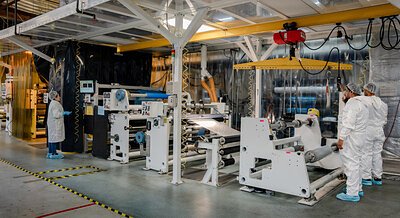
At the heart of Luminit's value proposition is its mastery of advanced optical manufacturing. The company is a pioneer in using a patented roll-to-roll (R2R) process to produce holographic optical elements (HOEs) and light-shaping diffusers at a massive scale. This isn't lab-scale science; it's industrial-grade production capable of outputting holographic film by the kilometer.
This R2R process, which involves embossing microscopic, light-diffracting patterns onto a flexible film substrate, is the key to making advanced optical technologies both effective and commercially viable. Traditional HUD systems often rely on bulky, expensive, and complex projector-and-mirror setups. Luminit’s transparent holographic films, however, can be laminated directly into a vehicle's windshield or a pilot's visor. These films act as a highly efficient, transparent screen, precisely directing light from a compact projector to the user's eye to create a crisp, bright virtual image that appears to float in the distance.
This capability is critical for next-generation AR-HUDs, which overlay navigational cues, hazard warnings, and other critical data directly onto the driver's or pilot's view of the real world. The company’s technology is also being applied to "MovieHUD" concepts for autonomous vehicles, turning the windshield into a high-brightness entertainment display. Beyond automotive, these HOEs are integrated into sophisticated aerospace and missile systems, where precision, low weight, and performance are non-negotiable.
Fueling the Exploding Market for Advanced Displays
Luminit’s need to scale production is not happening in a vacuum. It is a direct response to explosive growth in the markets for advanced display systems. The automotive AR-HUD market alone is projected to grow at a compound annual growth rate (CAGR) exceeding 17% over the next decade, driven by the rapid adoption of advanced driver-assistance systems (ADAS) and the industry-wide push toward cockpit digitalization. Consumers and regulators alike are demanding features that enhance safety by keeping a driver's eyes on the road, and AR-HUDs are a primary solution.
In aerospace, the trend is similar. The market for aerospace HUDs is expected to see a CAGR of over 16%, as both commercial and military aviation seek to enhance pilot situational awareness, reduce workload, and improve safety during critical flight phases. Luminit’s technology provides the optical foundation for these systems.
While giants like BAE Systems and Thales Group develop full-scale aerospace display systems, and companies like Envisics and Ceres Holographics compete in the automotive holographic space, Luminit has carved out a crucial niche as a specialized component manufacturer with a unique, scalable production capability. The $2 million facility is a direct investment in maintaining this edge, ensuring the company can supply the "picks and shovels" for the gold rush in next-generation displays.
A Strategic Bridge to Market Leadership
Ultimately, this financing serves as a strategic bridge. It connects Luminit’s current manufacturing capacity with the escalating demands of its customers, and it connects its current growth stage with its ambition for a successful Series A round and long-term market leadership. By addressing its working capital needs now with smart, non-dilutive debt, Luminit is not just buying materials or funding payroll; it is building a more resilient and valuable enterprise.
The partnership with Hum Capital demonstrates a sophisticated approach to corporate finance, where capital is matched precisely to operational needs. It allows the company to focus on what it does best: pushing the boundaries of light-management technology and scaling its production to meet the needs of some of the world's most demanding industries. As vehicles become more autonomous and cockpits become more data-rich, the demand for the high-performance optical components that Luminit produces will only intensify. This financing ensures the company is well-equipped to capture that future.