
- FRNT Launch Date: January 2026
- SSA Working Group Deadline: February 27, 2026
- GENIUS Act Passage: Mid-2025
Experts agree that the SSA's initiative is a necessary step to address regulatory ambiguity in 'public-sector-associated' stablecoins, though its effectiveness will depend on industry participation and transparency.
SSA Sets Sights on 'Public-Associated' Stablecoins Amid FRNT Scrutiny
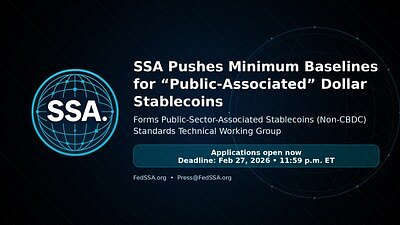
NEW YORK, NY – January 12, 2026 – The Stablecoin Standards Authority (SSA), an independent body operating within FedMSB, today announced the formation of a technical working group aimed at establishing minimum standards for a burgeoning and ambiguous class of digital assets: so-called "public-sector-associated" U.S. dollar stablecoins.
The initiative arrives as Wyoming's recently launched Frontier Stable Token (FRNT), the first state-issued stablecoin, faces early and intense scrutiny over its structure and the nature of its public backing. The SSA's move signals a proactive industry effort to inject clarity and build trust in a corner of the market where the lines between private enterprise and public assurance are increasingly blurred.
Decoding the 'Public Trust' Dilemma
The SSA's new working group is zeroing in on stablecoins that, through "naming, official communications, distribution structure, or governance context, could reasonably lead a reasonable observer to infer a public-institution association." This definition, while excluding sovereign Central Bank Digital Currencies (CBDCs), squarely targets arrangements like Wyoming's FRNT.
Launched this month, FRNT is pegged 1:1 to the U.S. dollar and is overseen by the state's Wyoming Stable Token Commission. Its reserves, composed of U.S. dollars and short-term Treasuries, are managed by financial giant Franklin Templeton. While this structure is designed to offer a level of public accountability absent in many private stablecoins, it has also drawn criticism for what some analysts call a dangerous ambiguity.
Critics point out that while FRNT leverages the state of Wyoming's reputation for stability and oversight, its legal framework includes limited liability clauses that could shield the state from full financial responsibility in a crisis. One market observer described the legal language as a "pre-written escape route," raising concerns that consumers might overestimate the token's safety net. The core issue is whether such projects capitalize on a state's good name without providing the ironclad guarantees of a true public financial instrument, potentially misleading users about the risks involved.
This scrutiny is amplified by a complex legal environment. The recently passed GENIUS Act of 2025, which establishes a federal framework for stablecoin issuers, explicitly excludes state governments from federal oversight when they issue their own tokens. This carve-out places FRNT in a unique regulatory position, fueling the debate over governance and accountability that the SSA's new initiative aims to address directly.
A Floor, Not a Ceiling: The SSA's Standards-Based Approach
In its announcement, the SSA was careful to frame its role as a technical standards body, not a regulator. The working group will not issue licenses, enforce rules, or provide any form of governmental approval. Instead, its goal is to establish a "minimum baseline—a floor for clarity and comparability, not a ceiling on risk management."
The group's focus will be on three practical areas where ambiguity can lead to consumer harm and market instability:
- Disclosure: Defining responsibility boundaries, clarifying recourse and remedies, and ensuring key terms do not create an unjustified expectation of public backing.
- Redemption: Detailing the operational mechanics of redemption across all channels and transparently disclosing any constraints or conditions under which redemptions could be paused.
- Governance: Clarifying who holds decision-making authority, how changes are managed, and how critical service providers are governed.
To build credibility, the SSA's process is designed for transparency. All outputs will be voluntary standards documents based solely on publicly available information, using an "evidence-to-finding" approach. Each major release will be accompanied by an Evidence Index with pinpoint citations, and the authority will maintain archived snapshots of web sources. This methodology is intended to allow any outside observer to review and verify the group's findings. The governance structure also includes tiered conflict-of-interest disclosures, dual-channel voting requiring both institutional and expert majorities, and a pre-publication adversarial review process to challenge assumptions.
Navigating a Patchwork of Regulation
The SSA's industry-led effort does not exist in a vacuum. It comes amid a flurry of legislative and regulatory activity in Washington D.C. as lawmakers and agencies race to construct a comprehensive framework for the digital asset market. The Guiding and Establishing National Innovation for US Stablecoins (GENIUS) Act, signed into law in mid-2025, created a dual federal-state licensing regime for stablecoin issuers but, as noted, left state-issued tokens largely outside federal jurisdiction.
Meanwhile, the House of Representatives is advancing its own STABLE Act, and a new draft of the Senate's CLARITY Act seeks to further delineate oversight between the SEC and CFTC. Federal agencies are also moving quickly. The U.S. Treasury has championed U.S. dollar stablecoins as a policy objective, the OCC has reaffirmed banks' ability to engage in crypto-asset activities, and the FDIC recently proposed rules for bank-linked stablecoin issuance under the GENIUS Act. The CFTC has even launched a pilot program allowing certain digital assets, including the stablecoin USDC, to be used as collateral in derivatives markets.
Against this backdrop, the SSA's voluntary standards initiative can be viewed from several perspectives. To its proponents, it is a necessary and practical complement to formal regulation, allowing the industry to establish best practices and operational norms more nimbly than the legislative process allows. To more skeptical observers, it represents an attempt at self-regulation designed to shape, and perhaps preempt, more stringent government mandates. "Industry is trying to write the rules of the road before the government paves it over entirely," one financial policy analyst commented.
A Call to Arms for Industry Experts
The success and influence of the working group will largely depend on the breadth and depth of expertise it can attract. The SSA has opened a call for participation through a two-track structure, inviting applications from both organizations and independent professionals until the deadline of February 27, 2026.
Institutional members are sought from firms with expertise in payments and settlement, custody and reserves management, compliance, cybersecurity, and risk management. This could include major financial institutions, leading stablecoin issuers like Circle and Paxos, and audit firms with experience in digital asset attestation. The second track is for expert members—independent professionals serving in a personal capacity with qualifications in financial law, consumer protection, financial engineering, and governance.
The SSA will publish a provisional roster of members for public comment before final confirmation, another step toward ensuring a transparent and credible process. The final composition of this working group will be the first major indicator of its potential to forge consensus and establish standards that could bring much-needed stability and clarity to a vital and rapidly maturing sector of the digital economy.