
- $280M Funding: Spirit AI secures $280 million in new funding, reaching a valuation of over $1.4 billion.
- 90% Cost Reduction: The company achieves a 90% reduction in data acquisition costs, enabling it to collect over 200,000 hours of real-world interaction data.
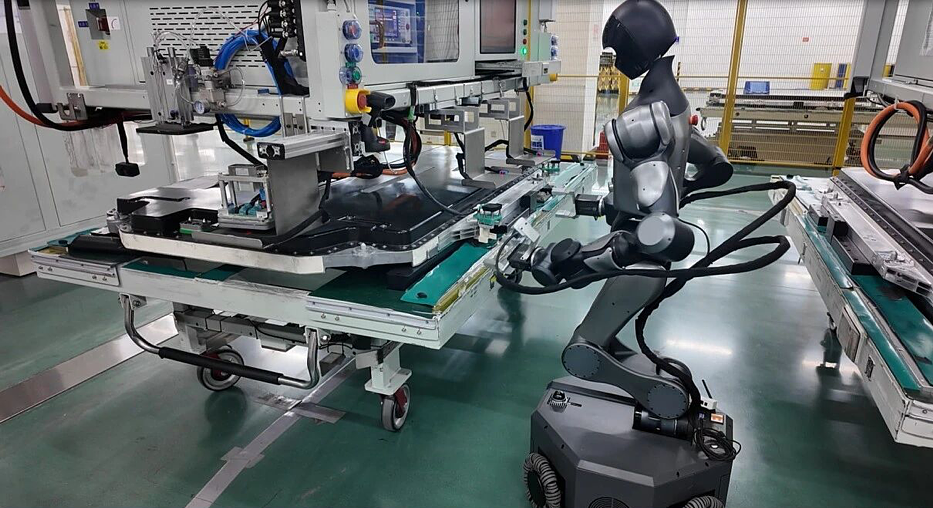
- 99% Success Rate: Spirit AI's robots achieve a 99% success rate in handling and testing flexible wire harnesses at CATL, outperforming human workers.
Experts would likely conclude that Spirit AI's innovative 'dirty data' approach and successful industrial deployments position it as a formidable contender in the global embodied AI race, with significant implications for automation and workforce transformation.
Spirit AI's $280M Bet on 'Dirty Data' to Win the Embodied AI Race
BEIJING – February 25, 2026 – In a move signaling a major acceleration in the global race for robotic intelligence, Beijing-based Spirit AI has secured $280 million in new funding to scale its 'universal robotic brain.' The investment catapults the company to a valuation of over $1.4 billion, cementing its status as a unicorn and positioning it as a formidable challenger to established tech giants in the burgeoning field of embodied AI.
The funding round, which includes a mix of top-tier financial firms like Yunfeng Capital and HongShan Capital Group alongside strategic industrial giants such as CATL, TCL, and JD.com, highlights a pivotal industry shift. Capital is flowing toward companies that can bridge the gap between AI research and real-world industrial application, moving intelligent robots from controlled labs to the complex, unpredictable factory floor.
The 'Dirty Data' Revolution
At the heart of Spirit AI's strategy is a counterintuitive and aggressive approach to machine learning: a reliance on what it calls "dirty data." While many competitors have focused on training robots with highly curated, clean datasets from simulations or teleoperation, Spirit AI is betting that true intelligence comes from messiness.
"Dirty data is the key to scaling VLA models," says Yang Gao, Co-founder and Chief Scientist of Spirit AI, a prominent researcher with a PhD from UC Berkeley. The company's philosophy posits that for a robot to develop genuine common sense and the ability to generalize its skills, it must learn from the vast, unstructured, and unpredictable data of the real world. This includes everything from slight variations in lighting and object placement to unexpected human interventions.
To achieve this, Spirit AI has developed proprietary wearable devices that allow it to collect massive amounts of human interaction data at a fraction of the cost of traditional methods. The company reports a 90% reduction in data acquisition costs, enabling it to amass over 200,000 hours of real-world interaction data, with a goal of surpassing one million hours by the end of 2026. This data feeds its Vision-Language-Action (VLA) models—a unified neural network architecture that integrates sight, language comprehension, and physical action, allowing a robot to understand a command and execute a physical task.
From Benchmark to Battery Factory
Spirit AI's approach is not merely theoretical; it has delivered verifiable, world-class results. In January, its Spirit v1.5 model topped the global RoboChallenge leaderboard, a standardized "exam" that tests embodied AI models on 30 complex physical tasks. The model achieved a task success rate of over 50%, outperforming entries from global competitors, including Physical Intelligence (Pi), a leading U.S.-based startup.
More significant is the company's successful deployment at an industrial scale. On the production lines of CATL, the world's largest battery manufacturer and a strategic investor, Spirit AI's "Moz" robots are tackling a notoriously difficult and high-risk task: handling and testing flexible wire harnesses on high-voltage battery packs. This delicate operation, previously performed by skilled human workers, requires precision and adaptability due to the unpredictable nature of the flexible materials.
The VLA-powered robots have achieved a success rate exceeding 99%, matching the cycle times of their human counterparts. Operating 24/7, a single robot can triple the daily workload of a human worker. The robots not only perform the task but also autonomously inspect their work, identify anomalies, and adjust their movements in real time, demonstrating a level of physical reasoning and adaptability that has long been a bottleneck for industrial automation.
A New Contender in the Global AI Race
The substantial funding and proven industrial success place Spirit AI at the forefront of a fiercely competitive market. The global embodied AI sector, valued at over $4.4 billion in 2025, is projected to surge to $23 billion by 2030. This growth is fueled by a technological arms race between established players like Google DeepMind, NVIDIA, and Tesla, and a new generation of highly capitalized startups such as Figure AI and Physical Intelligence.
Spirit AI's emergence underscores China's strategic push to become a leader in what it views as the next frontier of artificial intelligence. With a core team of young researchers and engineers from elite institutions like UC Berkeley, Tsinghua, and Peking University, the company represents a new model of innovation that combines cutting-edge academic theory with rapid industrial deployment. Its deep-pocketed and strategic investor base, which spans manufacturing, logistics, and consumer electronics, provides a unique ecosystem for sourcing data and scaling applications across a wide range of real-world scenarios.
The Societal Blueprint of Embodied AI
The rapid advancement of general-purpose robots heralds a profound transformation with significant societal implications. While the immediate benefits include enhanced productivity, improved worker safety in hazardous roles, and solutions to labor shortages, the technology also raises critical questions about the future of work. The deployment at CATL is a clear example of robots taking over complex manual tasks, which will inevitably lead to job displacement and necessitate large-scale workforce reskilling.
Safety and ethics are also paramount concerns. As autonomous robots begin to operate in shared environments, ensuring they are safe, secure from cyber-physical attacks, and transparent in their decision-making becomes critical. Regulatory bodies are already taking notice, with the EU's AI Act classifying some industrial robots as "high-risk" systems requiring stringent oversight. Furthermore, the constant stream of sensory data collected by these machines to learn and operate raises new and complex challenges for data privacy and consent.
As Spirit AI and its competitors push the boundaries of what is possible, they are not just building machines; they are writing the blueprint for a future where intelligent, autonomous agents are integrated into the fabric of the global economy and daily life, forcing society to confront these complex questions head-on.