
- €465.4 million: Spain's tile exports to the U.S. in 2025, accounting for 13.4% of the sector's total foreign revenue.
- 60 manufacturers: Number of Spanish ceramic companies showcased under the Tile of Spain banner at Coverings 2026.
- Advanced digital fabrication techniques: Enabling high-resolution printing, 3D surface texturing, and performance-driven design in Spanish ceramics.
Experts agree that Spain's ceramic industry is redefining modern design through a strategic blend of ancient craftsmanship and cutting-edge technology, establishing a new standard for luxury, functionality, and sustainability in interior surfaces.
Spain's Ceramic Renaissance: Ancient Craft Meets Modern Design
MIAMI, FL – April 24, 2026 – Amid the vibrant hum of Coverings 2026, North America's premier tile and stone exhibition, the Spanish Pavilion stood out not with loud declarations, but with a quiet, confident showcase of profound innovation. Nearly 60 manufacturers under the Tile of Spain banner presented collections that signal a significant shift in interior design: a move away from fleeting trends toward materials rich with story, texture, and technological prowess. The central theme was a masterful blend of centuries-old tradition and advanced manufacturing, proving that the future of surface design is both deeply authentic and brilliantly engineered.
This year's exhibition in Las Vegas saw Spanish companies pivot from chasing ephemeral styles to establishing a new language of luxury. It's a language spoken through surface articulation, refined aesthetics, and an emphasis on materials that engage the senses, offering architects and designers a palette that is as functional as it is poetic.
A Return to Roots: The Rise of Tactile, Authentic Surfaces
The most palpable trend emerging from the Spanish collections is a collective exhale—a move toward calm, restorative environments. Dubbed 'A Sea of Calm,' this ethos champions restraint and intentionality. Low-sheen finishes, softened contrasts, and subtle detailing are being used to create spaces that feel balanced and composed. Here, luxury is not shouted; it is felt in the integrity of the material itself.
This aesthetic is built upon 'Evolved Earth Palettes.' Spanish manufacturers are redefining neutrals, moving beyond monotonous grey and beige to a more nuanced, mineral-driven spectrum. The new collections are grounded in off-white foundations infused with ochre, blush, olive, and sand. Charcoals are softened with red and brown undertones, creating a chromatic range that feels both elemental and sophisticated. This shift aligns perfectly with a broader global design movement toward warm, comfortable, and human-centric interiors that prioritize well-being.
Driving this movement is 'Artisanal Surface Expression,' where technology is used to celebrate, not erase, the beauty of craftsmanship. Hand-formed aesthetics, the subtle pooling of glazes, and heritage patina effects are meticulously replicated, capturing the soul of kiln-fired production while maintaining the precision of modern manufacturing. These are not mere imitations of handmade tiles; they are technologically advanced products that embody an artisanal spirit. Micro-relief textures and softly worn edges introduce a tactile dimension that encourages interaction, transforming walls and floors from passive backdrops into active, sensory elements of a room. For architects and designers, these materials answer a growing demand for spaces with depth, character, and a tangible connection to the natural world.
The Digital Artisan: Technology Behind the Tile
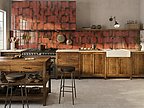
The seemingly handcrafted beauty of Spain's latest ceramic offerings is made possible by some of the industry's most advanced technology. The 'Reinterpreted Materiality' trend showcases how familiar materials are being reimagined. Terracotta, a staple of Mediterranean design, is now available in expanded tonal ranges with vastly improved technical performance. Brick is elongated, texturized, and refined for contemporary architectural applications. This is not simply about aesthetics; it's about enhancing usability.
Behind these innovations are digital fabrication techniques that have reached a remarkable level of sophistication. High-resolution digital printing allows for incredible tonal depth and variation, enabling the creation of 'stone hybridizations' that merge multiple natural references into a single, interpretive surface. The result feels more like a unique material than a literal copy. Furthermore, 3D surface printing and textural embossing create a level of realism and haptic feedback that was previously unattainable, allowing designers to specify surfaces with the rich character of natural materials without their inherent vulnerabilities.
This technological prowess is seamlessly integrated with 'Performance-Driven Design.' Functionality is not an afterthought but an intrinsic part of the design process. High-traction surfaces are engineered for wet and high-traffic areas without sacrificing visual appeal, a crucial factor for both commercial and residential projects. The inherent properties of Spanish ceramics—resistance to moisture, UV exposure, fire, and wear—are now baseline expectations. This fusion of beauty and brawn means a single product line can often be used to create a cohesive design that flows from an interior living space to an outdoor patio, ensuring both aesthetic continuity and long-term durability.
A Calculated Craft: Spain's Strategic Market Dominance
The powerful showing at Coverings 2026 is a key component of the Spanish ceramic industry's deliberate and highly successful strategy in North America. The United States remains the leading destination for Spain's tile exports, accounting for €465.4 million in 2025, or 13.4% of the sector's total foreign revenue. This market leadership is not accidental.
Spain's competitive advantage is built on a three-pronged approach: design leadership, technological innovation, and superior performance. By consistently delivering on all three fronts, Spanish manufacturers have positioned their products as a foundational investment for quality construction and design. Their commitment to sustainability—using natural ingredients, minimizing waste, and producing recyclable products—further aligns with the values of today's architects and specifiers.
Promotional bodies like ASCER (The Spanish Ceramic Tile Manufacturers' Association) and ICEX (Spain Trade and Investment) play a crucial role in amplifying this message. Through coordinated efforts including industry seminars, trend lookbooks, and interactive events at trade shows—like the popular mood board station and live podcast recordings at this year's Coverings—they ensure that the narrative of Spanish innovation reaches key decision-makers. This transforms the Spanish Pavilion from a mere product showcase into an educational and inspirational hub for the entire design community.
The evolution of ceramic applications further solidifies this market position. Tile is no longer confined to floors and backsplashes. With the advent of large-format porcelain slabs and coordinated trim systems, Spanish ceramics are now being used for furniture-scale installations, such as cladding for kitchen islands, integrated vanities, and architectural seating. This expansion of use transforms the material from a simple surface covering into a defining component of a space's architectural identity. This fusion of the elemental and the engineered ensures that Spanish ceramics will continue to form the very foundation of modern design for years to come.