
- 385+ patents held by Solidion, with a potential valuation of over $750 million.
- $35 million secured in private placement to fund operations through 2028.
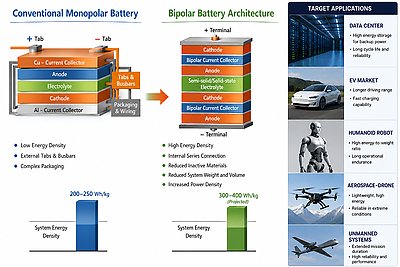
- BEEP architecture claims to reduce weight, volume, and cost while boosting energy density.
Experts view Solidion's BEEP battery technology as a promising but unproven innovation in the competitive solid-state battery space, with its success hinging on scalable manufacturing and market adoption.
Solidion's BEEP Battery: A Leap for Aerospace, AI, and Space Tech?
DALLAS, TX – June 16, 2026 – In a market defined by incremental gains and persistent bottlenecks, Solidion Technology (NASDAQ: STI) today made a bold claim for a revolutionary leap. The Dallas-based firm unveiled its patented Bipolar Electrode-to-Pack (BEEP) technology, an AI-assisted design for solid-state batteries that it claims will slash weight, volume, and cost while dramatically boosting energy density. The announcement targets some of the most demanding and fastest-growing sectors: electric vertical take-off and landing (eVTOL) aircraft, AI data centers, and the burgeoning space economy.
For years, the promise of solid-state batteries—safer, more powerful, and faster-charging alternatives to current lithium-ion technology—has remained just over the horizon. The key obstacles have been twofold: the immense difficulty and cost of manufacturing at scale, and the cumbersome, heavy packaging required for safety and connectivity. Solidion asserts its BEEP architecture directly confronts these hurdles, potentially unlocking a new performance tier for electrified systems.
The BEEP Blueprint: Rethinking Battery Architecture
Conventional battery packs are an exercise in complex assembly. They consist of hundreds of individual cells, each in its own housing, which are then bundled into modules, which are finally connected within a larger pack casing. This monopolar design results in a significant portion of the pack's weight and volume being dedicated not to storing energy, but to redundant casings, connectors, wiring, and fire mitigation systems.
Solidion’s BEEP technology discards this approach. Instead of building a pack from individual cells, it constructs the pack directly by stacking large-format bipolar electrodes and solid electrolyte layers in series. The entire stack is then housed in a single casing with minimal connectors. This electrode-to-pack method is intrinsically simpler, eliminating the vast majority of non-active materials that plague traditional designs.
“BEEP represents a fundamental rethinking of how battery packs are built,” said Jaymes Winters, Chief Executive Officer of Solidion Technology, in the company's official announcement. “By eliminating the redundant housings, connectors, and fire mitigation systems that burden conventional designs, we've created a pathway to batteries that are lighter, smaller, safer, and less expensive to manufacture — precisely the attributes demanded by next-generation eVTOL, space, and AI infrastructure applications.”
The integration of artificial intelligence in the design and manufacturing process is another key element. While details are proprietary, AI is likely used to optimize the complex interplay between material selection, electrode stacking patterns, and thermal management, accelerating development cycles and refining production for what the company hopes will be a more efficient path to commercialization.
Powering the New Frontier
The technology’s true test will be its adoption in the high-stakes industries it targets. For the nascent eVTOL market, battery performance is the primary gatekeeper to commercial viability. Every kilogram of battery weight saved translates directly into increased payload or flight range. BEEP’s promised improvements in specific energy (watt-hours per kilogram) and energy density (watt-hours per liter) are precisely what air taxi and logistics drone developers are desperate for. The inherent safety of a solid electrolyte, which is non-flammable compared to the liquid electrolytes in current lithium-ion batteries, is an equally powerful selling point for vehicles designed to fly over populated areas.
Beyond the skies, Solidion is aiming at the voracious energy needs of artificial intelligence. As AI models grow more complex, the power consumption of data centers skyrockets. Reliable Uninterruptible Power Supply (UPS) systems are critical. Solidion sees an opportunity for its compact, high-density batteries to provide more robust backup power in a smaller footprint. This application becomes even more critical for the futuristic concept of space-based data centers, where every gram of mass is astronomically expensive to launch into orbit. The company’s focus on an “Extreme-Climate Battery” and its portfolio of over 30 patents related to space-based AI applications signal a clear strategic focus on this orbital frontier.
The Solid-State Gauntlet
Solidion is not entering an empty field. The race to commercialize solid-state batteries is a global marathon featuring heavily funded startups and established industrial giants. Competitors like QuantumScape (NYSE: QS), backed by Volkswagen, are developing their own solid-state cells using proprietary ceramic separators. Solid Power (NASDAQ: SLDP) is pursuing a sulfide-based electrolyte it claims can be manufactured on existing lithium-ion production lines, a major potential cost advantage. Both are also leveraging AI in their research and targeting similar high-value markets.
Industry veterans remain cautiously optimistic but grounded by experience. “We’ve seen dozens of ‘breakthrough’ battery announcements over the years,” noted one anonymous industry analyst. “The real challenge isn’t the lab result; it’s scaling production to millions of units with consistent quality and a competitive cost. That’s the valley of death where most battery startups perish.”
Solidion’s core differentiation lies in its BEEP architecture—a structural innovation at the pack level, rather than just a new cell chemistry. By simplifying the pack itself, the company hopes to sidestep some of the manufacturing complexities that have stymied its rivals. The question is whether this advantage is enough to propel it past the competition.
From Lab to Market: The Uphill Battle
Translating Solidion's ambitious vision into a market reality will require immense capital and flawless execution. The company, which operates pilot production facilities in Dayton, Ohio, recently secured approximately $35 million in a private placement, which it states should fund operations through 2028. This provides a crucial runway for development.
However, a look at the company’s financials reveals the high-risk nature of its endeavor. While its stock has seen meteoric gains over the past year, SEC filings reveal recurring losses, negative shareholder equity, and a “going-concern” warning from auditors for 2024 and 2025—a formal statement of doubt about a company’s ability to continue operations. In a recent move, the company also withdrew a planned public offering, citing changed circumstances.
Counterbalancing this financial precarity is the perceived value of its intellectual property. Solidion holds an extensive portfolio of over 385 patents, and in April, it signed a deal with Hilco Global to monetize this portfolio, with Hilco providing a potential valuation north of $750 million. This suggests that even if its own manufacturing scale-up faces hurdles, its innovations hold significant value. For Solidion Technology, the announcement of BEEP marks a pivotal moment, placing the company’s deep IP portfolio and novel architectural approach squarely in the spotlight of the multi-trillion-dollar electrification transition.