
- Die Weight Capacity: Up to 36,000 pounds
- Changeover Time: Reduced from multiple workers' time to under 1 minute
- Cost of Downtime: $10,000 to over $25,000 per hour
Experts agree that the omnidirectional Mold and Die Changer represents a transformative advancement in factory automation, significantly enhancing both operational efficiency and worker safety by eliminating hazardous forklift-based processes.
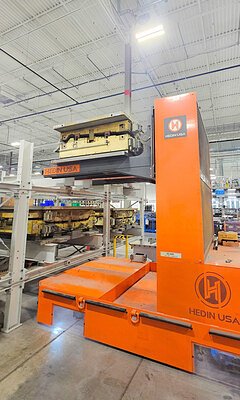
Smart Die Changers Remake Factory Floor Safety and Speed
ST. LOUIS, MO – February 19, 2026 – In a significant leap forward for industrial automation, Align Production Systems has unveiled a custom-engineered solution that is reshaping one of the most time-consuming and hazardous tasks in heavy manufacturing: the changing of massive metal stamping dies. Developed in partnership with a leading metal stamping manufacturer, the new omnidirectional Mold and Die Changer replaces cumbersome, forklift-based methods with a highly agile, automated system, promising dramatic reductions in downtime and a new benchmark for operator safety.
The system, capable of handling dies weighing up to 36,000 pounds, navigates factory floors with unprecedented precision, executing in under a minute a process that once took multiple workers a significant amount of time, fraught with risk.
The High Cost of a Slow Changeover
For decades, the process of changing a multi-ton die in a stamping press has been a necessary but inefficient bottleneck. The traditional method relies on heavy-duty forklifts and a team of skilled operators to painstakingly maneuver the die from a storage rack, transport it across a busy facility, and align it perfectly with the press. This manual-intensive process is not only slow but also inherently dangerous, creating numerous opportunities for equipment damage, collisions, and serious worker injury.
Every minute a press sits idle during a changeover is a minute of lost production. In the world of modern manufacturing, where unplanned downtime can cost companies anywhere from $10,000 to over $25,000 per hour, these delays have a direct and substantial impact on the bottom line. The pressure to minimize this downtime often clashes with the need for caution, creating a high-stakes environment.
"Before the upgrade, operators relied on forklifts and manual alignment to transfer dies between presses and storage, a process that required multiple workers, created downtime, and posed safety risks," noted a statement from Align Production Systems. Recognizing this critical inefficiency, the manufacturing partner sought a solution that could deliver both speed and safety, a challenge that legacy equipment could not meet.
A New Era of Precision and Mobility
The solution developed by Align Production Systems is a self-contained, battery-powered transporter that integrates several advanced technologies to create a seamless workflow. At the heart of its design is its omnidirectional movement capability. Unlike a forklift, which has a limited turning radius, the die changer can move forward, backward, sideways, and diagonally, and even rotate 360 degrees on a single point. This agility, often achieved through specialized wheel systems, allows a single operator to navigate congested factory floors and align the massive die with micron-level precision.
Once in position, a powerful hydraulic lift system raises the die, which can be elevated to a height of 103 inches, to match the press bed or storage rack level. A retractable roller system on the transporter’s surface then allows for smooth transfer. The most innovative feature, however, is the integrated electromagnetic push/pull mechanism. This system allows the transporter to magnetically latch onto the die and apply controlled force to pull it from the press or push it securely into place, eliminating any manual pushing or pulling by operators.
The entire unit is powered by a high-capacity lithium-ion battery, providing extended, cord-free runtime for maximum operational flexibility. The deployment of two such units at the partner facility has enabled service to multiple presses, transforming the entire plant’s workflow.
Redefining Safety on the Factory Floor
Beyond the impressive gains in efficiency, the most profound impact of the new system is on worker safety. The Occupational Safety and Health Administration (OSHA) documents tens of thousands of forklift-related injuries each year, making forklift-centric tasks a major area of concern for safety managers. By removing forklifts from the die-changing equation, the new system inherently eliminates a wide range of hazards, including tip-overs, collisions with personnel, and accidents caused by falling loads.
Automating the handling of 36,000-pound objects drastically reduces the risk of musculoskeletal injuries and catastrophic accidents associated with manual manipulation. The system's design incorporates multiple safety interlocks, including automatic speed reduction when the lift is elevated and sensors that monitor equipment status. This creates a controlled, predictable environment that protects both the operator and the expensive dies and presses.
This shift aligns with OSHA's General Duty Clause, which mandates that employers provide a workplace free from recognized hazards. By investing in engineered solutions that remove workers from harm's way, manufacturers not only enhance compliance but also foster a culture that prioritizes employee well-being, which can lead to improved morale and lower insurance premiums.
Customization Drives Competitive Advantage
Align Production Systems’ success highlights a key trend in the evolution of manufacturing: the move toward specialized, custom-engineered automation. While the market offers general-purpose Automated Guided Vehicles (AGVs), this project demonstrates the superior value of a solution tailored to a specific, high-stakes application. The combination of omnidirectional mobility, heavy-lift hydraulics, and an integrated magnetic transfer system in a single, cohesive unit is what sets it apart from off-the-shelf alternatives.
This bespoke approach is central to the principles of Industry 4.0 and smart manufacturing, where interconnected, intelligent systems are optimized to perform specific tasks with maximum efficiency. As manufacturers face pressures from global competition and domestic labor shortages, the ability to automate complex processes becomes a critical competitive advantage. Flexible systems like the omnidirectional die changer allow for quicker adaptation to changing production demands, enabling more frequent, smaller-batch production runs without the punitive downtime penalties of the past.
This project serves as a powerful case study for how targeted automation can modernize legacy workflows, proving that the safest and most efficient path forward is often one paved by innovation tailored precisely to the challenge at hand.