
- EV Battery Production Growth: US projected to increase EV battery production capacity from 55 GWh (2021) to nearly 1,000 GWh by 2030. - Precision Standards: Success in modern manufacturing measured in microns and parts-per-million. - Data Capture Rate: Leetx's servo press systems capture force-displacement signatures at 10,000 times per second (10 kHz).
Experts agree that integrated smart assembly technologies are critical for addressing precision and scalability challenges in US EV and aerospace manufacturing, enabling data-driven quality control and operational efficiency.
Smart Assembly Tech Aims to Solve US EV and Aerospace Bottlenecks
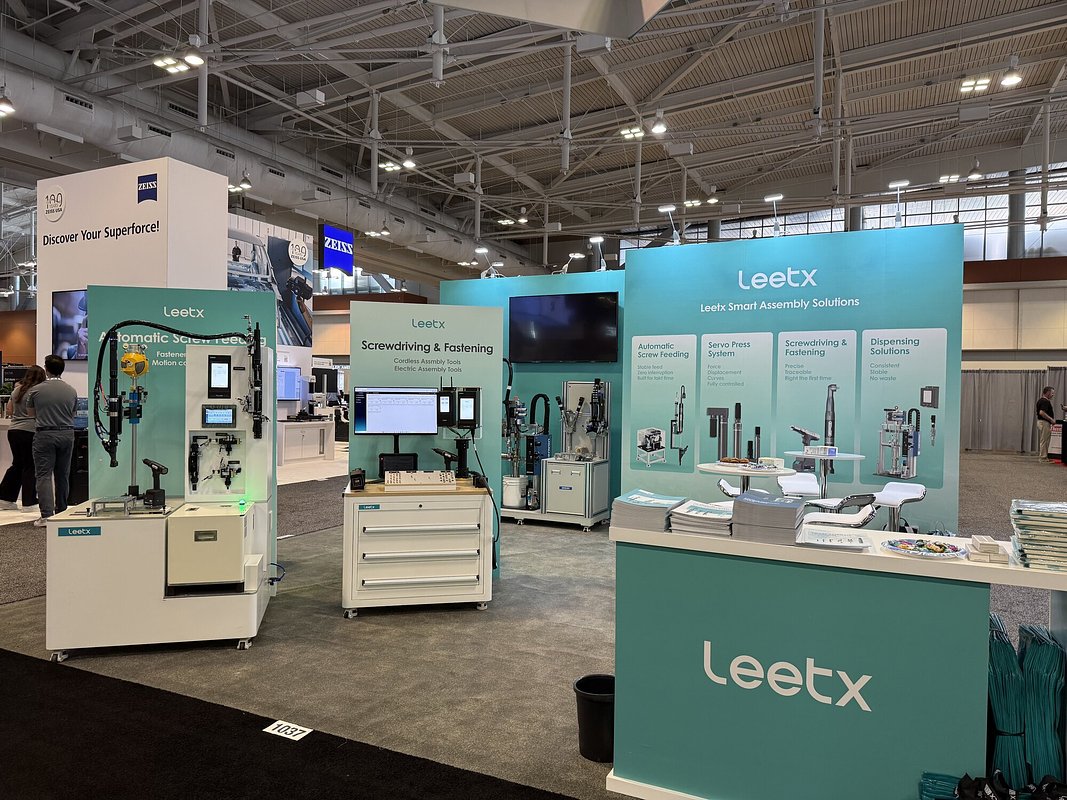
NASHVILLE, TN – April 09, 2026 – As North American manufacturers race to build resilient supply chains for electric vehicles and aerospace, two industrial technology brands have entered the market with a bold proposition: to transform assembly lines from a potential liability into a data-rich competitive advantage. Leetx and its dispensing brand, Centron, made their joint North American debut at The Manufacturing & Automation eXchange (MAX) 2026, held in Nashville last month, showcasing an integrated smart assembly ecosystem designed to address the sector's most pressing scalability and precision challenges.
The move comes at a critical juncture. The U.S. is projected to increase its EV battery production capacity from 55 GWh in 2021 to nearly 1,000 GWh by 2030, a monumental leap that strains existing manufacturing paradigms. Success in this new industrial era is measured in microns and parts-per-million, a standard that legacy equipment often fails to meet, leading to costly scrap and production delays.
The Precision Imperative in Modern Manufacturing
For decades, assembly has relied on tools that, while effective, often operate as 'black boxes.' Traditional pneumatic and hydraulic presses, for instance, lack the digital senses to provide granular feedback on the assembly process. This is a significant problem in high-stakes applications like EV motor stator and battery module assembly, where micron-level tolerances are not just ideal but essential for performance and safety.
Similarly, the consistent application of Thermal Interface Materials (TIMs) in EV battery packs—a critical step for thermal management—remains a notorious industry bottleneck. The abrasive, high-viscosity nature of these materials causes frequent equipment wear and inconsistent application, leading to line stoppages and potential long-term quality issues. Aerospace manufacturing faces its own version of this challenge, where every fastener and component must be perfectly installed and meticulously tracked to meet stringent AS9100 safety and compliance standards.
Leetx and Centron are betting that the solution lies in making every step of the assembly process transparent and quantifiable. Their platform is built to convert physical actions—tightening a screw, pressing a bearing, dispensing a bead of sealant—into verifiable digital assets, creating an unbroken data trail from the first component to the final product.
From Black Box to Digital Thread
At their MAX 2026 booth, the companies demonstrated three core technology pillars designed to replace ambiguity with data-driven certainty. Each pillar targets a specific pain point intensified by the push for electrification and advanced manufacturing.
First, Leetx's integrated screwdriving and fastening system combines transducerized tightening tools with automatic screw feeders. This automates screw delivery while capturing real-time torque-angle curve data for every single fastening event. By eliminating the risks of manual handling—such as missed fasteners, incorrect parts, or operator fatigue—the system ensures that every joint's integrity is verified and recorded in the manufacturing execution system (MES). This level of traceability is rapidly shifting from a best practice to a mandatory requirement from OEMs aiming to mitigate liability and prevent costly recalls.
Second, the company's servo press systems tackle the precision deficit of older technologies. By capturing force-displacement signatures at a high frequency of 10,000 times per second (10 kHz), the system allows engineers to virtually 'see' inside the press-fit process as it happens. This granularity enables immediate detection of anomalies, preventing entire batches of high-value components from being compromised by a single misaligned part. For industries where scrap rates directly impact profitability, this process visibility offers a significant financial advantage.
Finally, Centron's dispensing solutions address the persistent TIM application challenge. Featuring proprietary fast shut-off valve technology and ceramic components engineered for wear resistance, the system is designed to handle abrasive, thick materials without the common issues of 'tailing' (material stringing) or rapid equipment erosion. The result is consistent bead formation under demanding, high-speed conditions, which is critical for maintaining uptime in the gigafactories scaling up across the continent.
A Unified Ecosystem for a Complex Supply Chain
Beyond the individual technologies, the strategic core of the Leetx and Centron offering is its integrated nature. In a market where manufacturers often source automation solutions from a patchwork of different vendors, the two brands present a single, integration-ready ecosystem for screwdriving, press-fit, and dispensing.
This single-source approach is particularly compelling for North American OEMs and Tier 1 suppliers grappling with fragmented supply chains and the complexity of ensuring data consistency across disparate systems. By unifying these critical assembly processes under one technology partner, manufacturers can simplify line integration, reduce vendor management overhead, and enforce a common data standard. This is a crucial advantage as OEMs increasingly demand a unified and fully traceable record of a product's assembly journey.
"North American OEMs are no longer asking if they need full assembly traceability—they're asking how to implement it at scale without compromising throughput," said Samuel Chen, Strategic Business Development Manager at Leetx, in a statement. "Our technologies, proven across hundreds of high-volume production lines globally, provide the single source of truth for assembly data. MAX marks the beginning of our long-term commitment to being a strategic partner in this market."
Shaking Up the North American Automation Market
The entry of this integrated ecosystem introduces a new dynamic into a competitive North American market dominated by established players like Bosch Rexroth, Atlas Copco, and Nordson. While these industrial giants offer powerful solutions in their respective domains, the Leetx and Centron strategy directly challenges the siloed approach to assembly automation.
Their arrival could accelerate a market-wide shift toward more holistic, data-centric platforms, pushing competitors to enhance their own integrated offerings. The emphasis on providing a 'single source of truth' for assembly data aligns perfectly with the broader Industry 4.0 movement and federal initiatives like the CHIPS Act and Inflation Reduction Act, which incentivize the adoption of digital-twin and predictive maintenance capabilities in domestic manufacturing.
By targeting specific, well-known production bottlenecks in the nation's most strategic growth sectors, Leetx and Centron are not just selling tools; they are offering a solution to a core industrial challenge. Their success will likely depend on their ability to prove that a unified digital thread is the most effective way to build the resilient, high-precision, and scalable manufacturing base that North America urgently needs.