
- 82.2% Confidence: Over 82% of U.S. small business owners express confidence in their growth prospects for the next six months.
- Customer Demand Challenge: 53.3% of small businesses cite customer demand as their biggest obstacle.
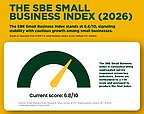
- SBE Small Business Index: Scores the business environment at a stable 6.8 out of 10.
Experts conclude that while small business owners demonstrate remarkable resilience and optimism about their individual growth prospects, they face significant challenges, particularly in customer demand and government support, highlighting a need for more effective policy alignment and technological adaptation.
Small Business Resilience: 82% Confident Despite Economic Headwinds
NEW YORK, NY – May 04, 2026 – A new report released for National Small Business Week paints a picture of remarkable resilience, with over 82% of U.S. small business owners expressing confidence in their growth prospects for the next six months. Despite persistent economic uncertainty, this wave of optimism suggests that entrepreneurs are adapting and finding new paths to success.
The 2026 State of Small Business Report, published by the Small Business Expo, surveyed more than 11,400 business owners across the country. The findings reveal a sector defined not by retreat, but by disciplined adaptation. However, beneath the surface of this confidence lies a complex landscape of mounting challenges, from acquiring customers to a significant disconnect with government support.
Personal Optimism vs. Economic Anxiety
The headline figure of 82.2% confidence offers a powerful testament to the entrepreneurial spirit. The report's SBE Small Business Index, which scores the business environment at a stable 6.8 out of 10, further supports this narrative of cautious but steady growth. "Small businesses are not pulling back—they're adapting," said Zach Lezberg, CEO & Founder of Small Business Expo, in the report's release. "What we're seeing is a shift toward disciplined growth."
However, this optimism appears to be highly personal, standing in contrast to broader economic sentiment. Other recent economic indicators present a more muted outlook. The National Federation of Independent Business (NFIB) Small Business Optimism Index, for instance, recently fell below its 52-year average, citing declining profit trends and a rise in uncertainty. Similarly, the U.S. Chamber of Commerce Small Business Index dipped in the first quarter of 2026, with inflation remaining a top concern for 53% of owners.
This suggests a growing dichotomy: while entrepreneurs remain confident in their own ability to navigate challenges and grow their individual businesses, they are far more pessimistic about the national economy. The SBE survey's respondents, attendees of business expos, are often proactive owners actively seeking growth, which may contribute to the high confidence levels. Nonetheless, the trend indicates that owners are betting on their own agility rather than favorable external conditions.
The Customer Conundrum: Demand Emerges as the Top Hurdle
While inflation and hiring pressures have dominated headlines for years, the SBE report reveals a new primary obstacle. A majority of small businesses, 53.3%, now cite customer demand as their single biggest challenge. This shift highlights the direct impact of a strained economy on consumer and business-to-business spending.
With rising costs for essentials, many consumers are becoming more selective with discretionary purchases. This forces small businesses to compete more fiercely for a smaller share of the customer's wallet. The challenge is twofold: not only must they attract new customers in a crowded marketplace, but they must also retain existing ones who are increasingly price-sensitive.
This focus on customer acquisition has become the central constraint that entrepreneurs are working to overcome. It has moved beyond a simple marketing task to become the core strategic problem for a majority of small firms. Their ability to solve this "demand deficit" is directly tied to their survival and ability to realize the growth they are so confident in achieving.
Technology as the New Growth Engine
In the face of flagging customer demand, savvy business owners are turning to a powerful ally: technology. The report underscores a critical correlation, noting that "Technology is no longer just an operational tool—it is increasingly tied to revenue performance," as Lezberg stated. Businesses that effectively adopt and leverage technology are reporting stronger customer demand outcomes.
This digital transformation is manifesting in several key areas. The adoption of Artificial Intelligence (AI) among small businesses is accelerating, with reports indicating that a majority are now using AI tools. Of those, nearly 90% report a positive impact, particularly in functions like marketing, content creation, and data analysis. AI-powered tools allow businesses to personalize marketing at scale, optimize advertising spend, and gain deeper insights into consumer behavior.
Beyond AI, Customer Relationship Management (CRM) systems are becoming indispensable for managing leads and nurturing client relationships. E-commerce platforms have also become table stakes, allowing brick-and-mortar shops to reach a national or even global audience. These tools are no longer seen as a luxury for large corporations but as essential infrastructure for small businesses aiming to "hack" the customer demand problem and drive revenue.
The Policy Paradox: A Widening Gulf Between Support and Reality
Perhaps the most startling finding in the report is the profound sense of disconnect between small businesses and government policy. A mere 10.8% of respondents reported feeling fully supported by government initiatives. This figure points to a significant policy paradox: despite numerous federal, state, and local programs designed to help, the vast majority of entrepreneurs do not feel their needs are being met.
Government bodies like the Small Business Administration (SBA) and its network of Small Business Development Centers (SBDCs) offer a wide array of resources, from loan guarantees to free business counseling. Yet, for many owners on the front lines, these programs remain either unknown or inaccessible. The primary obstacles often cited are bureaucratic complexity, time-consuming application processes, and a fundamental mismatch between the support offered and the most pressing needs of the business.
While a government program might offer a complex loan application, a small business owner's most urgent problem may be generating enough sales to make payroll next week. The low approval rating suggests that policies may be failing to address the core challenges of customer demand and rising operational costs in a timely or effective manner. This chasm between policy intent and real-world impact remains a critical area of friction for the nation's small business backbone, leaving many entrepreneurs feeling they must succeed despite government efforts, not because of them. The sentiment underscores a need for more direct, accessible, and relevant support that aligns with the immediate operational realities of running a small business in 2026.