
- $7M Seed Funding: Skygen.AI secures $7 million in seed funding to launch its autonomous Execution Layer.
- 2-3x Faster: Claims its AI operates 2-3 times faster than existing market alternatives.
- 85% Adoption: 85% of enterprises plan to deploy AI agents by 2025, per industry surveys.
Experts view Skygen.AI's autonomous Execution Layer as a significant leap forward in AI automation, potentially redefining business process efficiency by enabling AI to perform tasks dynamically rather than relying on scripted actions.
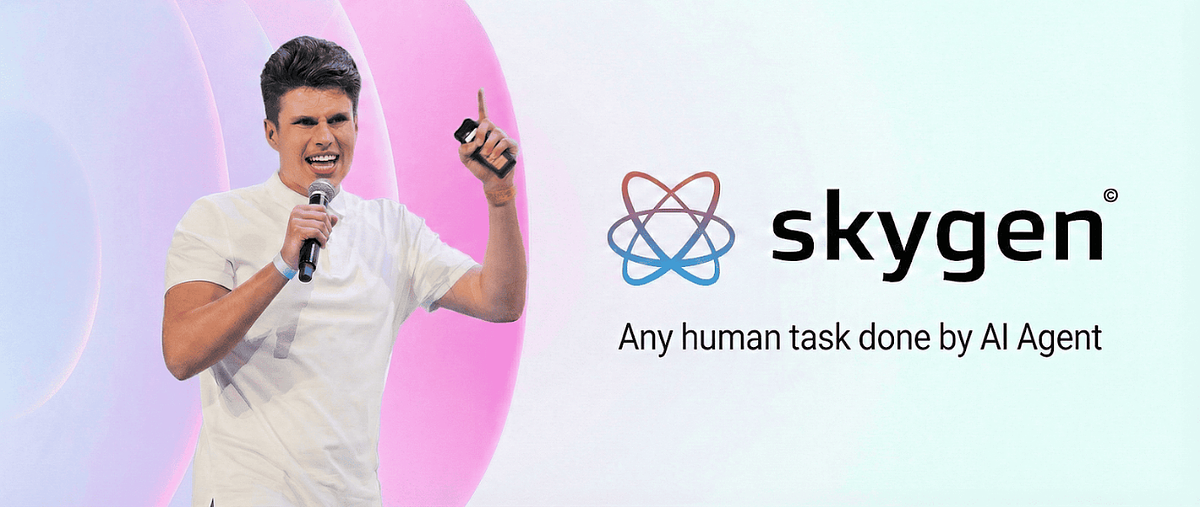
Skygen.AI Debuts With $7M, Vowing to Give AI 'Hands, Not Just a Voice'
SAN FRANCISCO, CA – February 16, 2026 – While the artificial intelligence market buzzes with increasingly sophisticated conversationalists, a new startup is making an audacious claim: the era of the chatbot is over. Skygen.AI has emerged from stealth mode, announcing a $7 million seed funding round and the launch of what it calls the world's first autonomous Execution Layer. Founded by 19-year-old Mike Shperling, the company is challenging the industry to move beyond AI that simply gives advice to AI that actually performs the work.
Beyond Conversation: The Rise of 'Hands-On' AI
For years, the primary interface for AI has been a text box. Users ask questions, and large language models provide answers. Skygen.AI argues this model is fundamentally inefficient, leaving a critical gap between insight and action. The company's core innovation, an autonomous Execution Layer, aims to close that gap by giving AI digital 'hands' to operate any piece of software just as a human would.
This is accomplished through a proprietary 'Computer Use mode,' which allows the AI agent to visually interpret a computer screen in real time. Instead of relying on brittle APIs that may be limited or non-existent, the agent 'sees' and interacts directly with graphical user interfaces. It can navigate complex enterprise software, from CRMs and ERPs to proprietary banking platforms, executing tasks by clicking buttons, filling forms, and interpreting data on the screen. The company claims this method is two to three times faster than any existing market alternative.
"We’ve stopped building assistants that give advice. We’ve created employees that do the work," stated founder Mike Shperling in the company's announcement. "If your AI still requires a human to copy-paste its response into another program, you’re living in the past. Skygen closes that gap at record-breaking speeds."
This approach positions the technology as a direct evolution of business process automation, moving from scripted actions to dynamic, goal-oriented execution.
A New Player in a Crowded Automation Market
Skygen.AI enters the hyperautomation market, a sector projected to swell from $46.4 billion in 2024 to over $276 billion by 2035. This space has long been dominated by Robotic Process Automation (RPA) giants like UiPath and Automation Anywhere, which excel at automating highly structured, repetitive tasks. However, RPA's reliance on predefined scripts makes it fragile; a minor change in a software's interface can break the automation entirely.
Autonomous agents represent a paradigm shift from automation to autonomy. By leveraging generative AI, these systems can reason, learn, and adapt to changing environments. Where RPA follows a script, an autonomous agent understands a goal. If an interface changes, the agent can analyze the new layout and determine how to proceed, much like a human employee would. Skygen.AI's technology places it firmly in this emerging category, competing with other agentic AI startups like Adept AI and Cognition Labs to define the future of work.
The market appears ready for this shift. Recent industry surveys indicate that as many as 85% of enterprises plan to deploy AI agents by 2025, driven by the promise of dramatic efficiency gains, reduced operational costs, and enhanced decision-making capabilities.
Under the Hood: Speed, Learning, and Endurance
To deliver on its promise of high-speed, long-duration autonomy, Skygen.AI has developed a sophisticated architecture. The system is managed by a central orchestrator that deploys specialized sub-agents, powered by models like Gemini Flash, to handle specific parts of a complex task. This distributed design is engineered to prevent 'context overflow'—a common failure point where long-running AI tasks lose track of the original goal. By intelligently summarizing progress and maintaining focus, the system can operate autonomously for several hours on a single, complex objective.
Beyond raw execution, the platform features 'In-Context Learning.' As the agent works, it observes the user's communication style and workflows. It stores key information—such as important contacts, preferred communication channels, or multi-step processes—as structured notes. This allows the agent to become progressively more efficient and personalized over time, adapting to individual and team-specific needs without requiring explicit reprogramming.
Furthermore, a specialized 'deep research mode' enables the agent to perform autonomous market analysis and data retrieval tasks, which the company claims achieves one of the highest accuracy rates in the industry, far outperforming standard AI-powered search tools.
The Trust Equation: Security in an Autonomous Age
Granting AI direct control over sensitive enterprise systems raises immediate and significant security concerns. With industry reports showing that 80% of enterprises cite security as the primary barrier to AI agent adoption, building trust is paramount. Skygen.AI addresses this head-on, describing its approach as a 'religion of security.'
Every agent operates within a completely isolated Virtual Machine (VM), a sandboxed environment that contains its activities and prevents any potential spillover into the broader network. The company provides a firm guarantee that user data never leaves this protected perimeter and is never used for training its AI models—a critical commitment that addresses major privacy concerns prevalent in the AI industry.
To manage the risks of unchecked autonomy, the system incorporates a security layer with built-in 'Guardrails.' These rules are designed to constrain the agent's actions and enforce a principle of least privilege. For any critical or ambiguous action, such as deleting data or authorizing a financial transaction, the agent is hardwired to halt its operation and request explicit permission from a human user. This framework aligns with cybersecurity best practices for mitigating risks like data exfiltration and privilege escalation, creating a system of human-in-the-loop oversight.
As businesses weigh the transformative potential of autonomous AI against its inherent risks, this focus on a secure, controllable, and transparent architecture may prove to be Skygen.AI's most crucial differentiator. The path forward for agentic AI will depend not only on its capability but on its ability to earn the trust of the enterprises it aims to serve.