
- 60 years of service: The Trauma & Burn Department at Stroger Hospital has been operating since 1966.
- 4,000 patients annually: The unit cares for an average of 4,000 patients each year.
- 25% lower risk of death: Patients treated at ACS-verified Level I centers have a 25% lower risk of death.
Experts agree that Stroger's Trauma Unit has set a national gold standard for trauma care, combining innovation, comprehensive treatment, and unwavering public service to save lives and transform medical practices.
Six Decades of Lifesaving: Stroger's Trauma Unit's Enduring Legacy
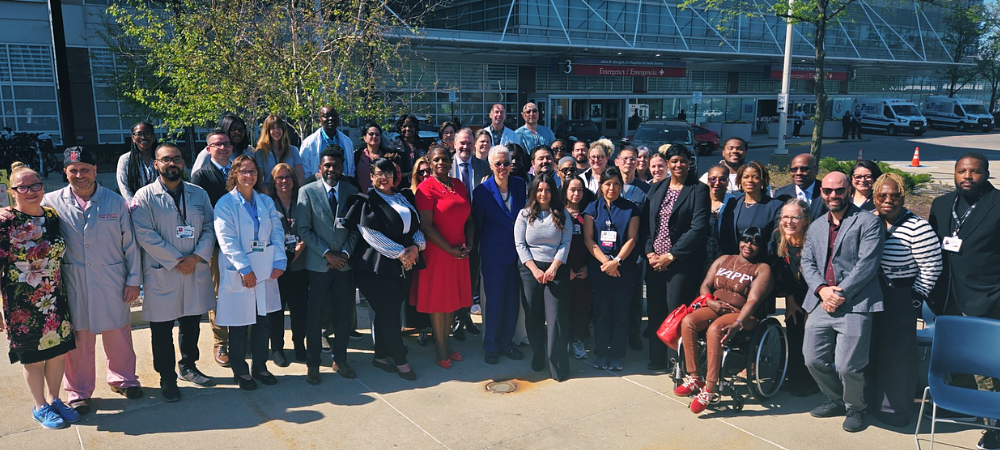
CHICAGO, IL – April 23, 2026 – On a day of reflection and recognition, Cook County Health celebrated the 60th anniversary of the Trauma & Burn Department at John H. Stroger, Jr. Hospital, honoring an institution that not only pioneered modern trauma care in the United States but has remained a steadfast bastion of hope and healing for the Chicago community.
Since its inception in 1966, the unit has been more than just an emergency room; it has been a crucible of innovation, a classroom for generations of medical professionals, and a vital safety net for millions. On Tuesday, county leaders, hospital officials, and former patients gathered to commemorate six decades of service that have saved countless lives and fundamentally transformed the practice of medicine.
A Pioneering Vision for Trauma Care
In the mid-1960s, the concept of a dedicated, comprehensive trauma unit was revolutionary. The 'brainchild' of Drs. Robert Baker and Robert Freeark at the former Cook County Hospital, the unit was born from a new way of thinking. Inspired by specialized hospitals in Austria designed to treat victims of high-speed car crashes with techniques honed in combat zones, they envisioned a system that moved beyond ad-hoc emergency treatment. Their goal was to create a designated space staffed by a specialized surgical, medical, and nursing team available 24/7 to handle the most critical injuries.
This established the first comprehensive trauma unit in the nation, integrating everything from pre-hospital coordination and critical care surgery to rehabilitation and long-term follow-up. It was a paradigm shift. In its first year, the unit treated 1,000 patients. By the 1970s, it had become the blueprint for trauma centers across the country, spurring the development of state and local Emergency Medical Services (EMS) systems.
“We are here today because decades ago, Drs. Baker and Freeark knew that we could deliver care in a better way,” said Dr. Mallory Williams, the current Chair of Trauma and Burn Services at Stroger. “Their legacy ensures that lives that might not have been able to have been saved in a previous era can be saved today. We carry their work forward every day because Cook County residents deserve to know we are here for them in their most vulnerable moments.”
The Heartbeat of a City's Safety Net
Today, the unit stands as one of the busiest in the nation, caring for an average of 4,000 patients annually. Its team confronts the brutal realities of urban life daily, treating complex injuries from falls and car accidents alongside a staggering volume of penetrating wounds. Approximately a quarter of its patients arrive with gunshot or stabbing injuries, making the unit a frontline defense against the epidemic of violence.
This unwavering service is central to the mission of Cook County Health. “For 60 years, the trauma team at Cook County Health and John H. Stroger Hospital has represented the very best of public service with an unwavering commitment to care for every person who needs it,” Cook County Board President Toni Preckwinkle stated during the anniversary celebration. “This department helped transform trauma medicine in Chicago and across the nation, proving that world-class care and human dignity must go hand in hand.”
The commitment extends beyond the operating table. The unit's multidisciplinary approach integrates social services and rehabilitation, recognizing that true recovery involves more than just mending physical wounds. This philosophy is embodied in programs like Healing Hurt People-Chicago, which provides intensive case management, therapy, and mentoring to help violently injured youth heal emotionally and break cycles of trauma.
“Cook County Health has long worked to ensure that every patient has access to the care they need,” said Cook County Health CEO Dr. Erik Mikaitis. “But we have also long believed that it’s not enough to simply treat the injury, we must also treat the person. Our trauma team’s legacy is built on the idea that world-class care should be available to everyone, regardless of their circumstances.”
Forging a National Gold Standard
The unit’s leadership was formally recognized on a national stage in 2025 when Stroger Hospital earned Level I trauma center verification from the American College of Surgeons (ACS). This prestigious achievement made Stroger the only hospital in Chicago and just the second in Illinois to meet the ACS's rigorous standards, which are considered the gold standard for trauma care.
Level I verification signifies the absolute highest level of readiness. It requires 24/7 in-house coverage by trauma surgeons and immediate availability of specialists in neurosurgery, orthopedics, and anesthesiology, among others. Studies show that patients treated at ACS-verified Level I centers have a 25% lower risk of death. This elite status is the result of a deep institutional commitment to resources, protocols, and continuous performance improvement.
The impact of this high standard reverberates throughout the entire hospital. “When you build one of the strongest trauma programs in the country, you don’t just improve trauma care at a hospital, you elevate all of the other services that support it,” explained Donnica Austin Cathey, Chief Hospital Executive at Stroger Hospital. “A trauma patient’s care may include experts in anesthesiology, neurology, gastroenterology, orthopedics, rehabilitation and more. Bringing those disciplines together at this level of medical complexity enhances quality and outcomes of care across our entire health system.”
A Critical Training Ground for Nation and Navy
The unique and challenging environment at Stroger has also made it an indispensable training partner for the U.S. military. Since 2013, the hospital has provided collaborative learning experiences for the U.S. Navy's medical personnel. This partnership was significantly expanded in 2022, embedding entire Navy Expeditionary Resuscitative Surgical System (ERSS) teams at Stroger for multi-year orders.
These teams—consisting of surgeons, nurses, anesthesiologists, and technicians—rotate through the trauma unit to gain invaluable, hands-on experience with the types of high-acuity, penetrating injuries they will face on the battlefield. The high volume of such cases at Stroger provides a level of training that is nearly impossible to replicate in traditional military treatment facilities. This nationally recognized military-civilian partnership ensures that Naval medical teams are mission-ready, fostering unit cohesion and ultimately saving lives in combat zones.
For 60 years, the Trauma & Burn Department at Stroger Hospital has been a story of resilience, innovation, and profound public service. From its revolutionary founding to its modern-day status as a national leader, it has remained a beacon for the people of Cook County, proving that even in the most vulnerable moments, there is a place of healing, expertise, and unwavering human dignity.