
- 40% of U.S. fleet could be unmanned by top commanders' projections.
- 6 months of autonomous surveillance capability with ThayerMahan's SeaPicket® system.
- 2022 Nord Stream pipeline sabotage highlighted vulnerabilities in undersea infrastructure.
Experts agree that autonomous undersea surveillance systems are now essential for modern naval defense, offering cost-effective, persistent monitoring to counter evolving global threats.
Silent Sentinels: CT Tech Redefines US Naval Defense Amid Global Threats
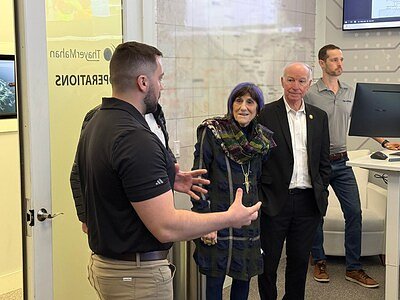
GROTON, CT – April 16, 2026 – As the global maritime environment grows increasingly contested, key congressional and defense leaders are turning their focus to a quiet revolution in undersea technology unfolding in southeastern Connecticut. A high-level delegation, including Congresswoman Rosa DeLauro and Congressman Joe Courtney, visited the headquarters of maritime tech firm ThayerMahan last week, signaling a pivotal moment in the nation's strategy to counter escalating undersea and surface threats.
The April 10th visit was not a routine tour but a pointed engagement driven by urgent necessity. With tensions simmering from the Red Sea to the South China Sea, the U.S. Navy's traditional fleet is stretched thin. In response, the Pentagon and Capitol Hill are accelerating the push for autonomous systems that can provide persistent surveillance without putting sailors in harm's way, and ThayerMahan has emerged as a key provider of these operational, ready-now capabilities.
A New Era of Maritime Insecurity
The demand for advanced, uncrewed maritime systems is a direct response to a complex web of modern threats. In recent months, Houthi rebels have used low-cost drones and missiles to effectively disrupt global shipping in the Red Sea, while China continues to employ “gray-zone” tactics—coercive actions that fall short of open warfare—to assert dominance in the South China Sea. These incidents highlight the vulnerability of maritime trade and the limitations of deploying expensive, crewed warships for constant monitoring missions.
More insidiously, the proliferation of Unmanned Underwater Vehicles (UUVs) by state and non-state actors presents a growing threat to naval assets, ports, and critical undersea infrastructure like communication cables and pipelines. The sabotage of the Nord Stream pipeline in 2022 served as a stark reminder of the vulnerability of this vital infrastructure. These challenges demand a new layer of persistent, wide-area surveillance that the current fleet, constrained by shipbuilding timelines and personnel, cannot meet alone.
“The security environment has shifted dramatically, and undersea awareness has become more important than ever,” said Congressman Courtney, the Ranking Member of the House Seapower and Projection Forces Subcommittee. He stressed that innovative unmanned systems are essential to relieve pressure on the nation's submarine force and provide commanders with constant awareness in contested waters.
Connecticut's Answer: Autonomous Watchkeepers
During their visit, the delegation witnessed the technologies ThayerMahan has developed to meet these challenges head-on. The company showcased a suite of autonomous solutions, moving the concept of unmanned surveillance from experimental to operational. These systems are designed to serve as the eyes and ears of the fleet, operating for months at a time in remote and dangerous waters.
Key systems on display included:
- SeaPicket®: A long-endurance acoustic monitoring system that can be deployed for up to six months, using passive sonar to detect and classify contacts over vast areas. This system provides the persistent overwatch needed to monitor strategic chokepoints or protect offshore infrastructure.
- Outpost®: A mobile, autonomous surface vehicle that provides 24/7 surveillance, capable of carrying advanced sonar payloads to detect undersea threats.
- SeaGuard™: The company’s newly launched system designed to provide a non-kinetic (non-explosive) defense against hostile UUVs. This technology offers a crucial protective shield for ports, naval bases, and high-value ships without escalating a conflict.
Congresswoman DeLauro, the powerful Ranking Member of the House Appropriations Committee, emphasized the strategic importance of this locally-driven innovation. "ThayerMahan is delivering unparalleled undersea defense technology right here in Connecticut," she stated. "Increasing our underwater capacity to improve our surveillance capabilities and better address threats is crucial to strengthening our national defense. ThayerMahan's innovative technology, driven by skilled Connecticut employees, reinforces our state as a leader in defense while strengthening our domestic industrial base."
A Strategic Pivot for Naval Power
The focus on companies like ThayerMahan reflects a fundamental shift in U.S. naval strategy. Top commanders have indicated a future fleet where as much as 40% of its vessels could be unmanned. The logic is compelling: deploy autonomous systems for the “dull, dirty, and dangerous” work of persistent surveillance, freeing up billion-dollar submarines and aircraft carriers for the most critical combat and deterrence missions.
Mike Connor, ThayerMahan's Chairman and CEO and a former Commander of the U.S. Submarine Force, framed the technology's immediate relevance. "Security challenges today are global, persistent, and increasingly complex," he said. "Autonomous sensing is no longer experimental - it's operational, and the demand signal is growing rapidly." By offering a cost-effective, rapidly deployable complement to traditional naval assets, these systems act as a force multiplier at a time of unprecedented strain on the fleet.
This approach allows the Navy to cover more ocean with fewer people, gather vast amounts of intelligence through systems like ThayerMahan's TransparenSea® software, and present a more resilient and distributed force posture to potential adversaries.
The 'Undersea Capital' and Its Champions
The visit also highlighted Connecticut’s central role in America's defense-industrial base. Groton, long known as the 'Submarine Capital of the World' for its role in building the nation's nuclear submarine fleet at General Dynamics Electric Boat, is now also an epicenter for the autonomous systems that will support and protect those very submarines. ThayerMahan's heavy investment in local facilities, talent, and its regional supply chain is a significant contributor to this ecosystem.
The presence of DeLauro and Courtney was particularly significant. As key figures on the committees that authorize and fund the military, their firsthand look and vocal support provide a strong tailwind for integrating these technologies into the fleet. For Congressman Courtney, the visit was a validation of his long-standing advocacy for undersea capabilities. "Friday's visit was different," he remarked. "It was a clear signal that ThayerMahan is ready now to deliver the capability our Naval, Coast Guard, and Border forces need at an incredible pace and impressive scale."
The day concluded with discussions on future missions and the need for continued alignment between innovators, the Department of Defense, and Congress. As the oceans become the new frontline of global competition, the silent, autonomous sentinels being built in Connecticut are set to play an increasingly vital role in securing American interests.
Topics & Related
Software & SaaS
AI & Machine Learning
Aerospace & Defense
Artificial Intelligence
Trade Wars & Tariffs
Related Company Pulse