
- 36% reduction in On-Demand team expenses
- 197% increase in bookings per broker
- 75% surge in on-platform transactions
Experts would likely conclude that Surf Air's AI-driven digital infrastructure strategy represents a transformative approach to regional aviation, though its long-term success hinges on execution and market adoption.
Signal From the Noise: Surf Air's AI Play to Rewire Regional Aviation
LOS ANGELES, CA – June 16, 2026 – When Surf Air Mobility took the stage at Palantir’s recent AIPCon, it wasn't just to showcase another piece of software. The demonstration of its BrokerOS, supercharged by Palantir’s Artificial Intelligence Platform (AIP), offered a glimpse into a far more ambitious project: building a unified operating system for the notoriously fragmented world of regional aviation. While many companies are chasing the dream of electric flight, Surf Air is tackling a different, yet equally critical, challenge—digitizing the complex, often archaic, operational backbone of the industry itself.
By integrating its own airline operations with advanced software development, the Los Angeles-based company is creating a powerful flywheel. It’s a strategy that moves beyond the press release, revealing a calculated effort to become the essential digital infrastructure layer upon which the next generation of air travel will be built.
An AI-Powered Control Tower
At the heart of Surf Air's strategy is SurfOS, a software suite built on Palantir's Foundry and AIP. The vision, as articulated by co-founder Liam Fayed, is to create a single source of truth for an ecosystem that currently relies on a patchwork of disconnected systems. The recently showcased BrokerOS is the customer-facing piece of this puzzle, a mobile application launched in late 2025 that streamlines flight management and aircraft sourcing for charter services.
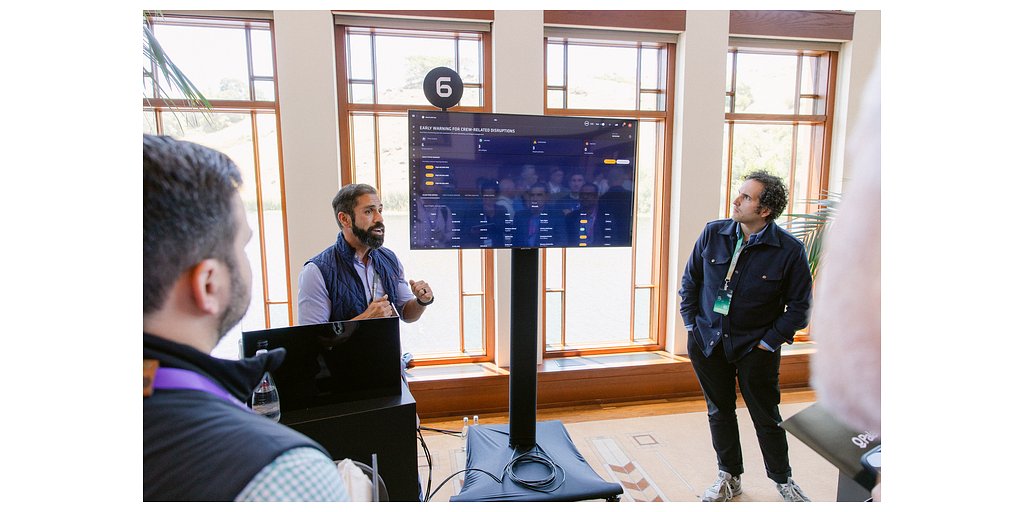
With the integration of Palantir's AIP, however, BrokerOS transforms from a simple booking tool into an intelligent agent. The platform now leverages AI to optimize everything from dynamic pricing and crew scheduling to aircraft sourcing and managing critical Aircraft on Ground (AOG) recovery scenarios. The results from internal adoption are compelling: the company reports a 36% reduction in its On-Demand team expenses, a 197% increase in bookings per broker, and a 14% decrease in the time it takes to convert a quote into a booking. On-platform transactions have surged by 75%.
This is more than just a front-end application. SurfOS provides a real-time “control tower” that offers leadership instant situational awareness across operations, maintenance, and flight logistics. Its AI-powered pricing engine, fed by data from thousands of flights, can now perform complex optimizations that once took large teams days to complete. The next piece of the puzzle, OperatorOS, is set for commercial launch later this year, promising to extend these capabilities directly to aircraft operators with tools for scheduling, crew optimization, and operational visibility.
A Partnership Forged in Equity and Data
Surf Air’s relationship with Palantir is far deeper than a typical software license. It is a foundational partnership built on a shared strategic vision and cemented with equity. Palantir holds a significant 20% stake in Surf Air Mobility, a result of a “barter for services” arrangement that underscores its belief in the company’s long-term value. This bond was further solidified when Surf Air made a $6 million equity prepayment for continued access to Palantir’s software and services.
This alliance fits perfectly within Palantir's broader strategy of embedding its powerful AI platform into the core of critical infrastructure sectors. Just as it is doing with GE Aerospace for military aircraft readiness and Archer Aviation for air traffic control, Palantir is positioning itself as the indispensable digital backbone for industries in transition. For Surf Air, the partnership provides access to world-class AI tools without the prohibitive upfront cash expenditure that could cripple a growing company.
Looking ahead, the two plan to form Surf Air Technologies LLC, a dedicated venture to commercialize SurfOS. The target is the vast and fragmented “Part 135” market, which encompasses the thousands of smaller charter operators and private planes that form the backbone of regional air mobility. By offering a sophisticated, AI-driven operating system, Surf Air aims to bring a new level of efficiency and connectivity to a market ripe for disruption.
The Flywheel: Blending Operations and Software
The most compelling aspect of Surf Air Mobility's strategy is its unique business model. Unlike pure software firms that lack operational context or pure airlines that lack deep tech capabilities, Surf Air is both. The company operates one of the largest commuter airline networks in the United States through its ownership of Southern Airways and Mokulele Airlines, alongside its Surf On Demand private charter business. These are not side businesses; they are a living laboratory.
Every module of SurfOS is developed, tested, and validated within its own real-world flight operations. This provides an invaluable feedback loop and a rich source of proprietary data that pure-play software competitors simply cannot replicate. It’s a classic flywheel effect: the airline operations generate the data to build better software, and the software, in turn, makes the airline operations more efficient and profitable. This operational scale gives Surf Air a significant competitive advantage in a regional air mobility market projected to explode from around $5.6 billion in 2024 to over $70 billion by 2034.
This integrated approach allows the company to address a total addressable market it estimates at $156 billion, spanning chartered transport, aircraft sales, and maintenance. By proving the software's value internally—as demonstrated by its impressive efficiency metrics—Surf Air builds an undeniable case for its adoption by third-party operators.
Navigating Toward a Sustainable Future
This ambitious strategy is not without financial turbulence. Surf Air reported a net loss of $20.3 million for the first quarter of 2026 on revenues of $25.6 million. Yet, beneath the surface, the operational flywheel appears to be gaining momentum. The company’s adjusted EBITDA loss of $12.3 million was better than guidance, thanks to improving private charter margins and the cost efficiencies delivered by SurfOS. Revenue per flight jumped 38% year-over-year, and the company projects full-year revenue growth of 20% to 30%.
Investors and analysts are watching closely, with ratings generally holding in cautious territory as they weigh the immense potential against the execution risks. The partnership with Palantir provides a significant backstop, but challenges from emerging eVTOL competitors and potential delays in aircraft electrification remain.
Ultimately, Surf Air's digital infrastructure play is inextricably linked to the future of sustainable aviation. The company is actively working with Textron to develop electrified powertrains for the Cessna Caravan—a workhorse of regional aviation—and is a launch partner for BETA Technologies' passenger electric aircraft. SurfOS is being purpose-built to manage the unique operational complexities of a future electrified fleet, from battery management to charging logistics. By building the digital rails today, Surf Air is positioning itself to be the central nervous system for the cleaner, more efficient, and more accessible regional aviation of tomorrow.