
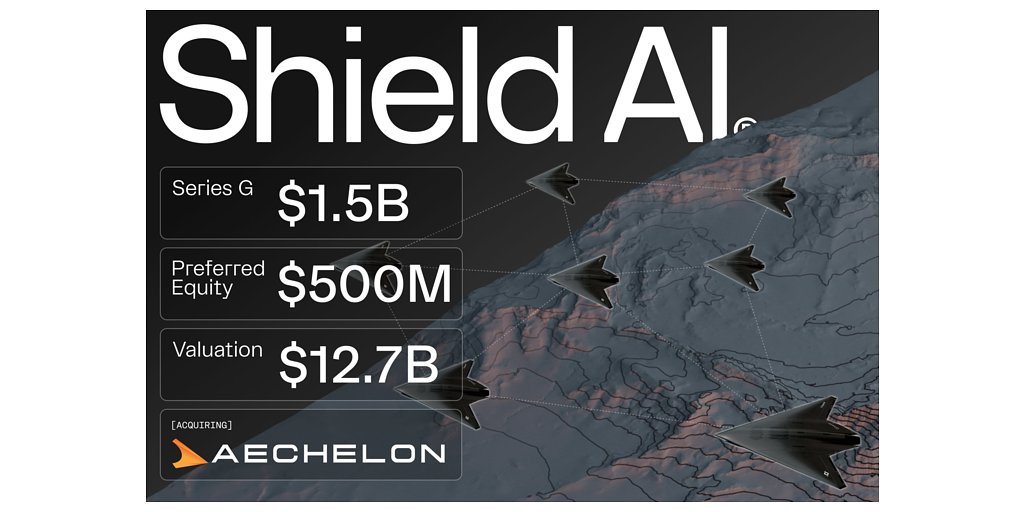
- $12.7B Valuation: Shield AI's new valuation after securing $2B in financing, placing it among top defense tech startups.
- $2B Financing: Composed of a $1.5B Series G round and a $500M preferred equity investment.
- 26 Aircraft Classes: Hivemind AI pilot software has been flown on 26 different vehicle classes, including F-16s.
Experts view Shield AI's valuation and strategic acquisitions as a pivotal shift toward AI-driven autonomous warfare, reflecting growing investor confidence in defense technology innovation and the U.S. military's push for AI-based warfighting capabilities.
Shield AI's $12.7B Valuation Signals Dawn of Autonomous Airpower
SAN DIEGO, CA – March 26, 2026 – In a move that reverberates through the defense and technology sectors, Shield AI announced today it is securing $2 billion in new financing, rocketing its valuation to $12.7 billion and signaling massive investor confidence in a future defined by autonomous warfare. A significant portion of the capital is earmarked for the acquisition of Aechelon Technology Inc., a leader in the military simulation software used to train pilots and test the very systems Shield AI is building.
The deal underscores a fundamental and accelerating shift in military strategy: defense capabilities are no longer just forged in steel, but are increasingly coded in software, honed in hyper-realistic virtual worlds, and refined through real-world operational data.
A New Titan in Defense Tech
The financial scale of the announcement places Shield AI firmly in the upper echelon of defense technology startups. The funding is composed of a $1.5 billion Series G round led by private equity giant Advent International and co-led by the Strategic Investment Group of JPMorganChase, alongside a $500 million preferred equity investment from funds managed by Blackstone. The deal is significant enough to warrant high-level board changes, with Advent’s Chairman David Mussafer joining Shield AI’s Board of Directors and JPMorganChase’s Todd Combs joining as a Board Observer.
This $12.7 billion valuation is not just a number; it is a statement. It places the company in the same league as its most prominent competitor, Anduril Industries, which was recently valued at $14 billion. This move reflects a powerful trend of venture capital and private equity pouring into a sector once dominated by legacy government contractors. With global military expenditures projected to climb significantly, investors see a fertile market for disruptive technologies, particularly in artificial intelligence, where defense-related AI contracts have nearly doubled in the past two years.
“Shield AI is a rare asset with the potential to deliver strong growth over the coming years,” said Advent’s David Mussafer, highlighting the company’s scaling V-BAT aircraft and the game-changing potential of its X-BAT fighter concept. “Hivemind is one of the most experienced and proven AI pilots in the world. We couldn’t be more excited to partner with the Shield AI team.”
Todd Combs of JPMorganChase echoed this sentiment, framing the investment as part of a mission to “accelerate innovation, reinforce the defense industrial base, and help advance and scale mission-critical solutions.”
From Simulation to Supremacy: The Aechelon Advantage
Central to this massive investment is the planned acquisition of Aechelon Technology. While less known to the public, Aechelon is a critical supplier within the defense ecosystem, providing the ultra-realistic simulation environments that the U.S. military and its allies depend on. The company is the technology provider for the Pentagon's Joint Simulation Environment (JSE), a vital program for testing next-generation combat aircraft like the F-35 and F-22.
By acquiring Aechelon, Shield AI is not just buying a software company; it is buying the digital training ground for its artificial intelligence. Aechelon’s synthetic reality platforms create geo-specific, high-fidelity virtual worlds where AI can be trained, tested, and validated at a scale and speed impossible in the physical world. This allows for millions of flight hours and combat scenarios to be run in simulation, rapidly accelerating the development of AI pilots without risking billion-dollar aircraft or human lives.
“The acquisition of Aechelon will accelerate the work we are doing with Hivemind, particularly in simulation like the Department of War's JSE,” said Shield AI CEO Gary Steele. He noted that the acquisition will advance the company’s “Hivemind Foundation Model for Defense,” which is trained in simulation and continuously refined through real-world operations.
Ignacio Sanz-Pastor, Aechelon's co-founder and CEO, who will continue to lead the company under Shield AI's ownership, expressed enthusiasm for the merger. “Their vision of a future filled with autonomous systems protecting service members and civilians, and deterring conflict, is inspirational. I couldn’t think of a better new home for the Aechelon team than Shield AI,” he stated.
Hivemind: The Brains Behind the Autonomous Fleet
At the heart of Shield AI’s valuation and strategic vision is Hivemind, its AI pilot software. Hivemind is designed to be a platform-agnostic brain that can fly a wide array of aircraft, from helicopters and drones to fighter jets. It has already been flown on 26 different vehicle classes, including F-16s. Unlike a traditional autopilot, Hivemind enables aircraft to execute complex missions autonomously, even when GPS signals are jammed or communication links are severed—a critical capability for a potential conflict with a peer adversary.
This capability has not gone unnoticed by the Pentagon. Shield AI was recently selected by the U.S. Air Force as a key autonomy provider for its landmark Collaborative Combat Aircraft (CCA) program. The CCA program aims to build thousands of autonomous drone wingmen to fly alongside manned fighters, dramatically increasing air combat mass and overwhelming adversaries. In a testament to the complex web of competition and collaboration in the sector, Hivemind is actively being flight-tested on the YFQ-44A CCA prototype, an aircraft built by rival Anduril.
The Strategic Shift in Modern Warfare
The convergence of massive funding, advanced AI, and high-fidelity simulation represents more than just a corporate transaction; it's a waypoint in the future of warfare. The move directly aligns with the U.S. Department of Defense's strategy to become an “AI-based warfighting force,” leveraging private sector innovation to maintain a technological edge. Programs like CCA are the tangible result of this strategy, shifting the paradigm from a small number of exquisite, expensive platforms to a larger, more expendable and adaptable force mix.
However, the rapid advancement of such autonomous systems also brings complex ethical questions to the forefront. International debates, particularly at the United Nations, continue to grapple with the implications of Lethal Autonomous Weapons Systems (LAWS) and the imperative to maintain “meaningful human control” over the use of force. While companies like Shield AI focus on creating intelligent systems to protect service members and deter conflict, the technology's dual-use nature ensures that policy and ethics will have to evolve just as quickly as the software itself. As virtual worlds become the primary training ground for AI warfighters, the line between simulation and reality is blurring, heralding a new and uncertain era in global security.