
- $750 billion: Global capital expenditures on data centers projected in 2026
- 8x reduction: PowerCab2's footprint compared to traditional setups
- -40°C to 55°C: Operating temperature range for harsh environments
Experts would likely conclude that SENS PowerCab2 offers a significant advancement in critical power infrastructure by reducing risk, improving reliability, and streamlining deployment through factory-integrated systems.
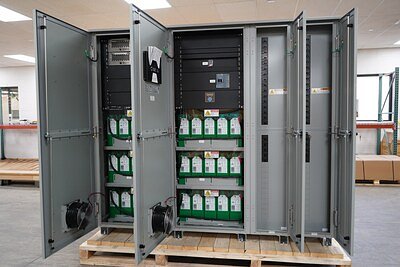
SENS PowerCab2 Aims to Overhaul Critical Power Infrastructure
LONGMONT, CO – April 28, 2026 – Stored Energy Systems (SENS) is challenging the decades-old practice of building critical DC power systems in the field, piece by piece. The company is set to showcase its PowerCab™2, a fully integrated and factory-tested DC power system, at the upcoming IEEE PES Transmission & Distribution Conference & Exposition in Chicago. The solution aims to replace complex, multi-vendor field assemblies with a standardized, pre-engineered cabinet, promising to reduce risk, accelerate deployment, and improve reliability for the world's most mission-critical infrastructure.
For industries where downtime is not an option—from sprawling data centers powering the AI revolution to the electrical substations that form the backbone of the grid—the reliability of backup power is paramount. The traditional approach has been to procure individual components like chargers, batteries, and distribution panels from various manufacturers and assemble them on-site. SENS argues this method, while common, introduces significant and often hidden risks that can compromise the very systems they are designed to protect.
The Hidden Risks of Field-Built Power Systems
The conventional method of constructing DC power systems on-site is fraught with potential pitfalls. Project managers and engineers must juggle multiple vendors, complex interfaces, and various installation teams. This fragmented approach often leads to inconsistent workmanship, wiring errors, and termination faults that can be difficult to detect until the system is under load or, in the worst-case scenario, during a power failure.
This complexity creates a cascade of issues. Procurement becomes a tangled web of separate part numbers and purchase orders. Installation schedules are frequently delayed by coordination challenges and the need for specialized labor. Commissioning can be a lengthy and unpredictable process as engineers work to validate the performance of a system that has never been tested as a complete, integrated unit. The result is increased project risk, budget overruns, and a higher total cost of ownership.
"Operators today manage too many vendors, interfaces, and handoffs in the field, and that complexity often isn't visible until something fails," said Olen Scott, Chief Commercial Officer at SENS, in a recent announcement. The long-term reliability of such systems can be a gamble, dependent on the variable quality of field integration rather than the certainty of a controlled manufacturing process.
From Complexity to Simplicity: A Factory-First Approach
PowerCab2 represents a fundamental shift in philosophy: moving the complex integration work from the unpredictable environment of a construction site to the controlled precision of a factory floor. The platform integrates power conversion, battery storage, AC/DC distribution, and advanced monitoring into a single, pre-engineered cabinet. Each unit is designed, assembled, and rigorously tested as a complete system at SENS's ISO 9001-2015 certified facility before it ever ships.
This factory-first approach provides a level of quality assurance that is difficult to replicate in the field. By engineering the entire system as a cohesive unit, SENS aims to eliminate the integration errors that plague multi-vendor solutions. The system is UL Listed for both the US and Canada, simplifying compliance and inspection processes. For customers, the process is streamlined to a single part number, a single vendor, and a single point of responsibility.
"By engineering, integrating, and testing the full DC power system before it ships, we reduce that risk and give operators confidence it will perform when it matters most," Scott explained. This approach delivers what the company calls "powerful simplicity"—an integrated architecture that ensures performance under real-world conditions, not just on-paper design specifications, providing an "always-on" power experience.
Powering the Engines of a Digital and Electrified World
The demand for faster, more reliable, and more efficient power infrastructure has never been greater, driven by two powerful global trends: the explosive growth of data centers and the urgent need to modernize the electrical grid.
Data centers, particularly the hyperscale facilities that power cloud computing and artificial intelligence, are being built at an unprecedented rate, with global capital expenditures projected to approach $750 billion in 2026. For these operators, speed to market is a critical competitive advantage, and physical space is a highly valuable commodity. PowerCab2 directly addresses these needs by dramatically decreasing installation time and field labor while reducing the system's physical footprint by up to 8x compared to traditional setups. This allows data centers to come online faster and dedicate more of their costly floor space to revenue-generating servers.
Simultaneously, the transmission and distribution (T&D) sector is grappling with aging infrastructure, the challenges of integrating renewable energy, and the increasing frequency of extreme weather events. Utilities require robust, reliable, and resilient power solutions that can withstand harsh conditions. PowerCab2 is engineered to meet these demands, offering configurations for N+1 or dual-bus architectures for enhanced reliability. Its availability in NEMA 3R enclosures ensures operation in harsh outdoor environments, with a temperature range from -40°C to 55°C, making it suitable for utility substations and other remote industrial applications.
A Strategic Showcase at a Premier Industry Forum
SENS's decision to feature PowerCab2 at the IEEE PES T&D Conference is a clear statement of intent. The conference is widely regarded as the leading event for the electric power industry, attracting over 10,000 professionals from utilities, equipment manufacturers, and grid technology suppliers. The 2026 theme, "Strengthening T&D Systems for the Demands of Tomorrow," aligns perfectly with the core value proposition of the PowerCab2 system.
By presenting the solution at Booth #3670 to this influential audience, SENS is positioning its factory-integrated approach as a viable, and perhaps superior, alternative to the status quo in the utility sector. The showcase provides a platform to demonstrate how a standardized, pre-tested system can help utilities modernize their infrastructure, improve grid resilience, and reduce long-term operational risk.
The move toward pre-engineered, modular systems is a growing trend across many industries, driven by the need for greater predictability, quality control, and speed. By applying this principle to the foundational layer of critical DC power, SENS is not just launching a new product but advocating for a new standard. For the data centers, utilities, and industrial operators tasked with keeping the lights on, this shift from field-built complexity to factory-engineered certainty could prove to be a crucial step forward in building a more reliable and resilient future.