
- 24-year career: Dr. Dan Javorsek brings 24 years of U.S. Air Force experience, including leadership roles in F-35 testing and DARPA's AI-driven warfare programs.
- 3 strategic hires: Scientific Systems appoints Dr. Javorsek, Louis Dube, and Nick Dille to drive growth in aviation and tactical autonomy.
- 2,000+ flight hours: Dr. Javorsek has logged over 2,000 flight hours across 50+ aircraft, including F-16, F-22, and F-35.
Experts would likely conclude that Scientific Systems is strategically positioning itself as a leader in military autonomy by leveraging top-tier talent with deep defense and AI expertise, aligning closely with the Pentagon's JADC2 and Mosaic Warfare initiatives.
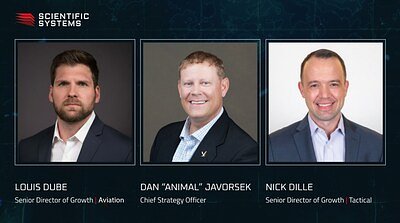
Scientific Systems Taps DARPA Vet to Lead Military Autonomy Strategy
BURLINGTON, Mass. – May 28, 2026 – Scientific Systems Inc., a specialist in artificial intelligence and autonomous systems, has significantly bolstered its leadership team by appointing Dr. Dan "Animal" Javorsek, a former high-ranking Air Force officer and DARPA program manager, as its new Chief Strategy Officer. The move, part of a trio of strategic hires, signals the company's aggressive ambition to scale its operations and solidify its position as a key provider of next-generation autonomous capabilities for the U.S. military.
Alongside Dr. Javorsek, the company has appointed Louis Dube as Senior Director of Growth for Aviation and Nick Dille as Senior Director of Growth for Tactical systems. These appointments represent a calculated effort to deepen the company's expertise and customer engagement across critical defense sectors, from large unmanned aircraft to tactical drones used by ground forces.
"These hires represent a major investment in both technical leadership and strategic growth," said Kunal Mehra, President of Scientific Systems, in a statement. "Animal, Louis, and Nick strengthen our ability to deliver intelligent, operationally relevant autonomy solutions that directly support the warfighter. They also bring the experience and leadership needed to help scale the company as demand for our capabilities continues to increase."
An Architect of AI-Driven Warfare Joins the Ranks
The appointment of Dr. Javorsek is particularly noteworthy, bringing a rare combination of elite operational experience and cutting-edge technological research to the firm. Before joining the private sector, he concluded a distinguished 24-year career in the U.S. Air Force, where his final role was Commander of the Air Force Operational Test and Evaluation Center's Detachment 6 at Nellis Air Force Base. In this capacity, he directed the operational test team for the F-35 Joint Strike Fighter, one of the most complex weapons systems in the world.
A command pilot with over 2,000 flight hours in more than 50 different aircraft, including the F-16, F-22, and F-35, Javorsek's value extends far beyond the cockpit. His tenure as a Program Manager at the Defense Advanced Research Projects Agency (DARPA) placed him at the heart of the Pentagon's push into AI-enabled warfare. At DARPA's Strategic Technology Office, he led pioneering research in AI and machine learning aimed at realizing two of the military's most transformative concepts: Mosaic Warfare and Joint All-Domain Command and Control (JADC2).
His work at DARPA included managing programs like the Air Combat Evolution (ACE) program, which famously pitted an AI agent against a human F-16 pilot in a simulated dogfight. This research was foundational to understanding how human-machine teaming could revolutionize air combat. Dr. Javorsek's deep involvement in these initiatives provides him with unparalleled insight into the architecture of future conflict, where disparate systems must collaborate seamlessly to overwhelm an adversary.
The Strategic Imperative for Connected Autonomy
The strategic context for these hires is the Pentagon's urgent push to develop and field multi-domain autonomous systems. JADC2, the concept Dr. Javorsek helped advance at DARPA, is the Department of Defense's answer to the increasing speed and complexity of modern warfare. It aims to create a unified network connecting sensors from every service—air, land, sea, space, and cyber—into a single, intelligent web. The goal is to provide commanders with a God's-eye view of the battlefield and drastically shorten the time between detection and engagement.
Multi-domain autonomy is the engine that will make JADC2 a reality. It involves creating intelligent, collaborative systems that can operate across these domains, often in environments where GPS and communications are denied. The ongoing conflict in Ukraine has served as a real-world laboratory, demonstrating both the immense potential and the brutal reality of drone and autonomous warfare. This has created an intense demand for the very technologies Scientific Systems specializes in.
By bringing in a key architect of the JADC2 concept, the company is positioning itself to not just participate in this technological shift, but to lead it. Dr. Javorsek's expertise ensures that the company's product roadmap will be intrinsically aligned with the military's most pressing strategic needs, developing systems that are not just technologically advanced but also operationally sound and combat-credible.
Building a Specialized Growth Machine
The appointments of Louis Dube and Nick Dille demonstrate a focused strategy to translate this high-level vision into market penetration and growth. Each brings a distinct and complementary skill set tailored to specific segments of the defense market.
Louis Dube, the new Senior Director of Growth for Aviation, has over 17 years of experience securing DARPA programs and supporting Air Force test activities. His recent work in the defense industry involved leading the development of production-level autonomy for large, high-altitude unmanned aerial vehicles (UAVs), often referred to as Group 4 and 5 systems. His role will be to cultivate relationships with customers pursuing advanced aviation autonomy, a field where human-machine teaming is becoming increasingly critical for platforms like the Collaborative Combat Aircraft (CCA).
In contrast, Nick Dille will focus on the tactical edge as Senior Director of Growth for Tactical systems. With a 25-year career in the U.S. Army and extensive experience in defense industry acquisition and program management, Dille is tasked with expanding the company's portfolio of small Unmanned Aerial Systems (UAS). This rapidly growing market involves providing autonomous capabilities for reconnaissance, surveillance, and targeting to ground troops, where ease of use and rugged reliability are paramount.
This dual focus on both high-end aviation and ground-level tactical systems allows Scientific Systems to address the full spectrum of military autonomous needs. The company, founded in 1990, has built a strong foundation with technologies like its ImageNav navigation system, which is already integrated into the U.S. Navy's Tomahawk cruise missile program. This new leadership infusion is designed to build upon that legacy, accelerating the transition of its advanced collaborative mission autonomy software from a specialized solution to a foundational component across the defense ecosystem.