
- 38 different technology solutions: School districts often juggle this many disparate tools, leading to inefficiencies.
- 40% of an administrator's time: Manual reconciliation between systems can consume this much of their workday.
- $20,000: The average cost to replace a single teacher, highlighting the financial impact of staff burnout.
Experts agree that schoolOS's AI-driven platform addresses critical inefficiencies in K-12 operations by unifying fragmented systems, reducing manual workloads, and enabling proactive management—ultimately improving district-wide efficiency and resource allocation.
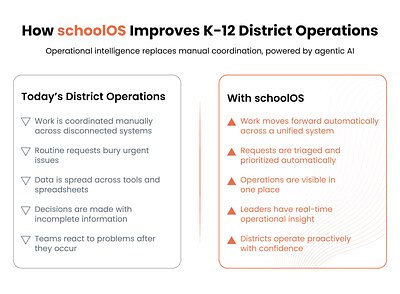
schoolOS Unveils AI Platform to Untangle K-12 Operational Chaos
SAN FRANCISCO, CA – April 09, 2026 – Tech startup schoolOS today announced the launch of its operational intelligence platform, a new system powered by agentic AI designed to bring order to the often-chaotic back-office operations of K-12 school districts. The platform aims to replace the patchwork of disconnected software that burdens IT staff and administrators, promising a unified, intelligent system to manage district operations.
For years, school districts have grappled with a growing collection of disparate digital tools for everything from helpdesk tickets and asset tracking to vendor management and student information. This digital fragmentation, while often unintentional, has created significant operational drag, forcing already-strained staff to perform manual data entry and coordination across systems that were never designed to communicate.
The High Cost of Digital Fragmentation
The challenges facing modern K-12 districts are immense. With budgets tightening after the expiration of federal pandemic relief funds and persistent staff shortages in both teaching and IT roles, the inefficiency caused by disconnected systems is more than a minor inconvenience—it's a critical financial and operational burden.
Research indicates that school districts can be juggling as many as 38 different active technology solutions at any given time. The effort to manually reconcile information between these systems can consume up to 40% of an administrator's time, diverting focus from strategic initiatives and student support. This constant, low-level friction contributes to staff burnout and turnover, a costly problem when replacing a single teacher can cost a district an average of $20,000.
"District operations typically rely on manual coordination across systems that were never designed to work together," said Rich Watson, co-founder and CEO of schoolOS, in today's announcement. "That's why work slows down, issues get buried, and leaders make decisions without full visibility. We built schoolOS to change that, so the coordination happens automatically and district teams can focus on what actually matters."
This lack of interoperability also poses significant security risks and hinders the adoption of advanced technologies. With student data privacy being a top concern for district technology leaders, managing security across dozens of siloed applications is a monumental task. Furthermore, the dream of leveraging AI to personalize learning is often blocked by the inability to access and analyze data locked away in separate systems.
Introducing Operational Intelligence with Agentic AI
schoolOS proposes a solution centered on a concept it calls "operational intelligence," powered by agentic AI. Unlike traditional automation that follows rigid, predefined rules, an agentic AI system is designed to perceive its environment, reason through problems, and take autonomous action to achieve its goals. In this context, the platform acts as a digital coordinator that learns from a district's daily activities.
By connecting to a district's various tools, the platform can automatically triage support requests, advance workflows without human intervention, and surface operational patterns over time. For example, the system could identify a recurring hardware issue with a specific model of student laptop, proactively order replacement parts, and schedule technician time before the problem becomes widespread.
This proactive and intelligent approach stands in contrast to the current reactive model prevalent in many districts. The goal is to move from putting out fires to preventing them, giving leaders a clear, real-time view of their operations and the data needed to make informed strategic decisions about budgets, staffing, and resource allocation.
A Practical Solution for Stretched Districts
To make this technology accessible, schoolOS is launching with a suite of three products built on its unified AI platform:
- schoolAssets: A free asset management system designed to give districts immediate visibility into their devices, warranties, and lifecycle history. By offering this crucial tool at no cost, schoolOS aims to provide an entry point for even the most budget-constrained districts.
- schoolChat: An AI-powered tool that resolves routine support requests and intelligently routes more complex issues to the correct personnel, reducing the burden on helpdesk staff.
- schoolAutomate: A feature that allows districts to build complex, cross-platform workflows using plain language, eliminating the need for custom development resources which are scarce in the education sector.
This strategy has already earned praise from early observers. "Managing district operations across disconnected systems has always meant someone has to manually hold it all together," noted Marc Elliott, CIO of Olympia School District. "I've been fortunate to have developer resources most districts don't have access to. For everyone else, that coordination falls on department staff doing it by hand, or it just doesn't get done. schoolOS is the first platform I've seen that actually addresses how operations work in practice."
A Bellwether for the Future of Ed-Tech
The launch of schoolOS is indicative of a broader maturation in the education technology market. The industry, long characterized by a proliferation of single-purpose apps, is now seeing a push toward consolidation and integration. As districts become more sophisticated technology consumers, the demand for platforms that simplify the IT landscape and provide holistic insights is growing.
The K-12 education technology market is projected to expand significantly, from an estimated USD 2.99 billion in 2026 to nearly USD 16.49 billion by 2035. Much of this growth is expected to be driven by AI, which is already used by a majority of teachers for lesson planning and instruction. However, to unlock the full potential of AI in the classroom, the operational foundation of the district must be solid. By streamlining backend processes, platforms like schoolOS could free up the necessary resources and create the data-rich environment needed to support next-generation educational tools.
Founded by a team with deep experience in K-12 technology and backed by seasoned entrepreneurs, schoolOS is positioning itself not just as a vendor, but as a partner in helping school districts navigate an increasingly complex technological and financial landscape. By tackling the unglamorous but essential work of operational efficiency, the company is betting that a well-run district is ultimately a better-equipped district to serve its students.