
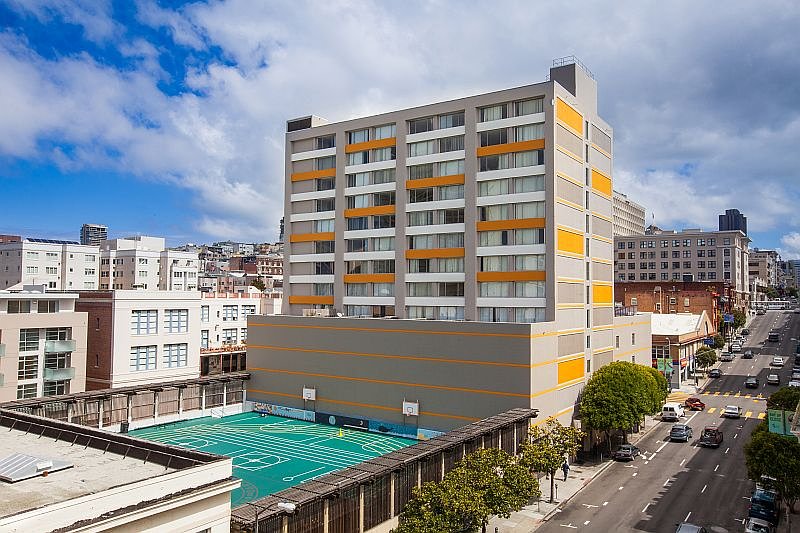
- $25M Acquisition: ArtHaus Partners and Belay Investment Group acquired The Terraces, a 117-unit rent-controlled building in Nob Hill, for $25 million.
- Rent Growth: San Francisco's annual rent growth accelerated from 6.3% in January 2026 to 8.4% by May 2026, with one-bedroom median rents surpassing $4,000.
- Vacancy Rate: Citywide vacancy rate dropped to a 25-year low of 2.9% in 2026.
Experts would likely conclude that this acquisition reflects both the city's tech-driven housing resurgence and the delicate tension between investor-driven value-add strategies and tenant protections in a rent-controlled market.
San Francisco's Housing Fault Lines: A $25M Bet on a Rent-Controlled Tower
SAN FRANCISCO, CA – June 02, 2026 – In a move that encapsulates the city's churning real estate market, ArtHaus Partners, in a venture with Belay Investment Group, has acquired The Terraces, a 117-unit, rent-controlled apartment building in Nob Hill for $25 million. The deal, which marks the developer's strategic return to San Francisco after a decade, is more than a simple transaction; it is a high-stakes bet on a city experiencing a whiplash recovery, and a forensic test of the delicate balance between property investment, urban policy, and tenant stability.
ArtHaus, formerly Riaz Capital, plans an ambitious repositioning of the 1975-era tower, located at 1300-1330 Bush Street. The strategy involves a structural retrofit, extensive cosmetic upgrades, and the rollout of its signature 'ArtHaus brand,' all aimed at capitalizing on what the firm calls San Francisco's “economic resurgence.” For a city grappling with a housing crisis, the acquisition of a large, rent-controlled asset by a value-add specialist raises profound questions about the future of attainable housing in one of its most iconic neighborhoods.
The Anatomy of a Resurgence
ArtHaus’s claim of “strengthening fundamentals” is not mere marketing jargon; it is rooted in a dramatic, tech-fueled market revival. After a period of pandemic-induced softness, San Francisco’s rental market has ignited. Multiple Q1 and Q2 2026 reports paint a picture of a market under intense pressure. CoStar data shows annual rent growth accelerating from 6.3% in January to a blistering 8.4% by May. Other analyses are even more bullish, pegging year-over-year growth for one-bedroom apartments at 13.3% and noting that the median rent for such a unit surpassed $4,000 for the first time in May 2026.
The engine of this resurgence is the city’s booming Artificial Intelligence sector, which has drawn a new wave of highly compensated professionals back to the urban core, reversing post-pandemic migration trends. This influx has collided with a chronically anemic housing supply, compressing the citywide vacancy rate to a 25-year low of 2.9%, according to CBRE. Bidding wars for apartments are reportedly now commonplace.
However, the market's health is not without its complexities. A handful of reports, including from Kidder Mathews and JLL, pointed to softening fundamentals and slight negative rent growth as recently as Q1 2026, suggesting the recovery may be uneven across submarkets or that different analytical models are capturing conflicting signals. Nonetheless, the dominant narrative is one of fierce demand, providing a powerful tailwind for ArtHaus's investment thesis.
A Calculated Risk on Bush Street
The $25 million purchase price—equating to roughly $212,000 per unit—is central to the developer’s strategy. This figure is significantly below the property's last sale price of $30.4 million during a 2011 foreclosure, and far below the city’s average per-unit sales price, which hovered above $400,000 in 2025. This allows ArtHaus and its institutional partner Belay Investment Group, which secured a $24 million acquisition loan from BrightSpire Capital, to claim an “attractive basis” with substantial room for value creation.
“Belay is pleased to announce this acquisition through its partnership with a true market and sector specialist like ArtHaus,” said Eliza Bailey, Co-Founder and CEO of Belay Investment Group, highlighting the strategy of pairing institutional capital with local operational expertise. “The opportunity represents a compelling fit within our attainable multifamily program given its attractive entry basis at a discount to replacement cost.”
The planned upgrades are extensive. Beyond cosmetic improvements to units and common areas, the developer has flagged a “structural retrofit.” Given the building’s 1975 construction date, this work may be linked to San Francisco's increasingly stringent seismic safety mandates. The city's Concrete Building Safety Program, passed in 2025, requires screenings for older concrete structures, and any major renovation can trigger mandatory seismic upgrades. This represents both a significant capital expense and a potential mechanism for future rent adjustments.
The Tenant Equation in a Value-Add World
For the current residents of The Terraces, the acquisition introduces a period of uncertainty. The building operates under the San Francisco Rent Ordinance, which provides some of the nation's strongest tenant protections, including limits on evictions and rent increases. However, the system is not impervious to the pressures of a value-add business model.
While mass evictions are unlikely without invoking the complex and costly Ellis Act, San Francisco's rent laws allow landlords to pass through a portion of capital improvement costs to tenants. For mandatory seismic work, 100% of the cost can be passed through via rent increases over time, though tenants can appeal based on hardship. The combination of construction disruption and the looming possibility of rent hikes, even if regulated, could create pressure for long-term tenants to relocate, a phenomenon often termed 'soft displacement.'
Housing advocates will be watching closely. The repositioning of 117 rent-controlled units risks eroding the stock of relatively affordable housing in Nob Hill, a neighborhood where the median listing price for a home now stands at $1.4 million. The core tension lies in how a developer can 'reposition' an asset and attract a higher-paying clientele without displacing the existing community the rent control laws were designed to protect.
A Native Son's Vision for 'Workforce Housing'
At the helm of this project is ArtHaus CEO Riaz Taplin, a San Francisco native for whom this acquisition is a homecoming. “This milestone holds personal significance for me,” Taplin stated, framing the project within a broader vision “to elevate workforce housing across the Bay Area.” This narrative positions the firm as a solution provider in a housing-starved region.
ArtHaus has a proven track record of this model in the East Bay, where it acquired nine Oakland apartment buildings for $30 million last year, a deal lauded by the San Francisco Business Times. The 'ArtHaus brand,' rolled out across those properties, focuses on modern, design-forward living spaces. The question is how this brand translates to a rent-controlled building in San Francisco.
The term 'workforce housing' itself is fluid; in the context of the Bay Area's new AI-driven economy, it could refer to tech professionals rather than the service workers and long-term residents who traditionally occupy such rent-stabilized units. As ArtHaus begins the multi-year process of renovating and rebranding The Terraces, its ability to navigate the city's regulatory environment while balancing its investment goals with the housing security of its existing tenants will serve as a critical case study for the future of urban development in San Francisco.