
- Launched on April 01, 2026 on the Apple App Store
- Uses AI to analyze behavioral data from sources like Apple Health
- Targets dating, friendship, and professional networking
Experts acknowledge RTHMS's innovative approach to compatibility but caution that algorithms may struggle to capture the nuanced, unpredictable aspects of genuine human connection.
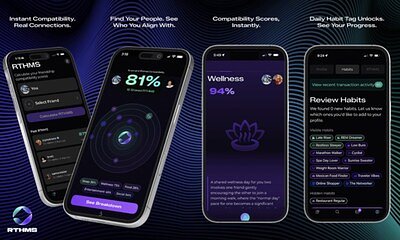
RTHMS App Launches, Swapping Profiles for Behavioral Data
LOS ANGELES, CA – April 01, 2026 – A new player in the crowded world of digital connection has officially arrived, promising to replace curated profiles and endless swiping with something it claims is far more authentic: your daily habits. RTHMS, an AI-powered platform, launched today on the Apple App Store with the ambitious goal of redefining compatibility for dating, friendship, and professional networking.
The app's premise, articulated by founder Jason Winkler, is a direct challenge to the status quo of online interaction. "People have spent years curating profiles that don't reflect reality," Winkler stated in the launch announcement. "RTHMS flips that model. We're not asking who you say you are, we're showing who you actually are based on how you live. That's where real compatibility exists."
Instead of relying on static bios and photo galleries, RTHMS uses a proprietary AI to analyze a user's real-world behavioral data—patterns in daily routines, movement, and wellness habits—to generate dynamic "Habit Tags." These tags form the basis of its "living compatibility engine," which promises to connect people based on how their lifestyles and energies actually align.
The Algorithmic Heartbeat
At its core, RTHMS operates on a "behavioral translation layer" that converts vast streams of activity data into high-level compatibility signals. By integrating with services like Apple Health, the app can access and analyze metrics such as sleep schedules, workout frequency, step counts, and mindfulness session data. The platform then translates this raw information into evolving "Habit Tags"—for example, 'Early Riser,' 'Gym Enthusiast,' or 'Night Owl'—that are meant to provide a more honest glimpse into a person's life rhythm.
This approach aims to solve a common frustration with modern dating apps: the gap between a person's online persona and their real-life self. The company asserts that this method fosters more "organic" and "honest" connections by bypassing the performance of online identity.
However, the very concept of quantifying compatibility raises complex questions. While the platform's dynamic nature acknowledges that people and relationships change, some experts in behavioral science and human-computer interaction remain skeptical. They argue that while algorithms can identify statistical correlations, they cannot capture the unpredictable and often un-optimizable nuances that form the bedrock of genuine connection—the shared jokes, the spontaneous conversations, or the way two people navigate a minor disagreement. The true "rhythms of human life," one sociologist noted, often emerge from moments that defy data analysis.
A New Playbook for Connection
Despite these philosophical questions, RTHMS is making a serious bid to disrupt the multi-billion-dollar industries dominated by giants like Tinder, Bumble, and LinkedIn. Its go-to-market strategy has been anything but quiet, fueled by months of buzz from private beta events attended by influencers and entrepreneurs, viral marketing stunts like skywriting over major cities, and public support from figures like Mike Majlak.
The company has also made a shrewd strategic move by bringing Durana Elmi, the co-founder of wellness brand Cymbiotika, on board as a partner and strategic advisor. Elmi's background in consumer behavior and holistic lifestyle branding lends significant credibility to the app's mission. "Connection should be rooted in truth and alignment," Elmi commented. "RTHMS is creating a platform where people can find others who genuinely match their lifestyle, values, and energy."
This alignment with the booming wellness sector positions RTHMS not just as a tech company, but as a lifestyle tool. It targets a user base that is already accustomed to tracking personal data for self-improvement and now offers them a way to leverage that same data for social and romantic fulfillment. The platform is designed for broad application beyond dating, with the potential to reshape how professional teams are formed or how new residents in a city find like-minded friends.
The Privacy Paradox
The innovative promise of RTHMS is inextricably linked to its most significant challenge: data privacy. To power its compatibility engine, the app requires access to a trove of deeply personal behavioral data. This immediately raises concerns and places the platform at the center of the ongoing "privacy paradox," where users must weigh the perceived benefits of a service against the data they must surrender to use it.
RTHMS's privacy policy presents a complex picture. The company makes strong claims about its privacy-conscious design, stating that it does not sell personal data or create advertising profiles. It asserts that raw behavioral data is anonymized, abstracted into "Habit Tags," and then discarded. The platform also requires explicit user consent during account creation for data collection and processing.
However, a closer look at the fine print reveals that personal information may be shared with "advertising and marketing partners" for "targeted advertising purposes." This language suggests that while raw data might not be sold, aggregated insights derived from it could still be monetized through advertising channels, a common practice in the tech industry. For users, the distinction may be a subtle one.
The company emphasizes that it has implemented robust physical and technical safeguards to protect user information and that location-based features use approximations to prevent precise tracking. Yet, the very nature of collecting such intimate data—from sleep patterns to daily movements—creates a rich target. For RTHMS to succeed, it must not only deliver on its promise of better connections but also earn and maintain an exceptional level of user trust in an era of widespread data skepticism. As users begin to download the app, they will be making an implicit choice, betting that the potential for a truly compatible connection is worth the price of sharing the data of their daily lives.