
- 23% CAGR: The industrial AI market is projected to grow at a compound annual growth rate of over 23%, reaching more than $150 billion by 2030.
- 70% of manufacturers: Over 70% of manufacturers who have implemented AI tools have seen reduced costs and improved operational efficiency.
- 20% reduction in downtime: Predictive maintenance via AI can reduce equipment downtime by up to 20%.
Experts agree that the autonomous factory, driven by AI and industrial intelligence, represents a transformative shift in manufacturing, offering measurable business benefits but requiring significant investment in data integration and cybersecurity to overcome adoption barriers.
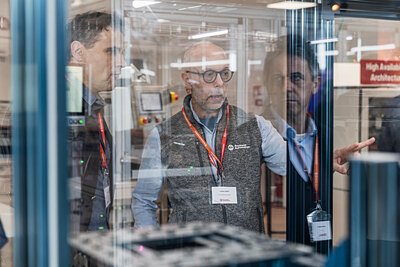
Rockwell to Showcase Autonomous Factory Future at Hannover Messe
HANNOVER, Germany – March 26, 2026 – The hum of the modern factory is changing. Where once the story was one of simple automation—robots performing repetitive tasks—a new narrative is taking shape, one driven by artificial intelligence, predictive insights, and self-adjusting systems. At the heart of this transformation, industrial giant Rockwell Automation is set to demonstrate the next leap forward at Hannover Messe 2026, showcasing a future where factories don't just automate, they think.
The company's presence at the world-renowned industrial trade fair, running from April 20-24, will focus on accelerating the journey from automation to full-scale autonomy. In the event's dedicated 'AI in Manufacturing' hall, Rockwell will unveil practical applications of industrial-grade AI and embedded intelligence, promising a new era of productivity, quality, and scalability for manufacturers navigating an increasingly complex global landscape.
From Automated Tasks to Autonomous Operations
For decades, automation has been about programming machines to follow a script. The shift to autonomy, however, represents a fundamental paradigm change. It involves creating systems that can perceive their environment, learn from data, and make independent decisions to optimize processes in real-time.
Rockwell Automation aims to make this transition tangible. "Our focus this year is clear: helping industry move from automation to autonomy to generate measurable business impacts," said Jordan Reynolds, vice president of artificial intelligence autonomy, Rockwell Automation, in a statement. "Visitors will see how industrial AI, digital twins and secure OT architectures are not visions of the future, but high-value, deployable solutions today."
At its booth, the company will feature hands-on showcases of key technologies enabling this shift. This includes the Emulate3D™ digital twin software, which allows manufacturers to design, test, and commission entire production lines in a virtual environment before a single piece of physical hardware is installed. By creating a digital replica of operations, companies can identify bottlenecks, optimize workflows, and train AI models in a risk-free setting, drastically reducing costs and time-to-market. This move towards simulation and virtual validation is becoming a cornerstone of modern industrial strategy.
Overcoming the Hurdles on the Path to Autonomy
While the promise of AI-driven factories is immense, the path is fraught with challenges. The industrial AI market is projected to grow at a compound annual growth rate of over 23%, reaching more than $150 billion by 2030. Yet, adoption remains uneven. Many manufacturers are hampered by significant barriers, including fragmented data from disparate systems, a persistent skills gap in data science and AI, and the high initial cost of overhauling legacy infrastructure.
Industry analysis reveals that nearly half of all industrial leaders struggle with low-quality or disconnected data, a critical roadblock for training effective AI models. Furthermore, an estimated 65% of manufacturers still rely on older operational technology (OT) systems that are difficult to integrate with modern AI platforms.
Rockwell is positioning its Plex Smart Manufacturing Platform as a central nervous system to address this fragmentation. The platform aims to unify data from across the factory floor—from enterprise resource planning to the production line—creating a single source of truth. By breaking down data silos, such integrated platforms provide the clean, contextualized data that AI algorithms need to deliver predictive insights for maintenance, quality control, and process optimization. This integrated approach is designed to help manufacturers adopt AI at scale, moving beyond isolated pilot projects to enterprise-wide transformation.
Securing the Interconnected Factory
As factories become smarter and more connected, they also become more vulnerable. The convergence of Information Technology (IT) and Operational Technology (OT) has erased the traditional "air gap" that once protected industrial control systems, dramatically expanding the attack surface for cyber threats. A successful attack on an OT environment can lead to catastrophic consequences, including production halts, equipment damage, and even threats to worker safety.
Recognizing this, Rockwell is emphasizing its "secure-by-design" philosophy, highlighted by its SecureOT™ cybersecurity offering. This approach embeds security into every layer of the industrial architecture, from the device level to the cloud. Unlike traditional IT security solutions that are often retrofitted onto industrial environments, specialized OT security is built with a deep understanding of industrial protocols and the critical need for operational uptime and safety.
This focus on proactive security is a response to a growing industry-wide concern. As manufacturers deploy thousands of IoT sensors and connect machinery to cloud-based analytics platforms, ensuring the integrity and availability of those systems becomes a mission-critical priority. SecureOT and similar solutions aim to provide the robust threat detection, network segmentation, and access control necessary to protect these vital assets without disrupting production.
The Tangible Returns of Industrial Intelligence
Beyond the technological spectacle, the core driver for adopting industrial autonomy is the pursuit of measurable business value. Executives and plant managers are no longer asking if AI works, but how quickly it can deliver a return on investment.
The data points to a compelling business case. Industry reports indicate that over 70% of manufacturers who have implemented AI tools have seen reduced costs and improved operational efficiency. Predictive maintenance, a leading application of industrial AI, has been shown to reduce equipment downtime by up to 20% by forecasting failures before they happen. Similarly, AI-powered computer vision systems for quality control can inspect products with a speed and accuracy that surpasses human capabilities, drastically reducing defects and waste.
Rockwell's showcase at Hannover Messe is designed to connect these benefits directly to its technology stack. By demonstrating how its AI solutions can lead to self-adjusting systems that boost productivity and improve quality, the company is making a direct appeal to the bottom line. This focus on tangible outcomes is critical in a competitive landscape that includes industrial powerhouses like Siemens, ABB, and Schneider Electric, all of whom are vying for leadership in the smart manufacturing space.
As thousands of industry leaders gather in Hannover, the message from exhibitors like Rockwell Automation is clear: the era of the fully autonomous, self-optimizing factory is no longer a distant sci-fi concept. The foundational technologies are here, the business case is solid, and the industrial world is on the cusp of a profound transformation driven by data and intelligence.
Topics & Related
Manufacturing & Industrial
Software & SaaS
Artificial Intelligence
Machine Learning
Cybersecurity & Privacy
Related Company Pulse