
- $390 million: The proposed investment for Reju's industrial-scale Regeneration Hub in Rochester's Eastman Business Park.
- 300 million articles: The annual capacity of the facility to regenerate clothing once operational by 2029.
- 50% lower carbon footprint: The reported reduction in carbon emissions from Reju's chemical recycling process compared to traditional methods.
Experts view this partnership as a groundbreaking model for textile circularity, combining advanced recycling technology with community-based collection systems to address the critical challenge of textile waste in the U.S.
Rochester's Green Weave: A New Era in Textile Recycling
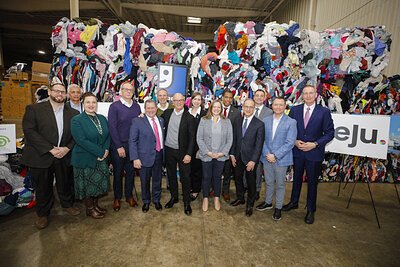
ROCHESTER, NY – February 17, 2026 – In a city renowned for its history of industrial innovation, a new chapter is being written—not in film or optics, but in the very fabric of our clothes. Leaders from technology, non-profit, and government sectors gathered today to celebrate a landmark partnership between textile regeneration company Reju and Goodwill of the Finger Lakes, a collaboration that aims to establish Rochester as a national hub for textile circularity.
The event brought together a formidable coalition, including Reju CEO Patrik Frisk, Goodwill of the Finger Lakes President & CEO Jennifer Lake, Congressman Joe Morelle, and Rochester Mayor Malik Evans, all united by a shared vision: to transform textile waste into a valuable resource, creating a blueprint for economic and environmental sustainability.
A New Industrial Revolution in Eastman Business Park
At the heart of this initiative is Reju's plan to build its first U.S. industrial-scale Regeneration Hub in Rochester's historic Eastman Business Park. The proposed $390 million clean-tech facility represents a significant bet on the region's capacity for innovation, a legacy built by giants like Eastman Kodak and Bausch & Lomb. The project, which is projected to create approximately 70 new jobs for engineers, technicians, and production workers, is a cornerstone of the region's pivot towards a green economy.
Spanning a 145,000-square-foot facility on an 18.9-acre lot, the hub is engineered to tackle the textile waste problem at an industrial scale. Once operational, which is anticipated by the end of 2029, the plant aims to regenerate the equivalent of 300 million articles of clothing annually. However, the ambitious project remains contingent on a final investment decision by the board of Technip Energies, Reju's parent company.
State and local support has been robust. Empire State Development is backing the project with a $4 million capital grant and up to $1 million in performance-based tax credits tied to job creation. This public-private partnership underscores a collective belief in Rochester's potential to lead in sustainable technology.
"Rochester isn't just where we're building infrastructure, it's where circularity becomes real," said Patrik Frisk, CEO of Reju. "By working alongside trusted local partners like Goodwill of the Finger Lakes, the business community, and our government partners, we're connecting community-based reuse with advanced regeneration technology to keep textiles out of landfills and create lasting value for this community."
Tackling America's Mountain of Textile Waste
The environmental stakes are immense. The United States generates an estimated 15.4 million tonnes of textile waste each year, a staggering 85% of which ends up in landfills or incinerators. Globally, the situation is just as dire, with less than 1% of the 124 million metric tons of textiles produced in 2023 being made from recycled, post-consumer materials.
Reju's proprietary technology, co-developed with IBM Research, offers a chemical recycling solution to this crisis. The process breaks down post-consumer polyester textiles—one of the most common but difficult-to-recycle synthetic fibers—into a base chemical known as rBHET. This regenerated material can then be repolymerized into high-quality Reju PET, a polyester with the same characteristics as its virgin, fossil-fuel-based counterpart. Critically, the company reports its process yields a 50% lower carbon footprint and creates a material designed to be recycled multiple times, truly closing the loop.
While this is Reju's first planned U.S. facility, the company has been honing its technology at a pilot plant in Frankfurt, Germany, since 2024 and has announced its first full-scale European hub in the Netherlands. The Rochester facility is poised to bring this proven technology to the American market on an unprecedented scale.
The Unsung Engine: Goodwill's Critical Supply Chain
Advanced technology is only half of the equation. A successful recycling system requires a massive and consistent supply of feedstock—in this case, used polyester clothing. This is where Goodwill of the Finger Lakes plays an indispensable role. Leveraging its vast donation network, Goodwill will serve as the front-end collection and sorting engine for the entire operation.
Jennifer Lake, President & CEO of Goodwill of the Finger Lakes, announced a pivotal agreement at the event. "We are excited to announce that the Northeast Goodwill Circularity Hub, a collective of eleven Goodwills, led by Goodwill Finger Lakes, has signed an agreement with Reju to supply polyester-rich materials to the Regeneration Hub," she stated.
This partnership transforms Goodwill's mission. The organization, which already diverted 28.8 million pounds of goods from local landfills last year, will now have a dedicated pathway for non-resalable textiles that were previously considered end-of-life waste. This creates a powerful synergy: Goodwill's community-based collection efforts provide the raw materials for Reju's high-tech process, turning donated goods into a cornerstone of a new industrial ecosystem.
"Reju will address one of the fastest-growing yet least understood waste streams in the United States: post-use textiles," Lake added. "Their breakthrough approach will divert discarded materials from landfills and transform them into valuable, sustainable resources, giving them new life."
Closing the Loop from Donation Bin to New Fabric
The collaboration between Reju and Goodwill creates a tangible, scalable model for a circular textile economy. It addresses the industry's most significant bottleneck: the lack of a reliable supply of sorted, recyclable feedstock. As the demand for sustainable materials skyrockets, this partnership provides a potential solution.
The global market for recycled polyester is projected to grow from $15.5 billion in 2024 to over $26 billion by 2030. This growth is fueled by consumer demand and aggressive corporate sustainability goals, with many major apparel brands pledging to use 50-100% recycled polyester in their products by 2030. The challenge has always been sourcing enough high-quality recycled material to meet these targets.
By creating a direct line from Goodwill's sorting facilities to Reju's regeneration hub, the partnership establishes a powerful, traceable supply chain. This model not only promises to reduce landfill waste and decrease reliance on fossil fuels but also offers a potential national blueprint for tackling the textile crisis. If successful, the Rochester initiative could demonstrate how existing non-profit infrastructure and cutting-edge technology can unite to reshape an entire industry, turning a linear path of waste into a continuous circle of value and renewal.
Topics & Related
Private Placement
Circular Economy
ESG
Revenue
Venture Capital
AI & Machine Learning
Manufacturing & Industrial
Software & SaaS
Related Company Pulse