
- 500,000 unfilled positions in North American construction (Bureau of Labor Statistics)
- 50% increase in efficiency and 60% reduction in construction costs claimed by Legend Robot
- 3rd-Generation Mobile Continuous Spraying Technology for seamless one-pass coverage
Experts view Legend Robot's AI fleet as a promising solution to the construction labor crisis, though widespread adoption will depend on proving safety, reliability, and cost-effectiveness in North American job sites.
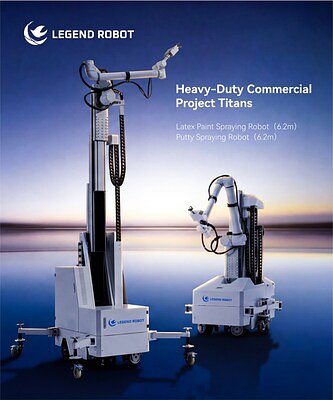
Robots Hit the Job Site: AI Fleet Tackles Construction Labor Crisis
LAS VEGAS, NV – February 24, 2026 – As the North American construction industry grapples with an unprecedented labor shortage and soaring costs, a new contender has entered the arena, not with hard hats and tool belts, but with sensors and algorithms. Singapore-based Legend Robot is making its regional debut at the CONEXPO-CON/AGG trade show this week, unveiling what it calls the industry's first "Physical AI" autonomous finishing fleet, a direct challenge to traditional construction methods.
The company is launching a suite of mobile robots designed to automate the strenuous and time-consuming tasks of interior commercial finishing, promising to revolutionize a sector in desperate need of innovation.
A High-Tech Answer to a Labor Crisis
The timing of Legend Robot's arrival could not be more critical. The North American construction sector is facing a perfect storm: a wave of experienced workers is nearing retirement, while not enough new talent is entering the trades to fill the gap. According to recent Bureau of Labor Statistics data, the industry has over 500,000 unfilled positions. Industry groups like the Associated General Contractors of America (AGC) consistently report that a vast majority of firms struggle to find qualified skilled labor, leading to project delays and inflated budgets.
It's this pain point that Legend Robot aims to solve. The company's approach is to deploy autonomous systems to handle what it terms "dull, dirty, and dangerous" jobs, such as high-volume interior painting and putty application. By automating these repetitive tasks, the technology is designed to augment understaffed crews, freeing human workers to focus on more complex, high-value responsibilities that require critical thinking and craftsmanship. This model positions robotics not as a replacement for human workers, but as a crucial support tool to enhance productivity and safety.
Beyond Pre-Programmed Paths: The Power of 'Physical AI'
While robots are not new to manufacturing, the chaotic and ever-changing environment of a construction site presents a far greater challenge. Legend Robot claims its key differentiator is "Physical AI"—a form of artificial intelligence that allows its machines to perceive, interact with, and learn from their physical surroundings in real-time.
Unlike traditional static robots that follow rigid, pre-programmed paths in the controlled setting of a factory, these new construction robots use a combination of 3D real-time sensing and dynamic path planning. This enables them to navigate cluttered job sites, adapt to unforeseen obstacles, and execute tasks with precision. The company's flagship models, the 6.2m Latex Painting Robot and the 6.2m Putty Spraying (Skim Coat) Robot, showcase this capability with what Legend Robot has branded "3rd-Generation Mobile Continuous Spraying Technology."
This technology allows the robots to spray paint or putty while in constant motion, a significant leap from older, static systems that must be repeatedly stopped and repositioned. The result, according to the company, is seamless, "one-pass" coverage even on complex surfaces like curved walls, eliminating the streaks and inconsistencies that can plague manual or static robotic applications. The company makes bold claims about the economic impact, citing a 50% increase in efficiency and a potential reduction in overall construction costs by over 60%, figures that are drawing significant attention at the Las Vegas convention.
Building a Unified Robotic Ecosystem
Legend Robot's ambitions extend far beyond just painting. The company is positioning itself as a provider of a complete "smart construction ecosystem," aiming to automate a wider range of finishing tasks. "We are bringing a solution that bridges the gap between robotic innovation and on-site execution," said Jason Liang, the company's Marketing Director, in a statement. "Legend Robot is no longer just about spraying; we are building a comprehensive smart construction ecosystem."
The company's 2026 product roadmap backs this vision, outlining plans for high-precision tile-laying robots that use LiDAR for perfect alignment and heavy-duty floor grinding robots for autonomous surface preparation. By offering an integrated fleet of specialized robots, the company hopes to provide general contractors a scalable way to stabilize project timelines, control costs, and ensure a consistent level of quality from the initial surface prep to the final coat of paint.
Navigating the North American Job Site
Entering the mature and often conservative North American market is a significant undertaking. While Legend Robot's mobile, fleet-based approach appears novel, it joins a growing field of construction technology firms. Companies like Dusty Robotics have already found success automating job site layouts, while others are developing solutions for everything from bricklaying to operating heavy machinery.
Furthermore, deploying autonomous robots on active construction sites presents considerable safety and regulatory challenges. The machines must operate safely alongside human crews in unpredictable environments, a far cry from a fenced-off factory floor. They will need to comply with a web of standards, including those from the Occupational Safety and Health Administration (OSHA) and principles derived from industrial robotic safety standards like ANSI/RIA R15.06. Proving that its "Physical AI" is robust enough to navigate these complexities safely and reliably will be paramount to gaining the trust of contractors and regulators.
The demonstrations at CONEXPO (Booth N12934) represent the first major test. For Legend Robot, the challenge is clear: move beyond the "battle-tested" successes in Asia and prove that its vision for a robotic-assisted future can be built, one flawlessly painted wall at a time, in the demanding reality of the North American construction site.