
- $70M Investment: Vitestro secures $70 million in Series B funding to advance its robotic phlebotomy device, Aletta®.
- 10% Growth: U.S. demand for phlebotomists projected to grow by 10% over the next decade.
- 70% of Errors: Up to 70% of laboratory errors occur in the pre-analytical phase, including sample collection.
Experts view Vitestro's Aletta® as a promising solution to address healthcare staffing shortages and improve diagnostic blood collection quality, with the potential to redefine clinical workflows similar to robotic surgery's impact.
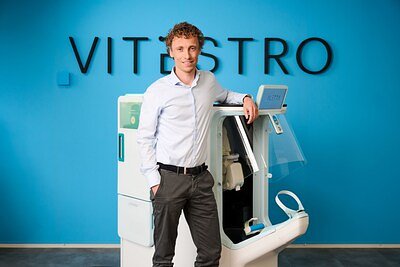
Robotic Phlebotomist Gets $70M to Tackle Healthcare Staffing Crisis
UTRECHT, Netherlands – March 10, 2026 – Vitestro, a Dutch pioneer in medical robotics, today announced it has secured $70 million in an oversubscribed Series B financing round. The investment, co-led by a syndicate of strategic U.S. healthcare leaders including Labcorp Venture Fund, Mayo Clinic, and Sutter Health, signals a major vote of confidence in the company's mission to automate one of medicine's most common procedures: drawing blood.
The funds are earmarked to advance the commercialization of Aletta®, the world's first and only CE-marked autonomous robotic phlebotomy device. The capital will fuel a multi-pronged strategy aimed at scaling up manufacturing, expanding clinical trials, and crucially, navigating the U.S. Food and Drug Administration's (FDA) De Novo regulatory pathway to bring the technology to the American market.
"Closing our Series B financing reflects strong conviction in our mission to establish a new standard in autonomous robotic venous access and diagnostic blood collection," said Toon Overbeeke, CEO and co-founder of Vitestro. "Our technology has evolved from a novel vision into a clinically validated reality, and we are grateful for the support of this distinguished syndicate of strategic, healthcare, and life science investors as we move toward broad clinical adoption."
A Robotic Solution to a Critical Staffing Shortage
The timing of this technological leap could not be more critical. Healthcare systems in Europe and the United States are grappling with a severe and worsening shortage of skilled laboratory professionals and phlebotomists. In the U.S. alone, the demand for phlebotomists is projected to grow by 10% over the next decade, far outpacing the average for all occupations. Compounding the issue are high turnover rates, which exceed 25% in some laboratory settings, and an aging workforce, with over 40% of lab professionals nearing retirement age.
This labor crisis directly impacts patient care, leading to longer wait times, increased workload and burnout for remaining staff, and a higher potential for errors. Vitestro's Aletta® is positioned as a direct response to these challenges. By automating routine blood draws, the device can help high-volume clinics and hospitals manage the relentless demand for diagnostic testing, which informs over 70% of all medical decisions. The goal is not to replace human phlebotomists but to augment their capacity, allowing skilled professionals to focus on more complex cases, improve operational predictability, and enhance patient flow.
Diagnostic blood collection remains the highest-volume invasive medical procedure globally, with billions performed annually. The ability to automate even a fraction of these procedures could have a profound impact on healthcare efficiency.
Beyond the Needle: AI and Imaging Redefine a Core Procedure
At the heart of Vitestro's innovation is a sophisticated fusion of technologies. The Aletta® device uses a combination of AI-powered image analysis and multimodal imaging to autonomously identify a suitable vein, guide the needle with high precision, and collect the blood sample. This process is designed to standardize a procedure that is often subject to human-dependent variability.
Such variability is a significant concern in diagnostics. The vast majority of laboratory errors—up to 70% by some estimates—occur in the pre-analytical phase, which includes sample collection. Issues like hemolysis (the rupture of red blood cells) caused by improper collection techniques can compromise sample quality, leading to inaccurate results and the need for painful and time-consuming redraws. By standardizing the procedure, Aletta® aims to dramatically improve the quality and consistency of blood samples, a benefit that has not gone unnoticed by its investors.
"The Labcorp Venture Fund sees strong potential in solutions that modernize core diagnostic processes and improve consistency for patients," said Megann Vaughn Watters, Head of Labcorp Venture Fund. "Applying robotics, multimodal imaging and AI to clinically validated diagnostic blood collection is an exciting approach, and we're thrilled to support Vitestro as they advance this important work."
The potential for this technology to fundamentally change clinical practice has drawn comparisons to other transformative medical innovations. Dr. Fred Moll, a key investor and a co-founder of surgical robotics giants Intuitive Surgical and Auris Health, sees a parallel. "Vitestro is redefining one of the largest and most under innovated clinical workflows," Dr. Moll stated. "I believe this technology has the potential to establish a new standard of care, much as robotic surgery did in its early days."
Strategic Stakes: Why US Healthcare Giants Are All In
The participation of Labcorp, Mayo Clinic, and Sutter Health is more than just a financial endorsement; it is a strategic alignment with the very institutions that represent Aletta's target market. These organizations operate on the front lines of healthcare delivery and diagnostics, experiencing firsthand the pressures of staffing shortages and the need for greater efficiency and quality control.
For a diagnostics leader like Labcorp, which performs billions of tests annually, the ability to ensure high-quality, standardized samples at the point of collection is paramount. For integrated health systems like Mayo Clinic and Sutter Health, known for their focus on patient care and innovation, the technology offers a dual benefit: improving the patient experience while optimizing clinical workflows and staff allocation.
This direct investment from major U.S. providers signals a readiness within the American healthcare market to adopt autonomous solutions for systemic problems. It validates Vitestro's approach and provides the company with invaluable partners as it prepares for its U.S. market entry. The collaboration will likely provide critical insights into real-world workflows, helping to ensure the technology is seamlessly integrated into existing clinical infrastructure.
Navigating the Path to the US Market
While Aletta® has already achieved CE marking in Europe, allowing for its deployment in clinical and pre-commercial settings there, the U.S. market represents the next major frontier. The $70 million in new funding will be instrumental in navigating the FDA's De Novo classification pathway. This process is specifically designed for novel medical devices with low-to-moderate risk that have no existing predicate on the market—a category Aletta® squarely fits into.
The pathway requires a rigorous demonstration of safety and effectiveness, demanding extensive clinical data and performance testing. Vitestro's leadership will use the proceeds to conduct these essential clinical studies, further advance the platform's technical capabilities, and build the commercial and manufacturing infrastructure necessary for a successful U.S. launch.
The journey from a visionary concept to a new standard of care is long and complex, but with strong clinical validation and the backing of global healthcare leaders, Vitestro is now well-capitalized to take the next decisive steps in its mission to revolutionize diagnostic blood collection.