
- 2,000 Robotaxis: WeRide and RoboSense plan to deploy 2,000 next-generation Robotaxis by the third quarter of 2026.
- 70% More Reaction Time: The EM4 LiDAR provides 70% more reaction time in high-speed driving scenarios.
- $103 Billion Market: The autonomous vehicle market is projected to exceed $103 billion in 2026.
Experts view this partnership as a pivotal shift toward scalable, commercially viable autonomous mobility, leveraging advanced LiDAR technology and high-efficiency manufacturing to accelerate global deployment.
Robotaxi Revolution: WeRide & RoboSense Launch Mass Production Fleet
SHENZHEN, China – March 09, 2026 – The era of mass-produced autonomous vehicles is accelerating as WeRide, in a landmark partnership with sensor specialist RoboSense and manufacturer Farizon New Energy Commercial Vehicle Group, announced plans to deploy 2,000 next-generation Robotaxis. The factory-installed fleet of GXR models, equipped with cutting-edge digital LiDAR, is scheduled to begin rolling off the production line in the third quarter of 2026, marking a pivotal transition from small-scale pilots to commercial-grade global operations.
This move signifies more than just an expansion; it represents a fundamental shift in the industry's approach to scaling autonomous mobility. The collaboration leverages the distinct strengths of a Level 4 (L4) autonomous driving leader, a top-tier perception system provider, and a major automotive manufacturer, creating an integrated ecosystem designed for efficiency and rapid deployment in markets across China, the Middle East, and Europe.
The Thousand-Beam Vision System
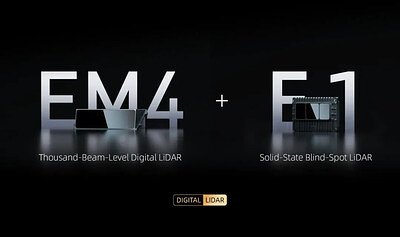
At the heart of the new Robotaxi GXR is WeRide's latest autonomous driving suite, GEN8, which relies on a sophisticated perception system powered by RoboSense's digital LiDAR technology. The vehicle's primary sensor is the EM4, a main LiDAR capable of generating what the company describes as a "thousand-beam-level" point cloud. Customizable with up to 2,160 individual laser beams, the EM4 provides a 17-fold increase in data density compared to previous generations.
This high-resolution environmental mapping is coupled with an impressive detection range of up to 600 meters—a distance industry analysts note is two to three times that of many mainstream solutions. For the Robotaxi, this translates into a critical safety advantage, providing the vehicle's decision-making system with over 70% more reaction time, particularly in high-speed driving scenarios. Launched in early 2025, the EM4 was among the world's first digital LiDAR systems to enter the market.
To ensure complete 360-degree awareness, the GXR is also outfitted with the RoboSense E1, a fully solid-state digital LiDAR. Featuring a wide 120° by 90° field of view, the E1 is specifically engineered to eliminate near-field blind spots around the vehicle, a crucial function for navigating complex urban environments with pedestrians and cyclists. As the industry's only mass-produced, automotive-grade solid-state LiDAR for this purpose, its inclusion underscores a commitment to comprehensive safety. This dual-LiDAR configuration is designed for robust performance in adverse weather, maintaining stable perception in heavy rain and dense fog.
From Blueprint to High-Efficiency Mass Production
The plan to deliver 2,000 units in a single year is made possible by a deepened strategic collaboration that moves beyond a simple supplier relationship. The partnership with Farizon, a subsidiary of the automotive giant Geely, provides the critical manufacturing backbone for this ambitious scale-up. This integrated approach is expected to slash the assembly time for a single Robotaxi from approximately one hour to under ten minutes, while also reducing the overall vehicle cost by an estimated 15%.
These efficiencies are essential for making L4 autonomous driving services economically viable on a global scale. By moving away from retrofitting existing vehicles to a factory-installed, mass-production model, the partners are creating a standardized, intelligent manufacturing process that can be replicated and scaled. This strategic alliance combines WeRide's L4 autonomous driving software and operational expertise, RoboSense's advanced perception hardware, and Farizon's industrial manufacturing power to accelerate the commercialization timeline significantly.
Scaling Global Autonomous Mobility
WeRide's operational footprint is already extensive and growing. The company currently runs commercial Robotaxi services in major international cities, including Abu Dhabi, Dubai, Riyadh, Beijing, and Guangzhou. With fully driverless operations already active in several of these locations, WeRide has proven its ability to navigate complex regulatory landscapes. The company holds autonomous driving permits in eight distinct markets, including China, the UAE, Singapore, the United States, and multiple European nations.
This new deployment of 2,000 GXR units will more than double WeRide's existing fleet, which stood at 1,023 vehicles as of January 2026, bringing the total to over 2,600 Robotaxis worldwide. This expansion aligns with a broader industry inflection point. The autonomous vehicle market, valued at over $80 billion in 2025, is projected to exceed $103 billion in 2026 and could reach nearly $278 billion by 2030. Transport-as-a-Service (TaaS) models like Robotaxis are moving beyond testing phases, with operations expected in nearly 40 global markets by the end of this year.
The Economic Engine of Autonomy
The push for mass deployment is backed by strong commercial momentum. In the third quarter of 2025, WeRide reported a remarkable 761% year-over-year surge in Robotaxi revenue, contributing to an overall company revenue increase of 144.3%. While the company still posted a net loss, it was reduced by over 70% compared to the previous year, with gross margins turning solidly positive at 32.9%. These figures indicate a clear path toward profitability as operations scale.
For RoboSense, this partnership solidifies its position as a critical enabler of the autonomous driving industry. The company claims partnership coverage with over 90% of the world's leading L4 autonomous driving companies, positioning its LiDAR as a foundational technology for the sector's evolution. As thousands of new, purpose-built Robotaxis prepare to join fleets in cities around the world, the combination of advanced sensor technology and high-efficiency manufacturing is paving the way for a future where autonomous transportation becomes an everyday reality.
Topics & Related
Software & SaaS
AI & Machine Learning
Automotive Manufacturing
Artificial Intelligence
Machine Learning
Automation
Revenue
Net Income
Corporate Finance
Related Company Pulse