
- 1141.8% year-on-year sales growth for RoboSense in the robotics sector in 2025, with 303,000 units sold.
- 2.343 million units of robotic lawn mowers shipped globally in the first half of 2025, a 327.2% year-on-year increase.
- $7 billion market value projected for robotic lawn mowers by 2033.
Experts agree that RoboSense's solid-state LiDAR technology is revolutionizing the robotic lawn mower market, enabling advanced navigation and obstacle avoidance that is driving rapid industry growth and reshaping consumer expectations for smart home automation.
RoboSense LiDAR Dominates Booming Robotic Lawn Mower Market
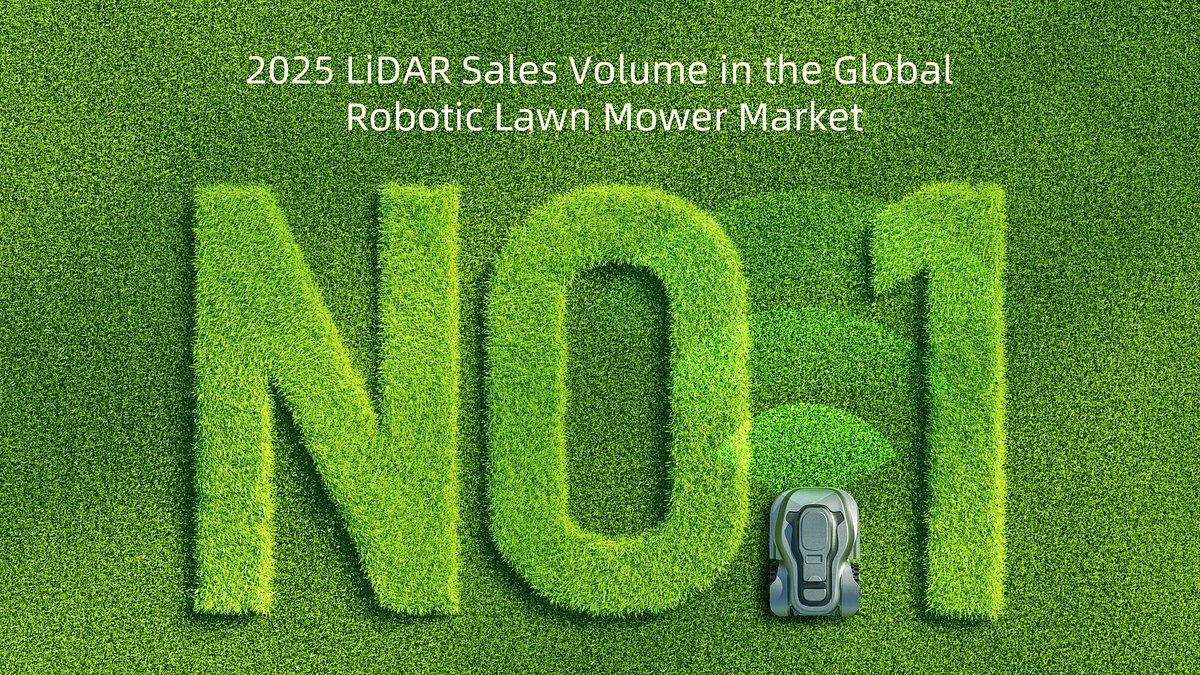
SHENZHEN, China – January 16, 2026 – A quiet revolution is transforming suburban landscapes, and its core technology is not coming from traditional garden tool manufacturers but from the high-tech corridors of AI-driven robotics. Shenzhen-based RoboSense has been crowned the number one global supplier of 3D LiDAR for robotic lawn mowers in 2025, according to a new report by industry analyst OFweek. This achievement underscores a pivotal shift in consumer robotics, where advanced sensor technology, once reserved for autonomous vehicles, is now enabling a new generation of intelligent, boundary-free home automation.
The ranking highlights the company's commanding position in one of the fastest-growing segments of the entire robotics industry. This success is not isolated; a separate report from the Gaogong Industry Research Institute (GGII) also ranked RoboSense as the top LiDAR supplier for the broader robotics sector in China. The company's staggering 1141.8% year-on-year sales growth in the robotics sector for 2025, culminating in 303,000 units sold, signals that the era of sophisticated spatial awareness for everyday machines has truly arrived.
The Sensor Powering a Garden Revolution
At the heart of this market disruption is LiDAR—Light Detection and Ranging—a technology that uses laser pulses to create a precise, three-dimensional map of the surrounding environment. For robotic lawn mowers, this capability is a game-changer, freeing them from the cumbersome and restrictive perimeter wires that defined earlier generations of the devices.
RoboSense's E1R, touted as the world's first fully solid-state digital LiDAR for robotics, is the key enabler behind this shift. Unlike traditional mechanical LiDARs that use spinning parts, the E1R's chip-based, solid-state design means it has no moving components. This makes it up to three times more resilient to the vibrations, bumps, and shocks inherent in traversing a bumpy lawn, significantly boosting operational stability and longevity.
The E1R’s technical specifications are tailored for the unique challenges of a garden. Its 90-degree ultra-wide vertical field of view allows it to see not just straight ahead but also down towards the ground, enabling it to precisely detect small ground obstacles like toys or garden tools, as well as subtle terrain changes and the edges of fences. With 144 laser beams creating a dense point cloud, it builds a detailed 3D map that allows for sophisticated navigation and obstacle avoidance, even in complex yards with trees or at night. Built to stringent automotive-grade standards and boasting an IP67 rating, the device is designed to withstand harsh outdoor conditions like rain and dust, with a reported outdoor service life of up to eight years—far exceeding typical industry benchmarks.
Riding a Wave of Explosive Market Growth
RoboSense's technological prowess is perfectly timed to capitalize on a market that is expanding at a breakneck pace. According to data from IDC, the first half of 2025 alone saw global shipments of robotic lawn mowers reach 2.343 million units, a staggering 327.2% increase year-on-year, making it the fastest-growing category in robotics.
This surge is fueled by a confluence of factors. Homeowners are increasingly seeking automated solutions to save time on household chores, while a growing environmental consciousness favors quiet, battery-powered alternatives to noisy, gas-guzzling mowers. The integration of these devices into the broader smart home ecosystem, controllable via smartphone apps, further enhances their appeal. Market research firms project a powerful growth trajectory, with various analysts forecasting the market to more than double in value over the next five to seven years, potentially exceeding $7 billion by 2033. While established players like Husqvarna and STIGA still command significant market share, the technological leap towards wire-free navigation is creating new opportunities for innovators like Mammotion and Segway Navimow, both of whom have partnered with RoboSense.
Beyond the Driveway: LiDAR's New Frontier
The success in the robotic lawn mower segment is emblematic of a broader trend: the diversification of LiDAR technology beyond its well-known application in autonomous vehicles. For years, the high cost and complexity of LiDAR confined it to high-stakes automotive development. However, innovations in digital, solid-state LiDAR, driven by companies like RoboSense, have dramatically lowered costs and increased reliability, opening up a vast new frontier of applications in industrial, commercial, and consumer robotics.
RoboSense's focus on a full-stack, in-house chip design, incorporating its self-developed SPAD-SoC and VCSEL digital chip architecture, has been a key competitive advantage. This allows the company to create highly specialized, cost-effective solutions tailored for specific use cases, from autonomous delivery bots and industrial cleaning robots to the burgeoning field of humanoid robotics. The company’s dominance in the lawn mower space serves as a powerful case study for how advanced perception can unlock mass-market potential, transforming a niche gadget into a mainstream smart home appliance. This strategic expansion is reflected in its overall robotics LiDAR sales, which now constitute a significant and rapidly growing portion of its total business.
Strategic Partnerships and a Competitive Edge
Securing the top spot in a competitive global market is not achieved through technology alone. RoboSense has forged deep, strategic partnerships with leading robotic lawn mower brands, embedding its technology as a core perception component. Collaborations with Mammotion and Segway Navimow have been particularly crucial. For instance, the new Segway Navimow i2 LiDAR, jointly introduced with RoboSense, heavily features the E1R, merging its data with vision and RTK-GPS signals to create a robust, multi-sensor navigation system capable of handling complex lawns with unparalleled precision.
These partnerships serve as a powerful validation of the technology's real-world performance and provide a strong moat against competitors in the LiDAR space, such as Ouster and Hesai. By becoming the essential enabling technology for the next generation of top-selling consumer robots, the Shenzhen-based firm has established a first-mover advantage that will be difficult to dislodge. As the market penetration for intelligent, wire-free robotic lawn mowers continues to accelerate globally, the demand for the sophisticated perception systems that make them possible is set to enter a new phase of rapid expansion.
Topics & Related
Automation
Artificial Intelligence
Generative AI
Machine Learning
AI & Machine Learning
Software & SaaS
AI & Software Platforms
Related Company Pulse